
The most uncomfortable phase of ERP implementation often begins after the system starts showing the truth.
Transactions stop midway. Inventory numbers do not match. Approvals get stuck. Planning errors become visible. Reports that looked simple earlier suddenly look unreliable. Teams begin to say that the old way was easier and that ERP has complicated the business.
But many ERP implementation problems do not begin with ERP. They begin much before ERP, inside the way the organisation was already working.
Enterprise Resource Planning, or ERP, is meant to integrate important business processes and create a single source of truth across functions like finance, manufacturing, supply chain, sales and procurement. That is the promise. But for the promise to work, the business must also be ready to follow one process, trust one data source and respect one operating discipline.
This is where many companies struggle. More than 70% of recently implemented ERP initiatives are expected to fall short of their original business case goals by 2027. The reason is rarely software alone. ERP success depends heavily on change management, data management, project ownership, business-process fit, communication, monitoring and management support.
ERP does not create control first. It exposes where control was missing.
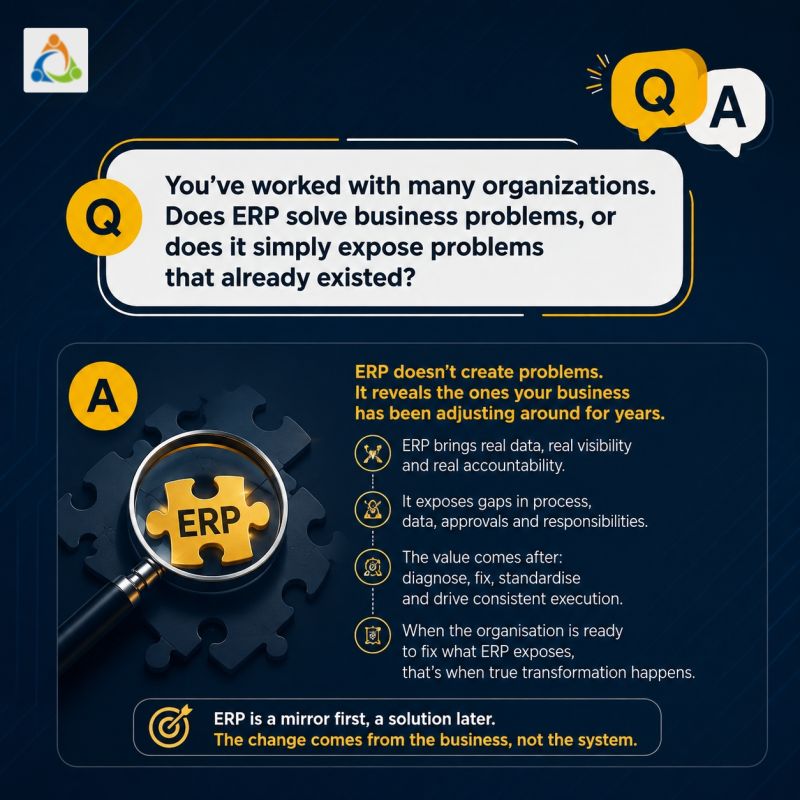
ERP as an X-Ray: The Expose, Diagnose, Correct, Standardise and Control Method
A business before ERP can look more stable than it actually is. The reason is simple. Experienced people keep compensating for weak processes.
The store person knows the actual stock even when the system shows a wrong number. The production manager adjusts planning manually because the planning process is weak. Finance corrects incomplete data at month-end. A senior employee knows which approval can be pushed through a phone call. Sales keeps a separate sheet because it does not fully trust the common report. Purchase tracks vendors separately because the system data is not updated on time.
Nothing looks broken because people are holding it together. This is not system strength. This is human compensation.
Human compensating controls are informal corrections people make every day to keep the business moving despite weak processes, poor data or unclear ownership. They are useful in emergencies. But when they become normal, the company starts believing the process is working.
Then ERP enters. ERP removes the hiding place. It asks the organisation to follow defined steps. It asks for clean data. It asks who owns the transaction. It asks which approval is pending. It asks which number is final. It asks whether every department is working from the same version of truth.
That is when the discomfort starts.
The problem that was earlier hidden inside people’s experience now becomes visible inside the system.
A wrong stock entry no longer remains a small internal adjustment. It affects planning, purchase, production and dispatch. An unclear approval no longer gets quietly resolved through a call. It appears as a pending workflow. Incomplete master data no longer gets corrected only at month-end. It starts damaging reports every day.
So when teams say, “ERP has created problems,” the leadership should pause.
The better question is: Did ERP create the problem, or did it stop the organisation from adjusting around the problem?
That question changes the full implementation conversation.
Because if ERP is treated as the problem, the business will keep blaming software, consultants, modules, reports and screens. But if ERP is treated as an X-ray, the business starts looking at process, data, ownership, skill and discipline.
The journey then becomes practical:
1. Expose:
ERP first exposes the gap between how management thinks the business works and how the business actually works.
This gap can be uncomfortable.
Management may believe inventory is under control. ERP may show that item codes are duplicated, stock entries are delayed, material issue is not captured properly, and physical stock is being adjusted manually.
Management may believe approvals are disciplined. ERP may show that authority is unclear, people bypass approval flows, and decisions depend more on personal follow-up than process.
Management may believe reports are reliable. ERP may show that departments are maintaining separate data, master data is unstable, and there is no single version of truth.
This stage should not be resisted.
Exposure is not failure. Exposure is the beginning of control.
2. Diagnose:
Once ERP exposes the gap, the next mistake is to rush towards correction without diagnosis.
Not every ERP problem has the same root cause.
An inventory mismatch may be a data-entry problem. It may also be a process timing problem. It may be a bill of material problem. It may be a physical stock discipline problem. It may be a responsibility issue between stores, production and purchase.
A pending approval may be a system configuration issue. But it may also be an authority issue. Nobody may know who should approve, who should recommend and who should only be informed.
A wrong report may be a software issue. But it may also be caused by poor master data, inconsistent transaction entry or multiple departments using different working definitions.
Diagnosis should therefore be done around five questions:
- what exactly is breaking?
- where does it first break?
- who owns that point?
- is the issue process, data, skill, authority or discipline?
- what must change so the issue does not repeat?
This step is where leadership maturity matters.
ERP implementation problems cannot be solved by shouting at users or blaming consultants. They must be diagnosed like operating problems.
3. Correct:
After diagnosis, correction must happen at the business level first.
- If master data is wrong, clean it and define who can create, edit and approve master data.
- If approval flow is unclear, define authority levels.
- If people are entering transactions late, fix the discipline of real-time or same-day entry.
- If departments are using parallel Excel sheets, stop the duplicate system gradually but firmly.
- If users do not understand the process, train them again.
- If people do not have the skill to follow the system, address capability.
- If people have the skill but not the intention to follow discipline, address accountability.
This is important because ERP cannot correct behaviour on behalf of management. It can only show whether behaviour is disciplined or not.
Digitalisation can improve productivity and growth for MSMEs, but skill shortage, lack of information, financial constraints and lack of trust in digital technology remain major barriers. In one MSME study, a quarter of enterprises that had not adopted intermediate or advanced digital tools said they lacked the required skill or human resources to operate them.
That is why correction cannot remain technical. It has to include people readiness.
4. Standardise:
Correction solves the immediate issue. Standardisation prevents the issue from returning. This is where many companies fail. They solve the problem once, then go back to the old way.
A standard process should define:
- which department starts the transaction
- what data must be entered
- who checks it
- who approves it
- what happens if it is wrong
- what happens if it is delayed
- what report will capture it
- who will review it
- what exception must be escalated
Standardisation also means every department stops creating its own truth.
There cannot be one stock number in stores, another in production, another in purchase and another in finance. There cannot be one sales commitment in the customer conversation and another inside production planning. There cannot be one payment status in accounts and another with the sales team.
ERP becomes powerful only when the business agrees to one disciplined way of working.
Standardisation is not paperwork. It is operating discipline.
5. Control:
Control does not mean the promoter or senior management checks everything. Control means the system shows the right exceptions, the right delays, the right owners and the right decision points.
A controlled ERP environment should help management see:
- which transactions are stuck
- which approvals are delayed
- which users are not updating data
- which process is being bypassed
- which reports are unreliable
- which department is creating repeated exceptions
- which master data needs correction
- which issue needs management intervention
This is where ERP becomes a management tool. But this stage comes only after exposure, diagnosis, correction and standardisation.
If the business skips these stages, ERP remains a source of frustration. If the business follows them, ERP becomes a control system. The real issue is not whether ERP is good or bad. The issue is whether the organisation is ready to accept what ERP reveals. Many companies want ERP benefits without ERP discipline.
- They want reliable reports, but users do not enter data properly.
- They want inventory visibility, but physical stock practices are weak.
- They want approval control, but authority is unclear.
- They want planning accuracy, but sales commitments keep changing.
- They want financial clarity, but departments work outside the system.
- They want dashboards, but data quality is poor.
This gap between expectation and readiness is where ERP disappointment begins.
A smoother ERP journey needs management to treat go-live as the start of discipline, not the end of implementation. The real work starts when the business begins using ERP every day.
- People must stop working outside the system.
- Managers must stop accepting verbal updates when system updates are missing.
- Leadership must stop asking for separate Excel reports if ERP is supposed to be the official record.
- Departments must stop treating ERP as extra work.
- The system must become the way work is done, not a parallel activity after the real work is done.
That is when ERP starts creating value. Not because the software suddenly becomes better, but because the organisation becomes more honest, disciplined and aligned around the software.
For growing SMEs, the practical lesson is clear. When ERP exposes problems, do not rush to reject the system.
Study what it is exposing:
- Is it a process gap?
- Is it a data gap?
- Is it an approval gap?
- Is it a role gap?
- Is it a skill gap?
- Is it an intention gap?
- Is it a review gap?
The answer will usually sit inside the business, not only inside the software. ERP is a mirror first and a solution later. It shows leaders the business they actually have, not the business they assumed they had.
- A weak organisation sees that mirror and blames the glass.
- A mature organisation sees that mirror and fixes the fracture.
That is where real system-led business transformation begins.


