
A founder can see every invoice and still not see the business clearly.
This is where many growing companies quietly lose leadership time. Daily bills, payment screenshots, dispatch updates, collection reminders and approval messages keep flowing to the founder on WhatsApp. It feels like control because information is visible. But visibility without structure can become another form of noise.
A proper business performance review is not about watching every transaction. It is about knowing which transaction needs attention, which pattern needs correction, which function needs review and which number needs a decision.
That difference is important because leadership time is limited. Decision-making studies show that managers spend around 37% of their time making decisions, and nearly 58% of that decision time is often used ineffectively. Another finding shows that only 37% of respondents say their organisations make decisions that are both high-quality and timely.
For a founder-led company, that loss becomes even more serious. If the founder’s day is spent watching raw transactions, the business may look supervised, but it is not necessarily being reviewed.
From Daily Transaction Checking to Structured Business Review
The first mistake is believing that more information automatically means better control. It does not.
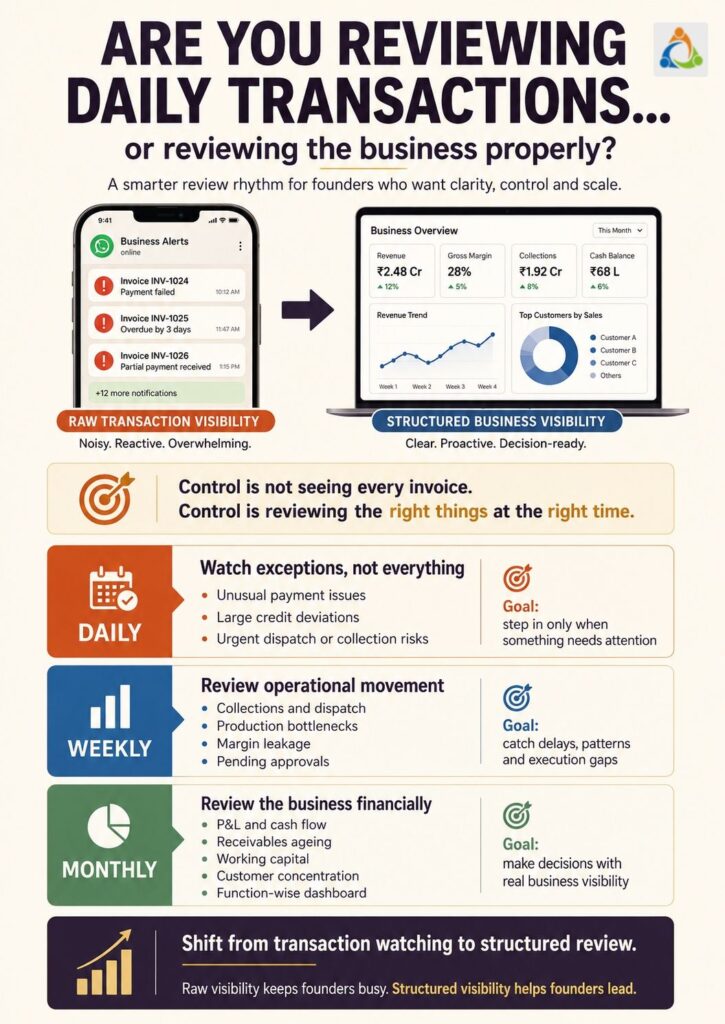
A founder who reviews 25 invoices every day may know what has been billed, but may still not know whether margins are leaking, collections are slowing, dispatches are getting stuck, credit terms are being violated, working capital is tightening, or one customer is creating concentration risk. That is why raw transaction visibility and structured business visibility are two different things.
Raw transaction visibility says:
- this invoice was raised
- this payment is pending
- this dispatch happened
- this approval is needed
- this customer has followed up
Structured business visibility says:
- which invoices are unusual
- which collections are at risk
- which dispatch delays are repeating
- where margin is reducing
- which approvals are blocking execution
- whether cash flow is moving as planned
- which function needs management attention
The first keeps the founder busy. The second helps the founder lead.
A growing business needs to move from “show everything to the founder” to “show the right things at the right frequency.” This does not mean the founder becomes disconnected. It means the founder stops becoming the daily filter for every small movement. The correct review rhythm should separate business information into 3 levels.
1) Daily review should be only for exceptions:
Daily does not mean every invoice, every bill and every routine entry. Daily means anything that can create immediate risk if ignored.
For example:
- unusual payment issues
- urgent collection risk
- large credit deviation
- blocked dispatch
- customer escalation
- sudden production stoppage
- approval that can affect delivery
- transaction outside policy
This is where exception reporting becomes useful. An exception report tells the founder what is not normal. It does not ask him to read the full transaction register. It only highlights what has moved outside discipline.
If every invoice comes to the founder, the team remains dependent. But if only exceptions come to the founder, the system starts maturing.
The daily question should not be, “What happened today?” The daily question should be, “What needs leadership attention today?”
That one shift saves time and improves control.
2) Weekly review should show operational movement:
Weekly review is where the business should stop discussing isolated incidents and start seeing movement across functions.
This review should cover:
- collections due and collected
- dispatches planned and completed
- production bottlenecks
- pending approvals
- purchase delays
- margin leakage
- customer complaints
- manpower gaps
- key order movement
- cross-functional delays
The purpose of the weekly review is not to read reports aloud. It is to catch patterns early.
- If the same customer keeps delaying payment, that is a pattern.
- If dispatch is stuck every week because quality clearance is late, that is a pattern.
- If production delays are repeatedly caused by purchase gaps, that is a pattern.
- If approvals are pending because no one knows who has authority, that is a pattern.
Weekly review should make these patterns visible before they become month-end surprises.
A good weekly review also reduces founder follow-up. When every function knows that progress, delays and next actions will be reviewed on a fixed rhythm, people start preparing better. The founder does not need to chase as much because the review system itself creates pressure and discipline.
The weekly question should be, “Where is execution moving, and where is it getting stuck?”
That is an operating question, not a transaction question.
3) Monthly review should show financial and business health:
Monthly review is where the founder should step back and look at the business as a whole. This is not the place to discuss every small invoice. It is the place to understand whether the company is financially healthy, operationally stable and decision-ready.
A strong monthly review should cover:
- profit and loss
- cash flow
- receivables ageing
- payables pressure
- working capital cycle
- gross margin trend
- customer concentration
- product-wise or service-wise profitability
- function-wise performance
- inventory movement
- overdue commitments
- branch or department dashboard
- key management decisions required
This review should help the founder make better decisions.
- Should credit terms be tightened?
- Should one customer’s exposure be reduced?
- Is working capital getting blocked?
- Are margins falling in a particular product line?
- Is one department consistently delaying execution?
- Is the business growing but cash getting weaker?
These questions cannot be answered by checking daily invoices on WhatsApp. They need a structured management dashboard.
The monthly question should be, “What is the business telling us, and what decision does it need?” That is where a founder moves from watching activity to reviewing performance.
There is also a deeper cultural issue here.
When the founder watches every transaction, people slowly stop owning control. The team starts thinking, “Sir will check.” That habit weakens reporting discipline. It also creates false comfort because everyone knows the founder is watching, but nobody is truly accountable for the full result.
A better system creates ownership before escalation. For example, a payment issue should first sit with the collection owner. If it crosses the agreed limit, it should move to the department head. If it becomes a risk, it should reach the founder. That is a healthy escalation path. Similarly, a dispatch issue should first be visible to operations. If it affects customer commitment, it should be escalated. If it affects revenue, cash flow or brand reputation, it should reach leadership.
This is how reporting matures.
The founder should not be the first person to see every problem. The founder should be the right person to see the right problem at the right stage.
A practical review system can be built around 4 filters:
1. Risk filter:
Anything that can affect cash, customer commitment, delivery, compliance, quality or reputation should be visible early. This is daily exception reporting.
2. Movement filter:
Anything that shows whether work is progressing across departments should be reviewed weekly. This includes dispatch, collections, production, pending approvals and bottlenecks.
3. Health filter:
Anything that shows the financial and operational health of the business should be reviewed monthly. This includes Profit and Loss, cash flow, receivables, working capital and margin.
4. Decision filter:
Anything that requires leadership judgement should come with options, not just information. The team should not only say what happened. They should say what they think, what they suggest and what decision is needed.
This is where many founders can change the reporting culture quickly.
Instead of asking people to send everything, ask them to send information in decision-ready format:
- what happened
- why it matters
- what is the risk
- what has already been done
- what options are available
- what decision is needed
- by when
This small format can reduce unnecessary calls, repeated follow-ups and half-information messages. It also trains the team to think. Because the goal is not only to reduce the founder’s workload. The goal is to build an organisation that can separate routine from risk, information from insight and update from decision.
That is the real meaning of business control.
Control is not checking every document personally. Control is knowing that routine work is moving, exceptions are visible, ownership is clear, reviews happen on rhythm and decisions are taken with the right information.
This also improves the quality of meetings.
Many businesses run meetings that are only reporting sessions. People say what has happened. The founder listens. The founder asks questions. The team goes back. Nothing structural changes. A proper review rhythm changes the meeting design.
- Daily exception review should be short and sharp.
- Weekly operating review should focus on movement, blockers and closure.
- Monthly business review should focus on financial health, patterns and decisions.
When these three rhythms are clear, the founder does not need to carry the entire business through personal follow-up. The system starts carrying part of the load. That is the shift many promoter-led businesses need.
Not from involvement to ignorance. Not from control to distance. But from transaction watching to structured review.
A founder should remain close to the business. But closeness should not mean drowning in daily details. The founder’s role is to see what others may miss: weak patterns, future risks, cash pressure, customer dependency, margin leakage, leadership gaps and decisions that will shape the next stage of growth.
Daily transactions are necessary. But they are not the full business.
If the founder reviews only transactions, the business may become active but not clear. If the founder reviews rhythm, patterns, exceptions and financial health, the business becomes decision-ready.
That is the real purpose of a business performance review.
It should not only tell the founder what happened. It should tell the founder what deserves attention, what needs correction and what decision must be taken next. This is where structured business review discipline becomes important. A growing company does not need the founder to see everything. It needs the founder to see clearly.
And clarity rarely comes from more messages.
It comes from the right review rhythm.