

One of the biggest ERP implementation mistakes in growing SMEs is not choosing the wrong software. It is choosing software before the business is ready to use it.
Many owners reach a stage where the company has grown beyond manual coordination. Orders are increasing. People are being added. A new factory may be coming up. Customers expect faster response. Reports are needed. Inventory, purchase, production, dispatch, finance and customer communication all need better visibility.
At this point, ERP feels like the natural answer.
And in many cases, ERP is needed. But ERP implementation for SMEs works only when the business already has enough clarity around roles, responsibilities, authority, process flow, data discipline and review rhythm. Research on ERP implementation repeatedly shows that clear goals, business process redesign, change management, communication, project management, user involvement, data management and fit between ERP and business processes are among the most important success factors.
Digital adoption is also increasing among Indian MSMEs. A recent national study covering 7,835 MSMEs found that 53.8% had adopted at least one digital tool, while 46.2% were still fully offline. That shows the direction clearly. SMEs are moving towards digital systems, but the real question is whether their internal operating discipline is ready to support those systems.
Because ERP cannot create discipline where the business has not defined discipline. It can only capture, reflect and enforce what the company has already clarified.
A Case Study on Why SOP-P Must Come Before ERP
A garment machine manufacturing business had reached an important growth stage.
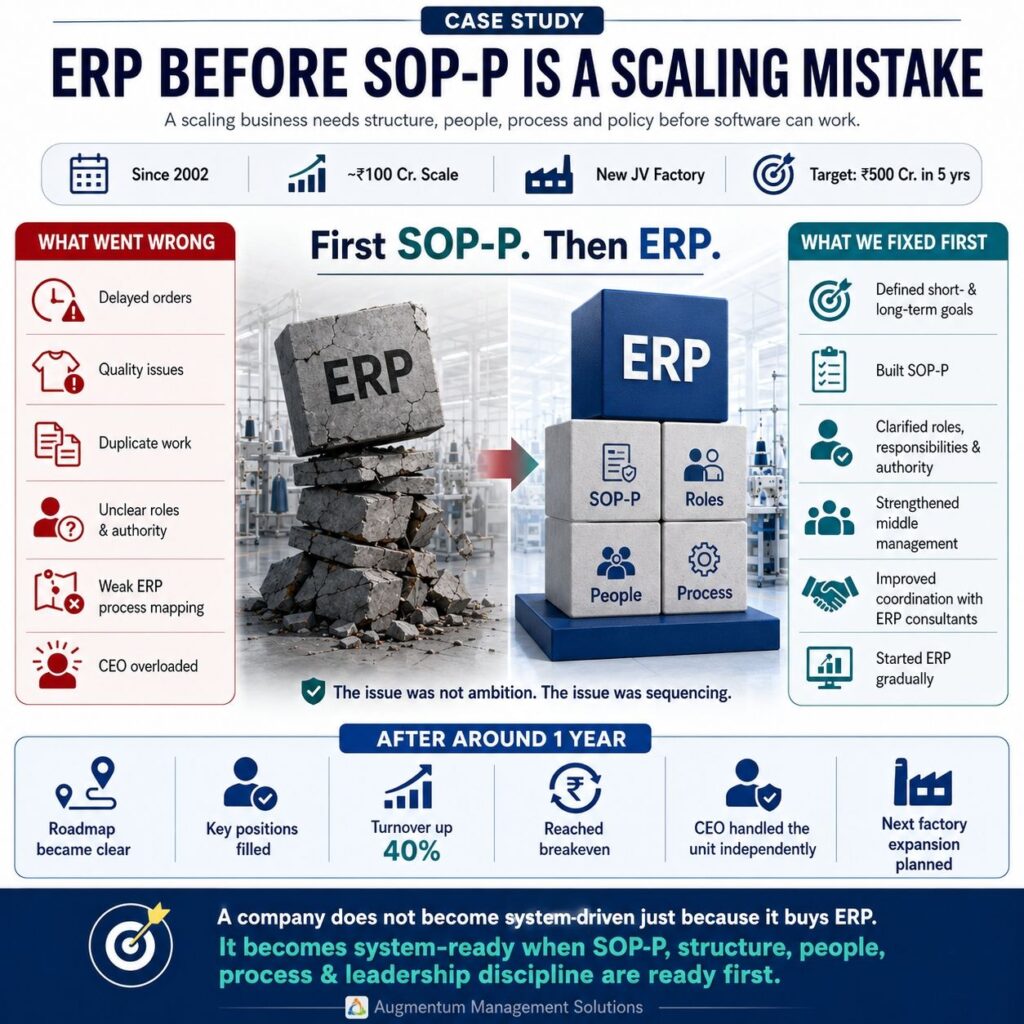
The old unit had been running since 2002. By 2016, one unit was around ₹30 crore in turnover, while the overall business scale was around ₹100 crore. The promoter had also entered into a new joint venture with an Italian company. A new advanced factory was created with capacity for 100+ people. The ambition was clear: take the business to ₹500 crore in five years.
From outside, this looked like a strong expansion story. A larger factory. International collaboration. Bigger target. Higher capacity. More people. More ambition. But inside, the business was not yet ready for that speed.
The problem was not ambition. The problem was sequencing.
The company was trying to scale the physical unit and implement ERP while its internal structure was still weak. Standard Operating Procedures and Policies were not clearly defined. Roles, responsibilities and authority were not settled. Middle management was not strong enough. ERP process mapping was weak because the business processes themselves were not properly mapped.
So the ERP did not become a solution. It became a mirror. It showed the confusion that was already present inside the business.
Orders were getting delayed. Quality issues were rising. People had started leaving. Duplicate work continued even after ERP. Reviews and reports were not structured. Policies were either missing or not implemented with discipline. The CEO was overloaded. The promoter was under financial pressure because overheads had increased by nearly ₹10 lakh per month.
This is where many businesses misread the situation. They think the ERP is not working. But the deeper issue is that the business is asking ERP to carry the weight of unclear structure.
A company cannot become system-driven just because it installs software. It becomes system-driven when its work has a defined path.
That path begins with SOP-P. SOP-P means Standard Operating Procedures and Policies.
- Standard Operating Procedures explain how work should move.
- Policies explain the rules within which decisions should be taken.
Both are needed before ERP can work properly. Without SOP-P, the software team asks, “How does this process work?” and different people give different answers:
- Sales gives one version.
- Production gives another.
- Purchase gives another.
- Finance gives another.
- The promoter gives a different version.
- The senior employee says, “Actually, this is how we do it practically.”
- The ERP consultant then builds around confusion.
And once the system goes live, the same confusion becomes digital. That is why “first ERP, then process clarity” is usually a costly sequence.
The better sequence is: First define how the business should run. Then configure ERP to support that way of running.
In this case, the correction did not start by pushing ERP harder. It started by stepping back and asking what the company needed before ERP could succeed.
The first requirement was goal clarity:
- The business needed to separate its short-term operating needs from its long-term growth ambition. A ₹500 crore target cannot be managed with the same structure that supported a smaller unit. Growth changes the pressure on planning, people, cash flow, quality, reporting and decision-making.
- So the company had to define what needed immediate control and what needed long-term capability.
The second requirement was SOP-P:
- The company needed clear procedures and policies for daily work. Not only for documentation, but for operating discipline. For example, how an order moves from enquiry to production. Who confirms specifications. Who checks material readiness. Who approves changes. Who owns delivery commitment. Who checks quality. Who updates the customer. Who escalates delay.
- When these points are not clear, ERP cannot create flow. It only records delay.
The third requirement was role clarity:
- In many SMEs, roles grow informally. A person starts with one function, then takes two more responsibilities, then becomes the default problem-solver. Over time, the business starts depending on individuals instead of roles.
- That may work at a smaller scale. It does not work during expansion. The company had to define:
- who owns which function
- who has authority to decide
- who must approve
- who must review
- who must escalate
- who is accountable for closure
- This reduced confusion between promoter, CEO, managers, teams and consultants.
The fourth requirement was middle management:
- A growing business cannot depend only on promoter energy and CEO effort. There has to be a layer that converts direction into execution.
- In this case, middle management was inadequate. That meant many issues moved upward. The CEO became overloaded. The promoter remained involved in too many things. The organisation had a larger factory, but not enough leadership depth inside the operating layer.
- So key people had to be recruited. Existing people had to be trained. Reporting lines had to be improved. KRAs, which means Key Result Areas, had to be clarified. The company needed people who could own functions, not only follow instructions.
The fifth requirement was better ERP coordination:
- ERP consultants cannot map what the business itself has not clarified.
- This is a common problem. Consultants ask for process details. The business gives partial answers. Users describe current habits, not required future processes. Owners explain the ideal version, while employees explain the practical version. The gap between the two is not resolved. Then the ERP gets configured around incomplete understanding.
- In this case, better coordination with ERP consultants became important. Business process mapping had to be improved. The ERP had to be implemented gradually, after SOP-P and structure were strengthened.
Research on fast-growing SMEs also points to a similar issue. Traditional ERP systems often create challenges because of high entry barriers, high implementation cost, difficulty in handling implicit processes, and mismatch between existing tools and the way work actually happens.
That is why ERP readiness is not only a software checklist. It is a business readiness checklist. Before pushing ERP implementation faster, an SME owner should ask:
1) Are the main processes written clearly?
If the process is not written, people will explain it differently. ERP cannot be configured properly on different versions of truth.
2) Are roles and authority defined?
If authority is unclear, approvals will keep moving upward. ERP will show pending approvals, but it will not solve the hesitation behind them.
3) Is middle management strong enough?
If the company does not have people who can own departments, ERP will become a reporting tool for the promoter instead of an execution tool for the organisation.
4) Is the data reliable?
Wrong item masters, incomplete customer details, weak inventory records, poor production data and unclear cost information can weaken ERP from day one.
5) Are policies actually being followed?
A policy that exists only in a file will not help ERP. The business must be ready to follow rules consistently.
6) Are ERP consultants getting the future process or only the current confusion?
This is important. ERP should not simply digitise today’s bad habits. It should support the better operating method the company wants to build.
7) Is the leadership ready to review through the system?
If the promoter and CEO continue to run parallel reviews outside ERP, users will also treat ERP as optional. System discipline starts from leadership discipline.
In this case, the company worked on these areas patiently.
Short-term and long-term goals were defined. SOP-P was built. Roles, responsibilities and authority were clarified. The promoter and CEO were trained and hand-held. Key people were recruited. The structure was strengthened. Coordination with ERP consultants improved. Reviews, KRAs, brainstorming and organisation redesign became part of the operating rhythm.
The answer was not “avoid ERP.” The answer was “do not place ERP before readiness.”
First SOP-P. Then ERP gradually.
After around one year, the business started showing a different picture. The management became clearer about the roadmap. Key positions were filled. Turnover increased by 40% from the previous year. The company reached breakeven. The promoter was able to plan another factory expansion. The CEO could handle the unit more independently.
The result was not only because ERP was used. The result came because ERP was placed in the right sequence.
This is the practical lesson for many SMEs.
If the business has delayed orders, quality issues, duplicate work, unclear authority, weak reporting, poor middle management and overloaded leadership, ERP should not be treated as the first medicine. It may be part of the treatment, but not the first step. The first step is to make the business system-ready. A scaling SME should prepare 4 layers before ERP.
Layer 1: Direction: the company must know what it is trying to build. A bigger factory, higher turnover, more people and more customers require a different operating design. Without direction, ERP becomes a data collection exercise.
Layer 2: SOP-P: the business must define the work method and decision rules. This includes procedures, policies, triggers, checklists, escalation points and quality controls.
Layer 3: People and authority: the company must decide who owns what. A role without authority creates delay. Authority without accountability creates risk. Accountability without support creates burnout.
Layer 4: ERP discipline: once the first three layers are ready, ERP can start supporting the business. It can bring visibility, consistency, reporting, control and speed. But it cannot replace the thinking that should have happened before implementation.
This sequence is especially important for manufacturing SMEs.
Manufacturing has dependencies at every stage. Order confirmation affects purchase. Purchase affects production. Production affects quality. Quality affects dispatch. Dispatch affects customer trust. Finance affects working capital. One unclear step can disturb the full chain.
If ERP is added without process clarity, the system may expose more problems than it solves. That does not mean ERP has failed. It means the business was not ready enough.
A good ERP implementation mistake to avoid is believing that software will automatically make people disciplined. It will not. People become disciplined when roles are clear, reviews are regular, policies are followed, process gaps are corrected, and leadership insists on using the system properly.
A good ERP implementation does not begin with modules. It begins with operating questions:
- What exactly should happen?
- Who owns it?
- Who approves it?
- Where does it get stuck?
- What data is needed?
- What policy applies?
- When should it escalate?
- What should the system capture?
- Who will review it?
If these questions are answered before ERP, the software has a strong foundation. If these questions are ignored, the software becomes another place where confusion lives. That is why the real scaling lesson is simple: A company does not become system-driven because it buys ERP. It becomes system-ready when SOP-P, structure, people, process and leadership discipline are ready first.
The quiet discipline behind implementation-led business transformation is sequencing:
- Build the operating method.
- Prepare the people.
- Clarify authority.
- Map the process.
- Then let ERP strengthen what the business has already made clear.

