
A promoter can own the company on paper and still owe a lot to the company in practice.
That is where corporate governance for promoter-led companies begins. Not in a boardroom document. Not only in compliance. Not only in shareholder language. It begins with one simple but uncomfortable question: is the promoter using ownership to strengthen the institution, or only to protect control?
In many Indian businesses, especially family-owned and promoter-led companies, ownership carries emotion. The company may have been built over decades. The promoter may have taken early risks, handled customer pressure, managed cash shortages, negotiated with vendors, and carried the business through difficult cycles.
That contribution deserves respect.
But after a company reaches a certain size, the responsibility of the promoter changes. The business no longer needs only personal control. It needs discipline, governance, reinvestment, capable people, working capital protection, and a structure that can survive beyond one person.
Family-owned businesses are a major part of India’s economy, with estimates placing their contribution at more than 75% of the country’s GDP. Yet governance and succession remain sensitive gaps. One large family business survey found that only 63% of Indian family business leaders had formal governance structures, while earlier data showed only 20% had a robust and documented succession plan.
That is why promoter governance is not a theoretical subject. It decides whether a company remains promoter-dependent or becomes institution-driven.
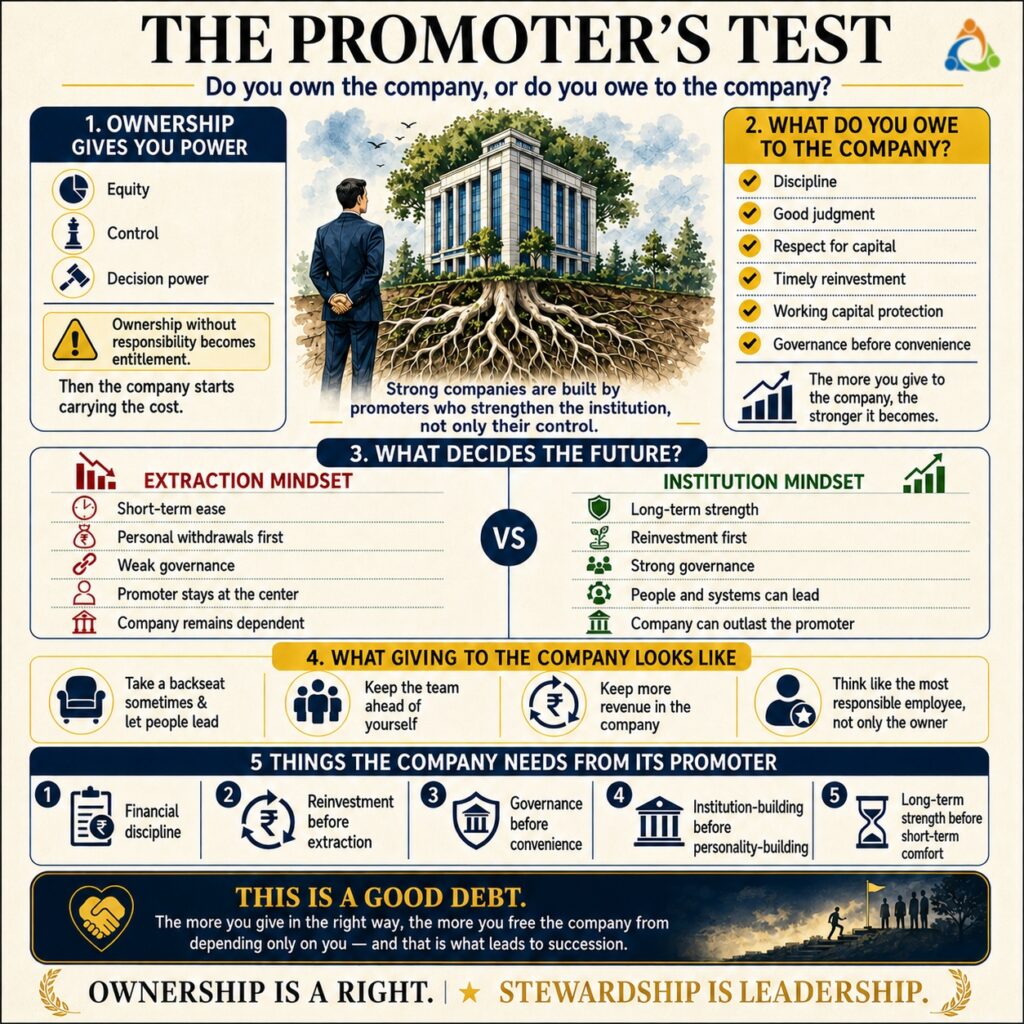
The Promoter’s Test: Ownership, Extraction or Stewardship
The first test is to understand what ownership gives.
Ownership gives equity. It gives control. It gives the right to decide. It gives the promoter authority over capital, people, expansion, risk, and direction.
But ownership also creates a blind spot. Because when a promoter has built the company, it is very easy to feel that the company must always adjust around him. His comfort, his approval, his preferences, his speed, his way of working, his personal withdrawals, his judgement, his convenience.
That is where ownership can slowly become entitlement.
It does not happen loudly. It does not look wrong in the beginning. The company may still be profitable. Customers may still be there. Sales may still be growing. But inside, the institution starts paying a hidden cost.
The cost may show up as weak working capital. It may show up as delayed reinvestment. It may show up as professionals leaving because they do not get authority. It may show up as family members taking benefits without clear roles. It may show up as governance being postponed because “we know how to manage things internally.”
This is where a promoter-led business must pause and ask a deeper question: what do I owe to the company?
Not debt in the legal sense. Debt in the leadership sense.
- The promoter owes the company financial discipline: this means the business cannot be treated like an unlimited personal account. Money taken out of the business may look like ownership benefit, but if it weakens working capital, delays vendor payments, reduces reinvestment, or creates pressure on operations, then the company is funding promoter comfort at the cost of future strength.
- The promoter owes the company good judgement: A promoter’s decision does not affect only one person. It affects employees, customers, vendors, lenders, family members, and the brand. That is why judgement must move from instinct-only to principle-led. The question should not be only “Can we do this?” The better question is “Will this strengthen the company over time?”
- The promoter owes the company respect for capital: capital is not only money in the bank. It is trust converted into business capacity. It is the ability to buy inventory, pay people on time, invest in systems, build branches, upgrade machinery, handle slow collections, and take the next opportunity. When capital is used casually, the business slowly becomes fragile.
- The promoter owes the company timely reinvestment: many businesses weaken because they delay the very investments that would make them stronger. Systems are postponed. People are postponed. Technology is postponed. Process improvement is postponed. Training is postponed. Professional hiring is postponed. The company keeps running, but the foundation does not keep improving.
- The promoter owes the company governance before convenience: governance is often misunderstood as something required only for listed companies or large corporates. But even an SME needs governance. Clear roles, defined authority, clean financial practices, proper reporting, family employment rules, approval discipline, and review mechanisms are all forms of governance. They protect the business from confusion.
- The promoter owes the company institution-building before personality-building: this is one of the biggest shifts. In the first phase, the promoter’s personality may help the business grow. His relationships, reputation, aggression, knowledge, and presence may bring momentum. But if the company continues to depend only on his personality, succession becomes difficult.
A company cannot outlast the promoter if everything important still depends on the promoter. This is where extraction mindset and institution mindset create two very different futures.
- An extraction mindset asks: how much can I take out?
- An institution mindset asks: what must I build in?
- An extraction mindset prefers short-term ease.
- An institution mindset protects long-term strength.
- An extraction mindset keeps the promoter at the centre.
- An institution mindset builds people and systems that can lead without the promoter being present in every room.
- An extraction mindset uses the company as a private asset.
- An institution mindset treats the company as a living organisation that must become stronger with every passing year.
This difference decides succession.
Across family businesses globally, commonly cited succession data shows that only about 30% survive into the second generation, around 12% into the third, and only about 3% beyond the fourth. The reason is not always lack of money or market opportunity. Many times, the company does not build governance, leadership depth, and institutional discipline early enough.
For a promoter-led company, the practical solution starts with 5 responsibilities.
1. Financial discipline before personal comfort:
The company must have clear rules on promoter withdrawals, family expenses, related payments, dividends, loans, reimbursements, and capital usage. This does not mean the promoter should not benefit from the business. It means the benefit should not damage the business.
A simple discipline can help: first protect operating cash, statutory payments, vendor commitments, salaries, working capital, and reinvestment needs. Only then decide what can be taken out safely.
When financial discipline is weak, the company may still look profitable on paper but feel cash-starved in daily operations.
2. Reinvestment before extraction:
A growing business constantly needs reinvestment. Not only in machinery or inventory, but also in people, systems, technology, leadership, reporting, and process capability.
If the promoter extracts aggressively and reinvests reluctantly, the company starts ageing from inside.
The market changes. Customer expectations change. Team expectations change. Compliance changes. Competition changes. But the internal engine remains old.
Reinvestment is not an expense. It is the company’s renewal mechanism.
3. Governance before convenience:
- Convenience says, “We will decide case by case.”
- Governance says, “We will create a rule so the company does not depend on mood, memory, or relationship.”
This is important in promoter-led businesses because informal working feels fast in the beginning. But as the company grows, informality creates confusion. People do not know who has authority. Decisions get reversed. Family members bypass processes. Professionals hesitate. Managers wait for the promoter.
Good governance makes the business cleaner.
It defines who decides, who approves, who reviews, who is accountable, and what cannot be compromised.
4. Institution-building before personality-building
A promoter may be respected in the market, but the company should not survive only because of that respect.
The brand must slowly move from “promoter-trust” to “company-trust.”
That happens when customers get consistent delivery, vendors experience professional dealing, employees see fair systems, and managers get authority to act. The promoter’s presence should remain valuable, but it should not remain mandatory for every important movement.
This is how a company becomes institution-led.
5. Leadership space before control becomes dependency:
Many promoters want succession, but they do not create leadership space.
They want the next line to step up, but they keep taking final calls. They want professionals to perform, but they do not give authority. They want family members to mature, but they do not let them handle real responsibility. They want the business to outlast them, but they remain the centre of every decision.
Leadership space is not given in one announcement. It is built through controlled responsibility.
Let people lead meetings. Let managers close decisions. Let the next generation handle defined business areas. Let professionals own outcomes. Let mistakes become review points, not reasons to take back all control.
A promoter should not disappear from the business. But the promoter must stop becoming the only source of confidence.
That is what frees the company.
The strongest promoter-led companies are not the ones where the promoter controls everything forever. They are the ones where the promoter uses control to build discipline, people, systems, and succession readiness.
This is the real meaning of stewardship. It is not weakness. It is higher ownership. It is the ability to say: “I own this company, so I must protect it from depending only on me.”
That one thought changes the promoter’s role.
- Promoter stops being only the owner of equity.
- Promoter becomes the builder of continuity.
- Promoter stops measuring success only by what he can take.
- Promoter starts measuring success by what the company can carry forward.
That is where corporate governance for promoter-led companies becomes deeply practical. It is not about making the company look professional. It is about making the company strong enough to function, grow, and transition without being trapped by one person’s control.
For founders, promoters, and family business leaders, the questions are simple but powerful:
- Does the company become weaker when you step back?
- Does it become stronger because you prepared it well?
- If the answer is the first one, ownership is still incomplete.
- If the answer is the second one, stewardship has started.
And in the long run, that is what decides whether the company remains a promoter-owned business or becomes an institution that can outlast the promoter.
That is where implementation-led business transformation becomes important, because lasting companies are not built only by ownership rights. They are built by the responsibilities the promoter is willing to carry before the company needs them urgently.


