
A company can give a good increment and still damage employee motivation.
That sounds strange at first, but it happens more often than owners realise. Salary increment is only one part of employee satisfaction. The bigger question is whether people feel that the increment was earned, explained, differentiated and connected to contribution.
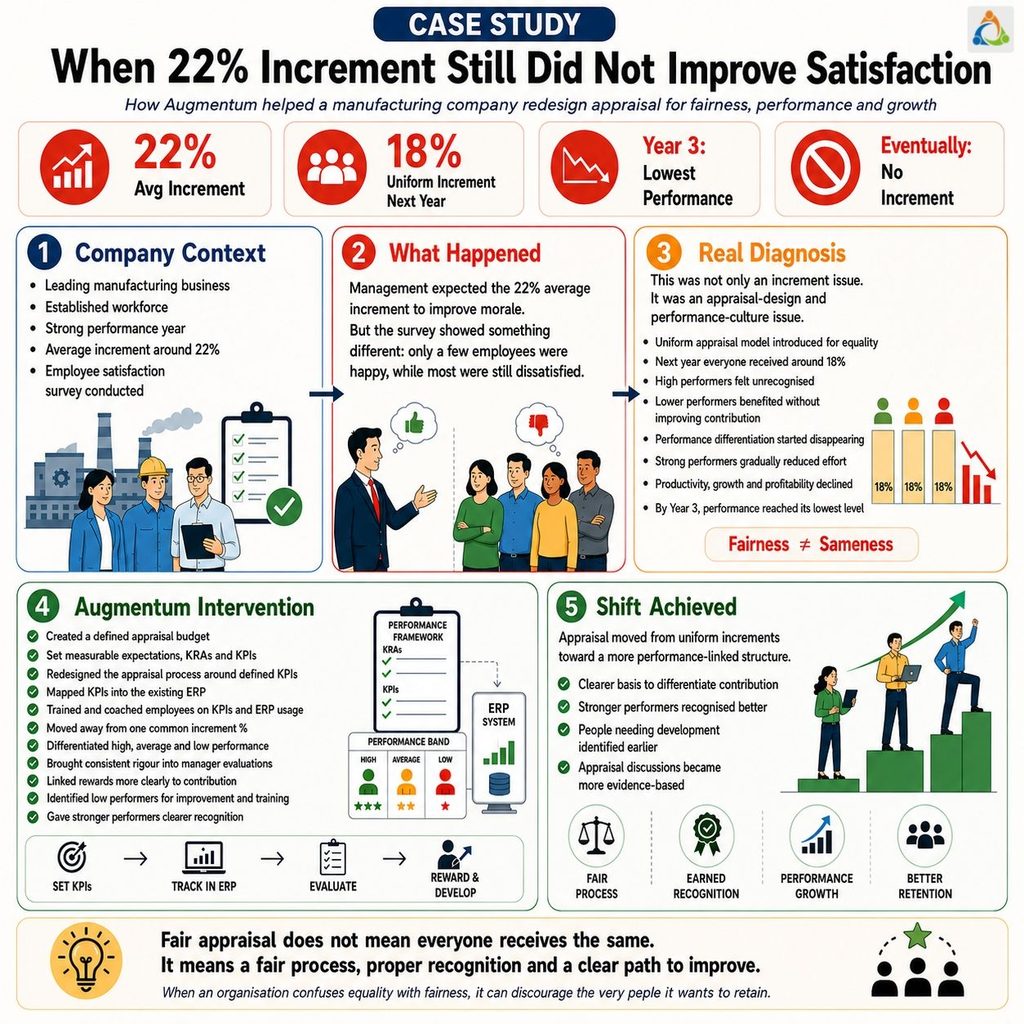
One manufacturing company faced this exact situation after a strong performance year. The management gave an average increment of around 22%. On paper, it looked like a generous decision. The expectation was simple: employees should feel happy, recognised and motivated. But when the employee satisfaction survey was conducted, the result was different. Only a few employees were happy. Many were still dissatisfied.
That is when the real issue became visible. The problem was not only the increment percentage. The problem was the performance appraisal system behind the increment.
Across organisations, performance management continues to be a weak area. In one large workplace study, 61% of managers and 72% of workers could not say they trusted their organisation’s performance management process. Another workplace finding shows that only 22% of employees strongly agree that their performance review process is fair and transparent.
So when employees are unhappy after increments, the first question should not be, “Was the increment too low?” The better question is, “Was the appraisal process clear, fair and performance-linked?”
The Fairness Gap in Employee Appraisal
Many business owners confuse fairness with sameness.
Fairness means people are evaluated through a clear and consistent process. Sameness means everyone receives almost the same reward, whether their contribution was strong, average or weak.
These two things are not the same.
In the manufacturing company, management tried to correct dissatisfaction by introducing a more uniform appraisal model in the next cycle. Everyone received around 18%. The intention was good. The company wanted to reduce dissatisfaction and create equality. But the result moved in the opposite direction. High performers started feeling that their extra effort was not being recognised. Average performers had no strong reason to stretch. Lower performers benefited without improving contribution. Slowly, performance differentiation started disappearing. By the third year, performance reached its lowest level. Eventually, the company reached a stage where no increment became possible.
This is where the appraisal design failed. Not because management did not spend money. But because reward was not properly connected with contribution.
A fair performance appraisal system must answer four questions clearly:
- What was expected from the employee?
- What was actually delivered?
- How was contribution measured?
- What should happen next: reward, development or correction?
If these questions are unclear, even a high increment can create dissatisfaction. Because employees do not only compare their increment with last year. They also compare it with effort, peers, promises, manager behaviour, company performance and perceived fairness. That is why appraisal is not only an HR activity. It is a performance-culture activity.
The first repair: define the appraisal budget before emotions enter:
A weak appraisal process often becomes emotional at the end of the year.
Managers recommend based on personal comfort. Employees expect based on hearsay. Owners decide under pressure. HR tries to balance everyone. The final increment becomes a mixture of affordability, pressure, memory and negotiation.
That creates confusion.
A better approach starts with a defined appraisal budget.
The company must first decide what it can afford based on profitability, cash flow, future commitments, retention needs and growth plans. Once the budget is clear, the next step is allocation. Not equal distribution. Thoughtful distribution.
The appraisal budget should be split based on contribution bands. For example:
- strong performers
- steady performers
- developing performers
- underperformers
- critical talent
- people needing correction or training
This does not mean the process should become harsh. It means the company should stop pretending that every contribution is the same. A well-designed appraisal budget protects both sides. It protects the company from uncontrolled salary cost. It protects employees from random manager decisions.
The second repair: set measurable expectations before the appraisal year begins:
Many appraisal disputes happen because expectations were never clearly defined. At the end of the year, the manager says, “You did not perform as expected.” The employee asks, “What exactly was expected?” That is where dissatisfaction starts.
A fair appraisal process needs measurable expectations. These can be built through KRAs and KPIs.
- KRA means Key Result Area. It defines the broad area of responsibility.
- KPI means Key Performance Indicator. It defines how performance will be measured.
For example, a production manager’s KRA may be production efficiency. The KPI may include output target, rejection percentage, machine utilisation, delay reduction and manpower productivity.
A sales manager’s KRA may be revenue growth. The KPI may include sales value, collection discipline, margin quality, customer retention and new account development. A purchase manager’s KRA may be material availability and cost control. The KPI may include vendor lead time, purchase savings, stock-out incidents, quality issues and emergency purchase reduction.
Once KRAs and KPIs are clear, the appraisal discussion becomes less personal and more evidence-based.
Pay-for-performance research also shows that performance-linked pay can improve task performance, contextual performance, pay satisfaction and positive employee attitudes when employees perceive the system as fair and meaningful.
The key is not only linking pay to performance. The key is defining performance properly.
The third repair: move appraisal data into the operating system:
In many companies, appraisal depends too much on memory.
A manager remembers the last few months more than the full year. A recent mistake gets exaggerated. A quiet but consistent performer gets missed. A louder employee gets more attention. A high performer who does not push politically may get less recognition than someone more visible.
That is why appraisal should not depend only on annual discussion.
Performance data should be tracked throughout the year.
In this case, KPIs were mapped into the existing ERP system. ERP means Enterprise Resource Planning. When used properly, it can help the business track work, output, process movement, delays, quality, productivity and discipline. This made the appraisal process more practical because performance conversations were no longer based only on opinions. Managers had a clearer basis to discuss contribution.
For a manufacturing business, this can be very powerful.
Production data, quality data, dispatch data, rework, downtime, customer complaints, pending approvals, purchase delays, inventory discipline and output consistency can all support better evaluation.
This does not remove managerial judgement. It improves it.
A good appraisal system uses both:
- measurable data
- manager observation
Data shows what happened. Manager judgement explains why it happened and how the person can improve.
The fourth repair: train managers before asking them to evaluate people:
Many appraisal systems fail because managers are not trained to evaluate fairly. A good worker is promoted into a manager role. Then suddenly, he is expected to set expectations, review performance, give feedback, handle difficult conversations and differentiate rewards.
But nobody teaches him how to do that. So he either becomes too soft or too harsh. He avoids difficult feedback. He gives average ratings to everyone. He rewards loyalty over contribution. Or he rates people based on personal comfort.
That weakens the system.
A fair appraisal process needs manager calibration.
Managers must be trained to evaluate performance through defined KPIs, evidence, behaviour, ownership and improvement. They should also be trained to explain ratings properly.
For example, if an employee is rated average, the manager should be able to explain:
- which expectation was met
- which expectation was not met
- what evidence supports the rating
- what improvement is expected
- what support will be given
- what better performance would look like next year
This makes the conversation developmental, not only transactional.
A performance management study also found that fewer than one in three workers considered performance reviews very fair and equitable, while almost half of organisations believed productivity could improve by at least 10% if performance management was optimised.
That is why manager capability is central to appraisal quality.
The process may be designed by leadership or HR. But employees experience the process through their managers.
The fifth repair: separate reward, recognition and development:
A common mistake in appraisal is treating increment as the only message. But employees need different responses depending on contribution.
- High performers need recognition, stronger rewards, growth opportunities and visible trust.
- Steady performers need appreciation, clarity and a path to stretch.
- Developing performers need training, coaching and sharper expectations.
- Low performers need honest feedback, improvement plans and consequences if performance does not improve.
If everyone gets nearly the same increment, all four groups receive the same message. That is not fair. A strong reward and recognition system should create differentiated action.
For example:
- high performers may receive higher increments, better roles or special recognition
- consistent performers may receive stable increments and new targets
- developing performers may receive training support and monitored goals
- low performers may receive lower increments with a clear improvement plan
This does not mean the company should punish people. It means the company should tell the truth through the appraisal process.
Fairness improves when people know what they did well, where they stand and what they must do next.
Recognition also matters. In one workplace study tracking nearly 3,500 employees, recognition was shown to have a clear relationship with retention. Employees who receive valuable performance feedback are also far more likely to be engaged.
Salary matters. But clarity and recognition also influence whether good people stay motivated.
The sixth repair: stop allowing equality to weaken performance culture:
Equality feels safe in the short term because it reduces conflict. If everyone gets the same increment, fewer people can complain that someone else got more. But inside the organisation, a different problem starts.
The strongest people notice. They may not react immediately. But they slowly reduce extra effort. They stop taking initiative. They stop carrying others. They start thinking like average performers because the system is rewarding average behaviour.
That is dangerous.
A company does not lose performance culture suddenly. It loses it slowly when contribution and reward stop having a meaningful connection.
Fairness does not mean the same result for everyone. Fairness means the same seriousness in evaluation for everyone.
A strong appraisal design should therefore have:
- defined appraisal budget
- clear KRAs and KPIs
- ERP or data-backed performance tracking
- manager evaluation training
- performance bands
- employee development plans
- documented appraisal discussions
- review consistency across departments
- reward differentiation based on contribution
- improvement path for low performers
This gives the company a better balance between fairness and performance.
Employees may still not agree with every decision. That is normal. But they are more likely to respect the process when it is clear, consistent and evidence-based.
That is the real objective of appraisal.
Not to make every employee happy for a few days. But to build a performance culture where people understand what matters, how they are judged, how they can grow and why rewards differ.
In the manufacturing company, the shift was not from “less increment” to “more increment.” The shift was from a common increment percentage to a more performance-linked structure. After the intervention, the organisation had a clearer basis to differentiate contribution, recognise stronger performers, identify people needing development and make appraisal conversations more evidence-based.
That is the lesson many growing SMEs can take from this case.
- When employees are unhappy after increment, increasing the percentage is not always the answer.
- When high performers feel ignored, giving everyone the same is not fairness.
- When low performers benefit without improvement, the system is encouraging the wrong behaviour.
- When managers evaluate without data, appraisal becomes opinion.
- When KPIs are not clear, employees cannot improve with confidence.
A fair performance appraisal system should not create fear. It should create clarity.
It should tell every employee:
- what is expected
- what was achieved
- what was missed
- what was recognised
- what needs improvement
- what support will be given
- what better performance can earn
That is how appraisal becomes a management tool, not only an annual salary exercise.
A company that wants growth cannot afford to confuse equality with fairness.
- Equality gives the same to everyone.
- Fairness gives the right recognition to the right contribution, through the right process.
And when that happens, appraisal stops being a yearly disappointment and starts becoming a serious part of performance culture.


