
Most growing businesses track Key Performance Indicators: Sales. Margins. Targets. Deadlines. Productivity. Collections. Dispatches. Customer complaints. Team output.
All of these are important. A business cannot be managed well if its numbers are not visible. But there is one KPI that many promoter-led businesses rarely track with the same seriousness: How much of the business moved without the promoter’s daily push?
This one question can reveal more about scalability than many dashboards.
A company may be growing in revenue, adding people, opening branches, implementing Enterprise Resource Planning and hiring managers. But if every important decision still comes back to the promoter, the company is not truly scaling. It is only increasing activity around the same central dependency.
In large decision-making studies, managers were found to spend around 37% of their working time on decisions, and nearly 58% of that decision time was used ineffectively. That means decision-making is not only a leadership habit. It is a major operating cost. For SMEs and promoter-led businesses, this cost becomes even sharper because decisions often concentrate around one person. The promoter becomes the source of clarity, confidence, approval, escalation and closure.
That is where the business must start measuring different KPIs.
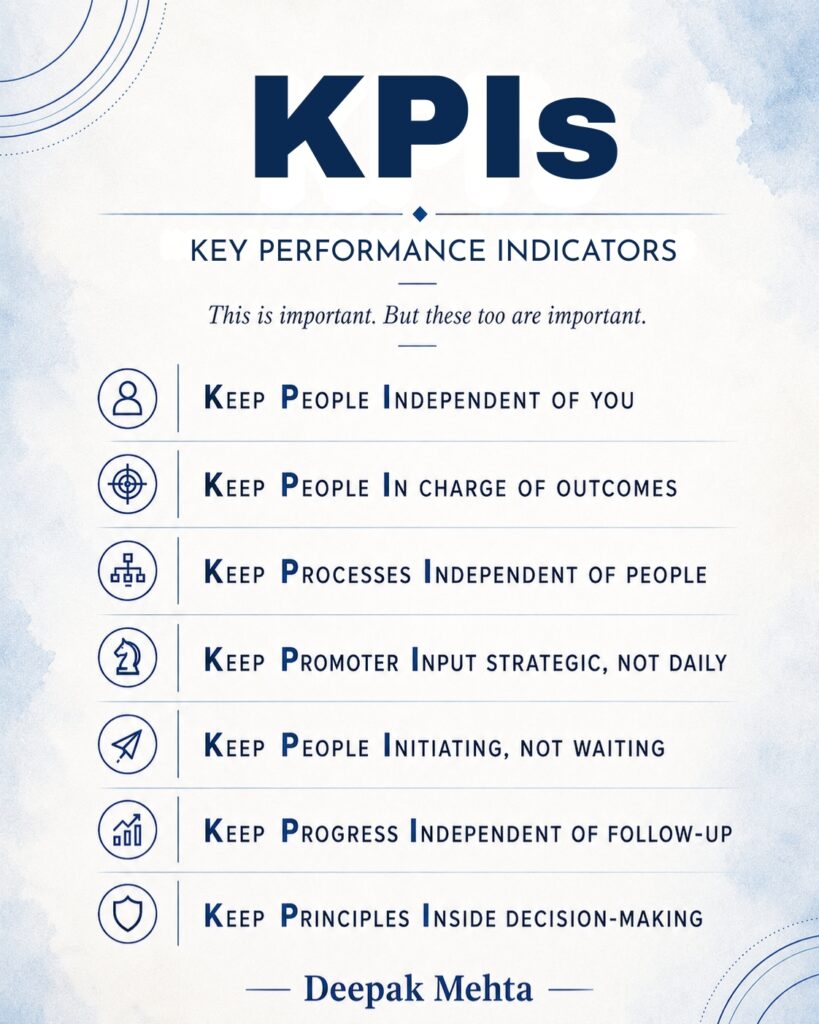
The Promoter-Independence KPI Framework
The usual KPI dashboard tells a promoter what the business achieved. A better scale dashboard also tells the promoter how the business achieved it.
That difference matters.
Two companies may have the same sales number. In one company, the team planned, decided, escalated only when necessary, and closed the result with clear ownership. In another company, the same result happened because the promoter followed up every day, corrected every delay, approved every decision and pushed every person.
The number is the same. The quality of scale is not. So a growing business needs a second layer of KPIs. Not only output KPIs, but independence KPIs. These indicators show whether the company is becoming stronger as a system or simply more dependent on the promoter:
1. Decision boundary KPI:
The first sign of promoter dependency is permission-seeking.
People come for approval even when the matter should have been handled at their level. Managers wait because they are not sure where their authority ends. Department heads escalate because deciding feels risky.
This is not always a people problem. Many times, the company has not clearly defined decision boundaries.
Every growing business should separate decisions into three categories:
- decisions people can take independently
- decisions people must discuss before taking
- decisions that must come to the promoter
This should not remain verbal. It should be visible by function.
Sales may need discount limits. Purchase may need approval limits. Production may need priority rules. Customer service may need escalation boundaries. Finance may need payment authority levels.
The KPI to track is simple:hHow many decisions came to the promoter that should have been handled one level below?
If that number stays high, the organisation is not building decision confidence. It is building dependence.
2. Outcome ownership KPI:
Many companies assign tasks. Fewer companies assign outcomes.
There is a difference.
- A task says, “Send the quotation.”
- An outcome says, “Close the quotation with customer confirmation by Friday.”
- A task says, “Follow up with purchase.”
- An outcome says, “Ensure material readiness for the order before production starts.”
A task can be completed without the business result moving. An outcome forces the person to think about closure.
This KPI should measure whether work has a clear owner, result and deadline.
The format can be very simple:
- what has to be achieved
- who owns the closure
- by when it must be completed
- what support is needed
- what is the current status
When people own outcomes, follow-up reduces. When people only own tasks, the promoter keeps checking whether the task actually moved the business forward.
The real KPI is not only whether people are busy. The real KPI is whether people are carrying closure.
A process is weak when it lives inside one person’s head.
Many SMEs operate like this for years. One person knows how the order moves. One person knows which customer needs special handling. One person knows the vendor sequence. One person knows where approvals get stuck. One person knows what usually goes wrong before dispatch. This looks manageable until that person is absent, overloaded, resigns or makes an error.
A strong business should ask: can this work continue if the usual person is not available?
If the answer is no, the process is not independent. It is person-dependent.
The process independence KPI should track:
- how many important processes are documented
- how many have defined triggers
- how many have clear steps
- how many have quality checks
- how many have escalation points
- how many can be performed by more than one trained person
This is where Enterprise Resource Planning can become useful, but only if the process is already clear. ERP cannot fix a process that nobody has defined. It can only make a defined process visible, trackable and disciplined.
A process becomes scalable when work does not stop because one person is absent.
4. Promoter time KPI:
The promoter’s time is one of the most expensive resources in the company. But in many businesses, that time gets consumed by daily firefighting. Approvals. Rechecking. Reminding. Correcting. Calling. Pushing. Solving the same issue again.
This creates a dangerous pattern. The promoter is busy, but not necessarily strategic.
The promoter time KPI should measure how much time goes into:
- daily operational follow-up
- repeated approvals
- people-related escalations
- customer firefighting
- vendor chasing
- internal coordination
- strategic thinking and direction
The goal is not to remove the promoter from the business. The goal is to move promoter involvement to the right level.
The promoter should spend more time on direction, people development, customer strategy, growth opportunities, risk review, capability building and long-term decisions.
The promoter should not become the company’s internal helpdesk.
A useful review rhythm can support this:
- weekly review for progress
- monthly review for direction
- immediate review only for critical decisions
This protects the promoter’s time from getting consumed by issues that should have been solved inside the system.
5. Initiation KPI:
A dependent team brings problems. An independent team brings problems with thinking.
That difference is important.
In many promoter-led businesses, people come and say, “This has happened. What should we do?” Over time, this trains the organisation to wait. People stop thinking beyond reporting the problem because they know the promoter will decide.
To build a stronger second line, the company should introduce one simple format:
- what happened
- what I think
- what I suggest we do next
- what risk I see
- what decision is needed
This small format changes behaviour. It forces managers and team members to think before escalating.
The KPI to track is:hHow many escalations came with a suggested next step?
If most escalations come only as problems, the business is still dependent. If more escalations come with options, reasoning and recommended action, decision capability is improving. This also builds better participation. Globally, only about one in four employees strongly agree that their opinions count at work. When people feel their view does not matter, they stop contributing to decisions and wait for instructions.
A business that wants ownership must create space for thinking, not only obedience.
6. Follow-up dependency KPI:
Some companies run only on chasing:
- The owner chases the manager.
- The manager chases the team.
- The team chases the vendor.
- The customer chases the company.
- Then the promoter steps in again.
Work moves, but only after repeated follow-up. That is not a system. That is pressure management.
The follow-up dependency KPI should track:
- how many tasks missed their date
- how many required more than one reminder
- how many were completed only after escalation
- how many got stuck because ownership was unclear
- how many delays were visible before the deadline
- how many delays were discovered only after customer pressure
A good system does not remove human effort. But it reduces unnecessary chasing.
For this, every important work item should have four things:
- clear owner
- clear next step
- clear date
- visible status
If these four are not visible, the business will depend on memory and follow-up.
ERP discipline matters here. When used properly, ERP does not only track stock, sales, accounts or production. It also shows where work is stuck, who owns it, what is pending and how fast decisions are moving.
Indian MSME digitalisation data shows that 53.8% of surveyed MSMEs have adopted at least one digital tool, while 46.2% still operate fully offline. The same survey covered 7,835 MSMEs across India, which shows that digital adoption is moving, but many businesses are still early in building data-backed management discipline.
Without data, a KPI remains a word. With data, it becomes a management tool.
7. Principle-based decision KPI:
Rules help people act. Principles help people decide.
This is the final and most mature KPI.
If the promoter wants people to decide well, the company must teach them how the business thinks. Otherwise, people will keep asking for approval because they do not know what matters most when there is a conflict.
For example:
- Should we protect margin or close the order?
- Should we dispatch fast or hold for quality clearance?
- Should we favour an old customer or follow the new credit rule?
- Should we hire quickly or wait for the right capability?
- Should we accept urgent work if it disturbs committed delivery?
These decisions need principles.
A company should define what it never compromises, what comes first during conflict, what good judgement means, and when escalation is necessary.
The KPI to track is not easy, but it is powerful: how many decisions were made correctly without promoter intervention?
This shows whether leadership thinking has moved into the organisation.
When principles are clear, people do not need the promoter for every decision. They can judge situations within a shared business logic.
That is when the business starts becoming stronger. Not only faster. Stronger.
- The common KPI dashboard asks: Did we achieve the number?
- The scale dashboard asks: Did the organisation become more capable while achieving the number?
That is the question many growing businesses need to add. Because if sales grow but dependency grows with it, the promoter has not built scale. The promoter has built pressure.
- If margins improve but every approval still comes to one desk, the system has not matured.
- If ERP is implemented but people still work outside it, data discipline has not arrived.
- If managers are hired but decisions still wait for the promoter, leadership depth has not developed.
- If deadlines are met only after chasing, rhythm is still weak.
The next stage of growth needs a different kind of KPI discipline. It needs to measure people independence, outcome ownership, process strength, promoter time, initiation, follow-up dependency and principle-based decisions.
These KPIs may not look as attractive as sales and margin numbers. But they decide whether the business can carry more growth without breaking the promoter’s time, energy and judgement.
That is where implementation-led SME growth becomes important.
A business becomes scalable when people know what they can decide, processes do not depend on memory, progress does not depend on chasing, and the promoter’s role shifts from daily push to strategic direction.
Sales may show that the company is growing.
These KPIs show whether the company is ready to grow.


