
Most teams aren’t broken. They’re just missing two things:
- a mission
- a mandate.
That is why meetings keep happening, calendars stay full, and yet work does not move forward in a meaningful way. People leave a room with notes, good intent, and even energy, but without decisions, without ownership, and without traction.
Meetings add hours. Clarity adds momentum.
When a team does not know what it is really here to do, or what it is truly allowed to decide, even high performers start drifting. Not because they are lazy, but because the structure is vague.
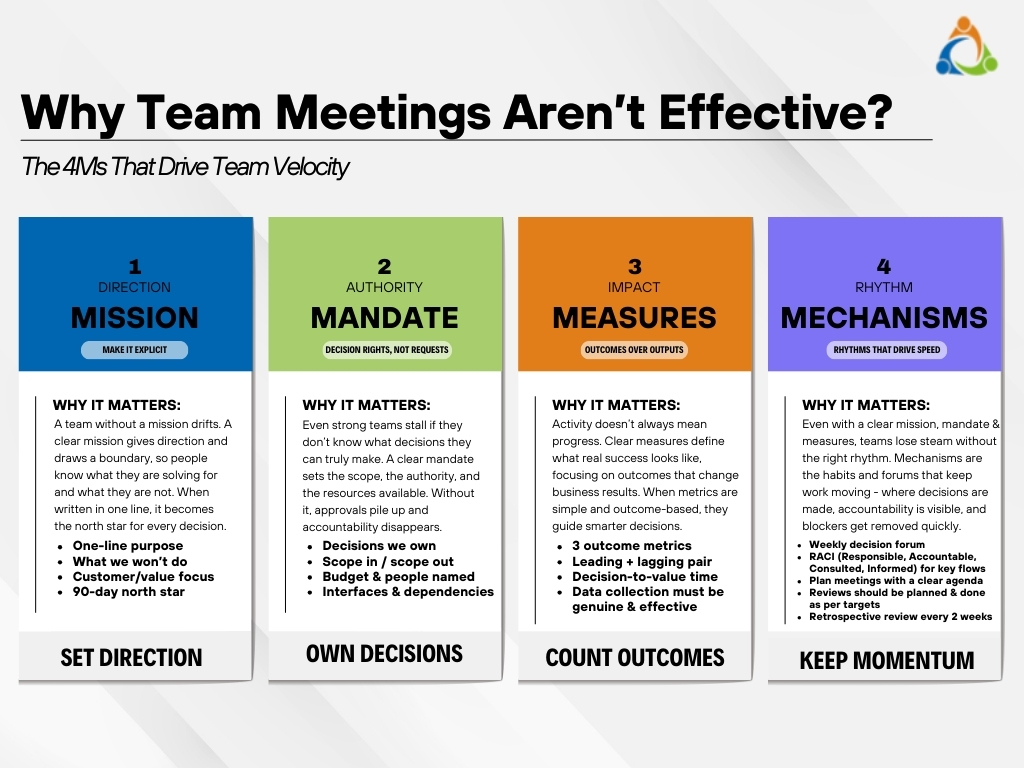
A One-Page Clarity Map for Meeting Effectiveness
If you want effective team meetings, do not start by fixing facilitation. Start by fixing the hidden “operating system” underneath the meeting. Most meeting problems are downstream effects of unclear purpose, unclear authority, unclear success, and unclear cadence.
When those four are defined, meeting effectiveness improves almost immediately. When they are missing, teams stay busy and still feel behind.
The five symptoms leaders mistake for “collaboration”
In most organisations, the meeting issue is not that people are not talking. It is that the room is producing conversation, not decisions.
You can usually spot the pattern through these symptoms:
- Notes get written, but decisions don’t.
- Priorities reset every Monday, even when nothing new happened.
- The room goes silent when someone asks, “Who owns this?”
- Approvals sit everywhere, but authority sits nowhere.
- Outputs get celebrated, while outcomes remain unclear.
On the surface, this looks like teamwork. Underneath, it creates a sequence that is predictable: DRIFT → DOUBT → DEPENDANCY.
Drift happens because people are unsure what matters most. Doubt builds because work feels busy but not valuable. Dependency forms because the team starts waiting for a leader to decide what the team should be deciding.
Why meetings fail: effort is present, structure is missing
It is tempting to believe that meetings become ineffective because people do not prepare, or because someone is not facilitating well. Those things matter, but they are rarely the root cause.
Meeting effectiveness collapses when a team cannot answer two questions without debate:
- What are we here to achieve?
- What can we decide without escalation?
These two answers are mission and mandate. When they are unclear, every meeting becomes a “status theatre” where everyone shares updates and nothing changes.
Clarity creates momentum because it turns discussion into decision, and decision into movement.
The 4Ms framework: how to turn meetings into velocity
When leadership teams want to fix meeting effectiveness without building a bureaucratic playbook, a simple structure works well. It can fit on one page, it can be reviewed quarterly, and it gives teams a shared language.
Think of it as a meeting operating model.
1) Mission: direction that prevents drift:
Mission is not a slogan. It is a boundary. It tells the team what it exists to deliver, and what is outside scope.
When mission is weak, meetings drift into topics that feel urgent but are not central. People then confuse activity with progress, and the team loses speed.
A mission that improves team velocity usually includes:
- A one-line purpose that a team can repeat without jargon.
- A clear “outside boundary” so the team can say no confidently.
- A defined customer or stakeholder focus.
- A time horizon that matters (for example, what “good” looks like in 90 days).
If you want effective team meetings, the mission must be explicit enough that people can challenge off-topic discussion without politics.
2) Mandate: authority that prevents dependency:
Mandate is where most meeting problems actually live. Teams do not slow down because they lack intelligence. They slow down because they do not know what they are allowed to decide.
When mandate is unclear, work gets stuck in approval loops. People hedge decisions, escalate unnecessarily, and “waiting for sign-off” becomes the default state.
A mandate that improves meeting effectiveness defines:
- Decision rights (what decisions the team owns vs. escalates).
- Scope (what the team is responsible for delivering).
- Resources (budget, tools, capacity, and constraints).
- Interfaces (which other teams the mandate depends on, and how those handovers work).
If your meetings feel polite but powerless, mandate is usually the missing piece.
3) Measures: outcomes that prevent busy work:
Most teams track what is easy to count, not what matters. That is why outputs get celebrated while outcomes remain unclear.
Measures do not need to be complex. They need to be honest and repeatable. The goal is to create a shared definition of progress so the team stops mistaking movement for momentum.
Strong measures typically include:
- One leading indicator (what predicts success early).
- One lagging indicator (what confirms success later).
- One quality indicator (what prevents “fast but sloppy” execution).
If you want meeting effectiveness, measures must force the team to ask: “What changed because of our work?” not “What did we do this week?”
4) Mechanisms: cadence that prevents rework:
Even with mission, mandate, and measures, teams can still lose speed if they lack the right mechanisms. Mechanisms are the rituals that make clarity usable in real life.
Without mechanisms, the team does not have a rhythm for decisions, reviews, escalation, and learning. The result is familiar: every week feels like starting again.
Mechanisms that increase team velocity include:
- A weekly decision-focused meeting (not a status meeting).
- A short review rhythm for key measures.
- A clear escalation rule (what gets escalated, how fast, to whom).
- A retrospective cadence (so the team improves the system, not just the work).
Mechanisms turn clarity into momentum because they make repeatable execution normal.
A meeting effectiveness rule that leaders can apply immediately
If you want a practical filter for every meeting agenda item, use this simple test:
If the topic does not end with a decision, an owner, and a next step, it does not belong in a decision meeting.
This one rule changes meeting behaviour quickly because it removes the illusion of progress. It forces the team to convert discussion into commitments.
It also makes accountability easier because ownership becomes visible in the room, not hidden in minutes.
The 7-day reset: a simple way to rebuild team velocity
Large re-orgs and offsites are not required to improve meeting effectiveness. What usually works better is short, disciplined clarity work that the team can execute without drama.
A 7-day reset is often enough to create noticeable momentum.
Day 1: Write the mission in one honest line:
Make it simple enough that a new hire understands it. Make it specific enough that it creates boundaries.
Day 2: Define the mandate clearly:
Write what the team owns, what it influences, and what it does not touch. List the decisions the team can make without escalation.
Day 3: Lock three measures:
Choose outcomes that matter. Make them few, repeatable, and visible.
Day 4: Design the meeting rhythm:
Define how the team meets, decides, and escalates. Decide which meeting is for decisions, and which is for updates (if any).
Day 5: Publish the working charter:
Keep it one page. Share it with stakeholders. Invite feedback early so misalignment is surfaced before it becomes politics.
Day 6: Turn the next meeting into a decision + owner list:
No long updates. No storytelling. Only decisions, owners, and next steps.
Day 7: Debrief and refine:
Ask what changed, what didn’t, and what rule needs tightening. Make one improvement to the charter, not ten.
A week of discipline can unlock months of momentum because it replaces ambiguity with a shared operating model.
What to put on the “one-page clarity map”
Teams often ask what the final one-pager should contain. The easiest answer is: it should contain only what reduces drift.
A useful one-page clarity map typically includes:
- Mission: one-line purpose + outside boundary
- Mandate: decision rights + scope + resources
- Measures: 3 outcomes that define progress
- Mechanisms: meeting cadence + escalation + review rhythm
- Owners: who owns what (by name, not by function)
This is not documentation for documentation’s sake. It is an execution tool. It prevents meetings from becoming therapy and turns them back into a vehicle for movement.
If your team is stuck in meetings but not moving, the solution is rarely “more meetings” or “better minutes.” It is clarity that removes drift.
Start with mission. Define mandate. Track outcomes. Build mechanisms. Then watch what happens to meeting effectiveness when the team finally knows what it is here to do and what it is allowed to decide.
When teams experience even small wins from clarity, they do not want to go back. Speed improves, trust strengthens, and dependency drops.


