
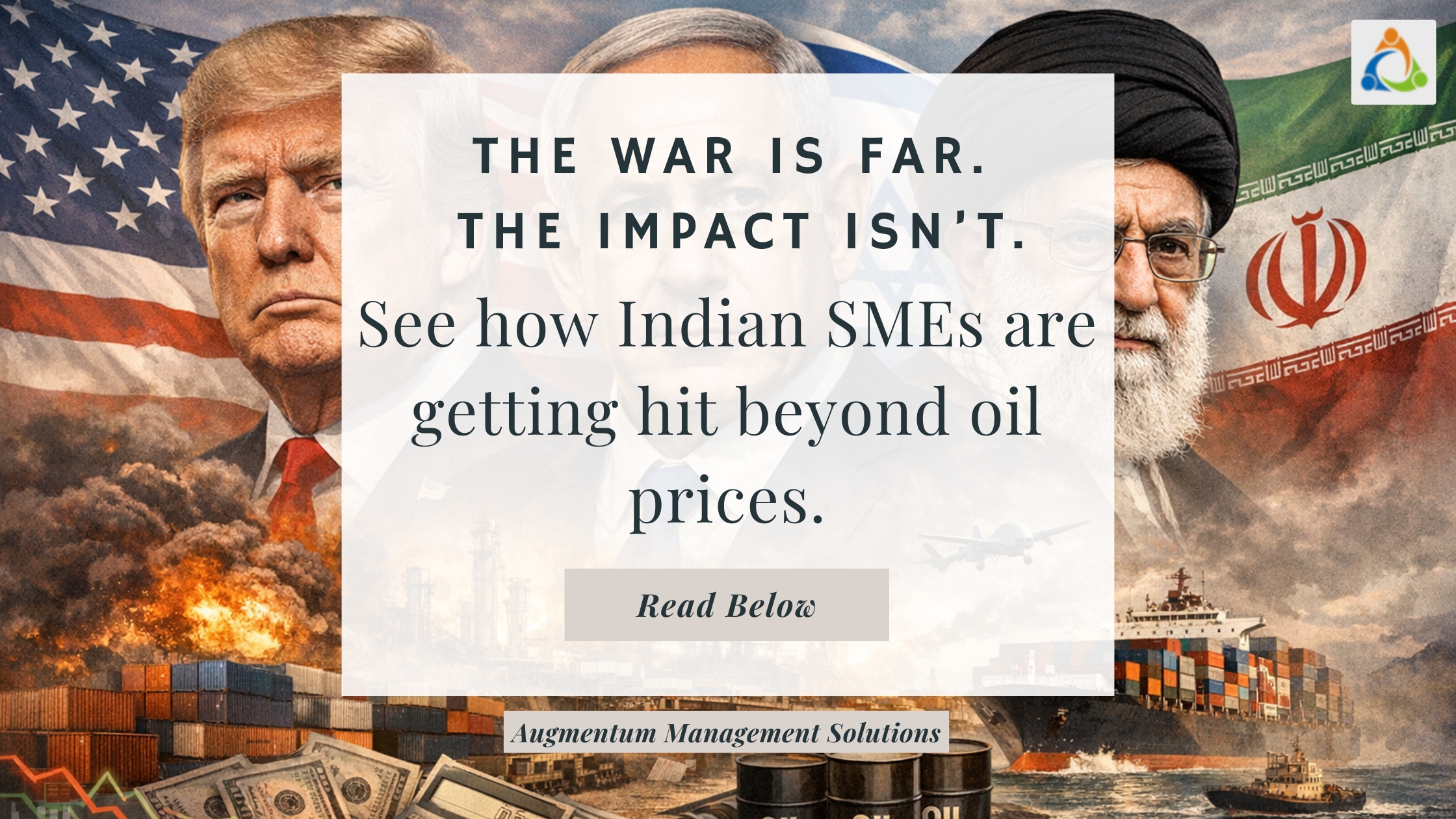
We are now in the 28ᵗʰ day of the U.S.-Israel vs. Iran war and for many Indian SMEs, the U.S.-Iran war is no longer a distant geopolitical headline. It has already entered the factory through freight bills, energy costs, input prices, shipment delays, and tighter cash flow. Brent crude rose sharply during the June 2025 Israel-Iran escalation before easing after a ceasefire, showing how quickly conflict in the region can move oil markets and reshape business assumptions.
But this is not only an oil story.
It becomes dangerous when multiple pressures move together: freight becomes costlier, insurance becomes tighter, lead times become less reliable, petrochemical-linked inputs start climbing quietly, and customer payment cycles do not improve fast enough to absorb the shock. Also conflict-related disruption pushed up plastic and petrochemical prices, underscoring how quickly input inflation can reach manufacturers that rely on packaging, polymers, and industrial intermediates.
That is why many SME owners make a mistake when they treat this only as a “cost increase” problem.
It is bigger than that. It is a systems problem.
If your business still depends heavily on one supplier route, one energy assumption, one customer cycle, or one old pricing model, a geopolitical shock does not create the weakness. It exposes the weakness that was already there. That matters even more in India because MSMEs are not a side story: they contribute roughly 30% of GDP and more than 45% of exports, making SME resilience a national competitiveness issue, not just a promoter concern.
Why this shock becomes an operations problem faster than most SME owners expect
The first impact is obvious. Fuel, freight, insurance, imported inputs, and gas-linked production costs become more volatile. But the more important shift happens underneath. The business model begins to lose the stability it was built on.
A lot of SMEs are still designed around assumptions that only work in calm periods: predictable lead times, stable vendor behaviour, regular cash collections, and customer willingness to absorb small cost changes. Once those assumptions start moving together, the pressure quickly shifts from margins to operations. Planning becomes noisy. Sales keeps quoting old timelines. Procurement hesitates between buying early and protecting cash. Production teams face shortages or cost spikes in materials they treated as routine. Leadership reviews start focusing on damage control rather than decision quality.
That is why this kind of disruption feels different from a normal commodity movement. One cost shock can usually be managed. But when freight, energy, input costs, and working capital all tighten together, the business is forced to reveal whether it has resilience built into its system or only in the promoter’s instincts.
This is already visible in 2 practical ways:
- Conflict-driven shipping risk has remained a major concern for global trade lanes connected to the Gulf and Red Sea, with Reuters reporting that carriers and insurers continued to treat routes as risky and expensive.
- India itself moved to limit gas supplies to some industrial and commercial consumers to 80% of average consumption during the recent disruption phase, showing that energy-linked industries cannot assume full availability during geopolitical stress.
So the question for SME owners is no longer, “Will this affect us?” The better question is, “Where is our business structurally exposed if this continues for another 30 to 45 days?”
The answer usually sits in 5 places:
1. Route dependence:
If exports or key imports rely heavily on one corridor, one port chain, or one assumption about transit timing, then a shipping disruption becomes a planning disruption very quickly.
2. Supplier concentration:
If a critical input is heavily linked to petrochemical, gas, or import dependence and there is no real backup, then procurement becomes reactive.
3. Pricing inertia:
If you are still quoting on old freight, old insurance, old foreign exchange assumptions, or old lead times, you are silently accepting weaker contribution margins without naming it.
4. Weak communication rhythms:
In normal times, delayed communication can be tolerated. In volatile times, silence magnifies confusion. Customers, employees, and suppliers start filling the gap with their own assumptions.
5. Working capital fragility:
This is often the biggest hit. Margins narrow first, but cash pressure makes the pain visible. When inventory gets costlier, shipments slow, or collections lag while outflows rise, the business starts feeling stretched even before the P&L fully reflects the problem.
This is why many SME owners need to think less like a “growth phase” business and more like a “sustainability phase” business during a geopolitical disruption window. The right posture is not panic. It is discipline.
A practical response starts by resetting the objective. For the next few weeks, the goal is not maximum sales. The goal is controlled survival with decision quality intact. That means protecting cash, protecting clarity, and protecting your ability to reprice, reroute, and respond before strain becomes damage.
Here is a practical operating response that SME leaders can use right now:
1. Plan like a lockdown phase, not a growth phase:
The first mindset shift is the most important. Move from expansion thinking to sustainability thinking. That does not mean shrinking blindly. It means testing whether your current commitments still make sense under disrupted assumptions. Stop treating current volatility as a short irritation. Treat it as a temporary operating regime.
2. Recalculate contribution margins using new assumptions:
Do not use old costing logic. Update freight, insurance, fuel, and foreign exchange assumptions immediately. If packaging, plastics, labels, caps, or imported industrial inputs are part of your cost structure, recalculate their contribution impact instead of waiting for next month’s gross margin surprise. Reuters reported conflict-related spikes in petrochemical prices and noted how dependent many regions remain on Middle Eastern flows.
3. Stop promising old lead times if route risk has changed:
A wrong promise is more expensive than a slower but honest one. If logistics assumptions have changed, refresh committed timelines now. Short-term discomfort in communication is better than long-term damage to trust.
4. Protect cash before protecting weak-margin volume:
Not every order is worth chasing in a stress window. If the margin has eroded and the payment cycle is weak, then revenue growth may actually worsen the problem. In volatile periods, cash discipline becomes more important than shipment count.
5. Build backup for critical inputs, especially petrochemical- or import-linked ones:
Not all second sources will be ideal, but backup is not built after the disruption worsens. It is built while the pressure is still manageable. Map the top 10 vulnerable inputs and identify what can realistically be dual-sourced, substituted, or buffered.
6. Communicate earlier with customers and employees:
This is not a soft step. It is an operating step. Customers need realistic expectations. Employees need clarity on what the company is prioritising and why. Extra communication prevents extra confusion, especially when teams are already stretched.
7. Run 3 scenarios for the next 30 to 45 days:
Do not plan only for one outcome. Build 3 scenarios:
- conflict eases
- conflict holds at current intensity
- conflict worsens
For each scenario, define what changes in pricing, procurement, inventory, and cash controls. This removes emotional decision-making from crisis reviews.
The strongest manufacturers in a disruption phase are not simply the ones that produce more. They are the ones that absorb shocks better, reprice faster, communicate earlier, and protect cash with discipline. That is the real advantage when the system around you is moving.
And that is why this issue should not be read only as a war story or an oil story. It is an operating-model story.
The businesses that come through these periods well are usually not the ones with the most confident commentary. They are the ones that already built some resilience into supplier design, review cadence, communication discipline, and working-capital thinking before the shock arrived.
For everyone else, this is still the right time to respond.
Not with panic.
With clarity.
Because when the environment starts shifting, the real differentiator is not size alone. It is how calmly, how early, and how structurally you respond.


