
A policy announcement becomes valuable only when it improves a real business decision.
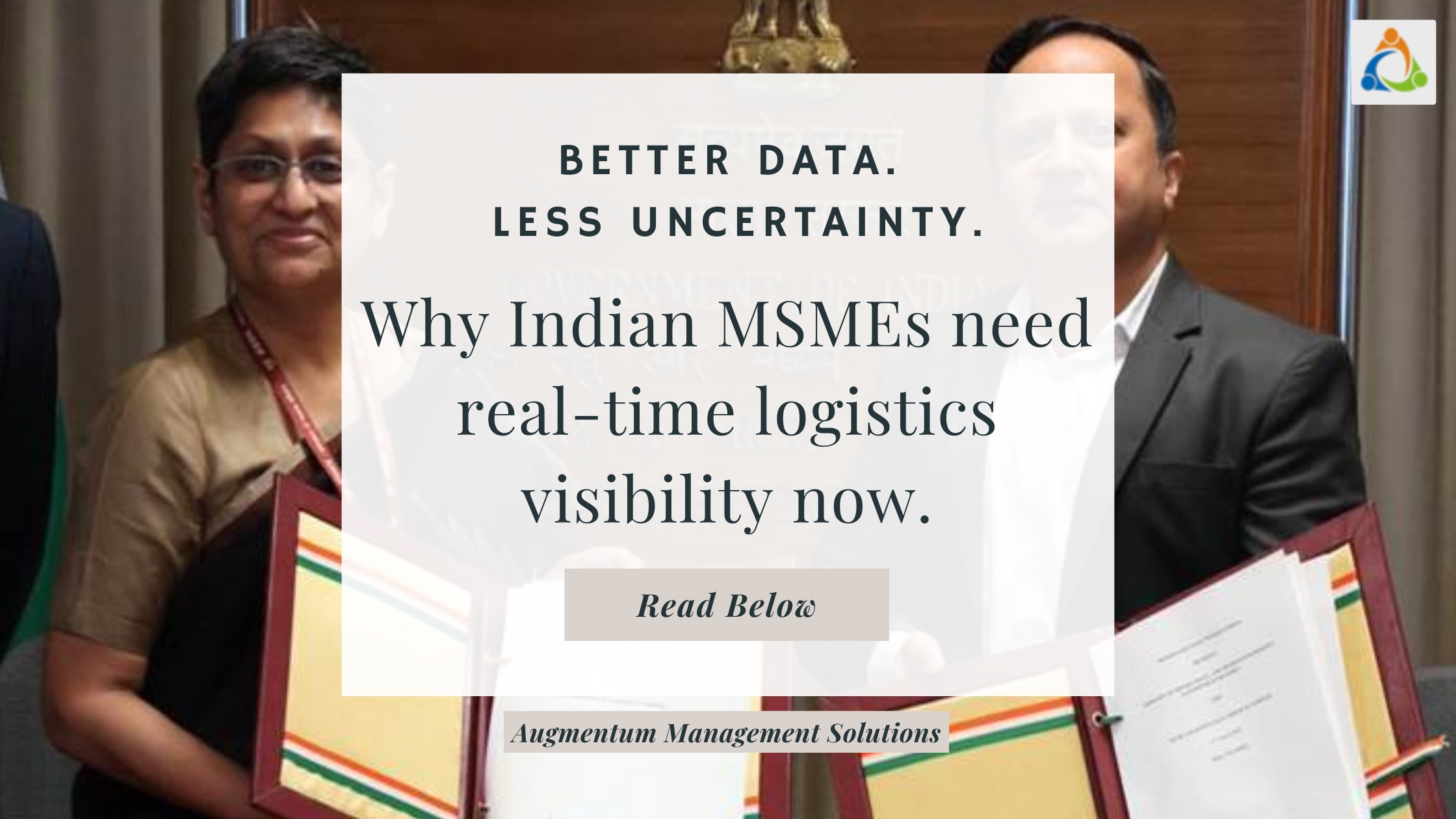
That is why the recent MoU between the Ministry of MSME and NICDC Logistics Data Services matters less as a framework and more as a possibility. The stated intent is to enable API-based data exchange, improve access to real-time logistics data, and strengthen supply-chain efficiency for MSMEs. That sounds useful on paper. The real question is whether it can reduce uncertainty where it hurts the most – inside planning, dispatch, customer commitment, and working capital decisions.
This matters because logistics problems for MSMEs are rarely only about transport cost. More often, the bigger damage comes from not knowing enough, early enough. If a shipment is delayed but the plant learns too late, production planning shifts. If dispatch and material movement are not aligned, customer commitments weaken. If incoming material timing becomes unclear, billing and collection timing also start drifting. For a sector that contributes around 30% of India’s GDP and over 45% of exports, better logistics visibility is not a side efficiency issue. It is a competitiveness issue.
Why better logistics data could matter more than lower logistics cost
For many MSMEs, logistics still gets viewed as a back-end function. That view is now too narrow.
Once a business begins depending on imported inputs, multi-location supply, time-bound dispatches, or tight customer commitments, logistics stops being only an operations issue. It becomes a management issue. That is because movement uncertainty starts affecting production rhythm, inventory assumptions, order confidence, and cash-flow stability at the same time.
This is where the MSME Ministry–NLDS MoU becomes meaningful. The announced intent is not just digitisation in general, but a more structured logistics data exchange through API-based integration so that real-time logistics data can become usable for better decisions. The larger digital logistics ecosystem already operates at significant scale, with 45 systems across 11 ministries and departments connected through 137 APIs, covering more than 2,000 data fields, enabling over 240 applications and more than 300 crore API transactions. That scale matters because it shows the underlying infrastructure is not small or theoretical.
But the real value for MSMEs will not come from hearing that data exists. It will come when the data starts helping leaders answer practical questions earlier:
- Where is the delay happening?
- What is likely to arrive when?
- Is production planning still aligned to realistic material movement?
- Should dispatch promises be changed now rather than defended later?
- Is the business responding before disruption, or only after disruption has already reached the customer?
That is where logistics visibility becomes different from logistics reporting. Reporting tells you what happened Visibility improves what you can still do.
For MSMEs, that difference is critical. A lot of small and mid-sized manufacturers do not fail because one shipment was late. They get strained because uncertainty multiplies silently. One delayed input changes the production plan. The revised plan affects dispatch. Dispatch shifts billing. Billing shifts collections. Collections affect cash-flow confidence. Then the business starts carrying higher inventory buffers just to defend itself from not knowing enough. Cost goes up quietly, but the deeper issue is not cost alone. It is reduced decision quality.
That is why the strongest operational benefit of this move, if it gets implemented well, may not be “cheaper logistics” first. It may be lower uncertainty.
And lower uncertainty has operating value.
It can improve production-dispatch coordination. It can help planners react earlier. It can reduce the need for safety buffers built out of guesswork. It can improve customer communication because the company can respond with evidence, not optimism. It can also reduce pressure on working capital because timing becomes more visible, not just historically reportable.
That said, this will only become meaningful if the data comes down from policy level into operational use.
If real-time logistics information stays inside dashboards meant only for institutions or policy reviews, the impact on MSMEs will remain limited. But if it starts helping an MSME owner, plant head, or supply-chain lead see movement risks early enough to adjust production, dispatch, and customer commitments, then this can become genuinely valuable. That is where the announced intent will need to prove itself.
A useful way to think about this is to separate 5 layers of value:
1. Movement visibility:
The first benefit is simple: knowing where the shipment is with greater clarity. That may sound basic, but for many businesses, delayed visibility is still one of the biggest reasons planning quality drops.
2. Earlier disruption signals:
The real operating advantage is not seeing the delay after it happens. It is seeing enough signal early enough to take action before the impact spreads across production and customer promise.
3. Better production-dispatch coordination:
MSMEs often run into trouble not because one team failed, but because dispatch reality and production planning were not updated fast enough together. Shared logistics visibility can reduce that lag.
4. Lower uncertainty in working capital planning:
When incoming material timing becomes more believable, inventory, dispatch, billing, and collection assumptions become more stable too. That directly affects how much stress the business carries in cash-flow planning.
5. Faster decisions, not better hindsight:
The final value is managerial. Better data becomes useful only when it improves decisions in time. Otherwise, it remains a cleaner post-mortem.
That is why this development deserves a practical response from MSMEs rather than only passive approval.
If this ecosystem starts opening better visibility, MSMEs should prepare themselves to use that visibility well. The businesses that benefit most from real-time logistics data will not necessarily be the biggest. They will be the ones that are able to connect logistics signals to planning discipline.
A practical response for MSME leaders would look like this:
What MSMEs should do if logistics visibility improves
1. Reconnect logistics data with production planning: do not treat shipment tracking as an isolated update. Build a habit where material movement information directly informs production decisions.
2. Review dispatch promises against live movement reality: if visibility improves, customer communication should improve with it. Promise based on current movement reality, not on old lead-time assumptions.
3. Rework inventory buffers with better data: if earlier signals reduce uncertainty, some defensive inventory assumptions can be reviewed. That helps working capital.
4. Build a simple exception rhythm: identify which movement delays should trigger action, who should respond, and how quickly. Visibility without response logic will not create value.
5. Bring logistics into management reviews more intelligently: instead of treating logistics as a support update, use it as a lead indicator for production, dispatch, and cash-flow risk.
6. Check whether data is reaching the actual decision maker: the benefit is lost if logistics visibility stays with one analyst while plant planning, sales commitments, or procurement action remain unchanged.
The bigger point is this: logistics strength is no longer only about moving goods. It is about seeing movement early enough to make better decisions.
That is why this MoU looks useful.
Not because one more framework has been signed. But because, if implemented well, it could shift logistics from a delayed reporting function to an earlier management capability.
And for MSMEs, that shift matters. Because in a smaller business, uncertainty is expensive. It stretches planning, weakens promises, increases buffers, and quietly eats margin. Better visibility cannot solve every supply-chain problem. But it can help the business respond earlier, with more clarity and less reaction.
That is where the real value will come from. Not from having more data. But from making that data usable enough to reduce uncertainty where it hurts the business most.


