
Some leadership transitions are not really about succession. They are about structure.
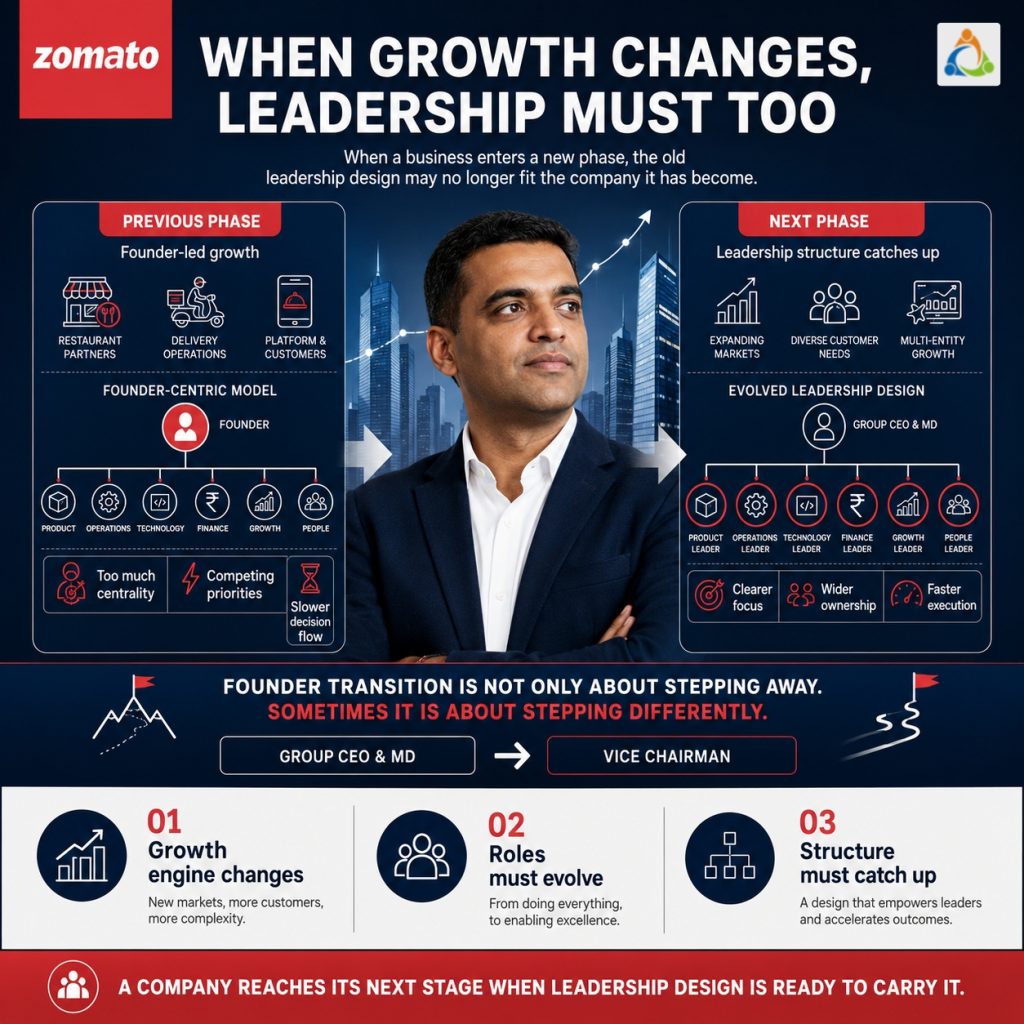
That is what makes the recent shift at Eternal worth studying. Deepinder Goyal moved from the role of Group CEO and Managing Director into the vice chairman role, and day-to-day leadership moved to Albinder Dhindsa. This came after Blinkit had already become Eternal’s largest revenue contributor among its consumer businesses, changing the shape of where growth was actually coming from.
That matters because when the growth engine changes, the leadership model cannot remain frozen in the logic of the previous phase.
This is where many companies get stuck. The business evolves. The revenue mix changes. A new growth line becomes more central. Complexity increases. But the leadership structure still reflects the old phase.
That is when growth starts running into a hidden barrier. What looks like a strategy issue from the outside is often a structure issue inside the company. Research on organizational redesign has long shown that companies lose value when strategy, operating model, and structure drift apart. Even high-performing companies can leave a large share of strategy value unrealized when the operating model does not keep up.
What changes first in a scaling company: the business, or the org chart?
In many founder-led businesses, the original leadership structure works well for the phase in which the company is being built. There is one dominant engine. Priorities are clearer. Decisions are more centralized. The founder is still the natural node through which customer, product, operations, finance, and people decisions flow. That centrality can actually be efficient in the earlier phase.
But as the business enters a new stage, the operating reality changes faster than the org chart.
A new growth line begins to matter more. The customer base becomes more diverse. The business starts carrying different time horizons at once – one engine must be stabilized, another must be expanded, a third may still be incubated. The market gets more competitive. Functional complexity goes up. Decision velocity matters more. The founder can still remain important, but the business now needs wider ownership and a different distribution of authority.
That is why founder transition is not always about stepping away. Sometimes it is about stepping differently.
The recent Eternal shift illustrates that principle well. Reuters reported that Deepinder Goyal would remain with the company as vice chairman focused on long-term strategy, leadership, and governance, while Albinder Dhindsa would take over daily operations and business decisions. That is a structural signal. It shows a business redesigning leadership around what the company has become, not just what it used to be.
That is the real lesson for owners.
The question is not only, “Who should take over?” The question is, “What kind of leadership structure does this phase of the business now require?”
Because when companies do not ask that in time, a few predictable symptoms begin showing up:
- the new growth engine becomes central, but old priorities still dominate decision-making
- one role starts carrying too many conflicting agendas
- the founder remains too operationally central even when broader leadership is needed
- execution slows because authority has not moved with complexity
- next-line leaders have titles, but not enough trust or decision rights
- review meetings become updates upward, not decision forums across leaders
This is not only a personality problem. It is a design problem.
And design problems do not correct themselves just because the company keeps growing.
That is why leadership structure becomes such a critical part of scaling. As businesses evolve, the design has to integrate people, processes, and structure more deliberately. Strong organizations do not only add more leaders. They reconfigure roles, decision rights, reporting logic, and focus areas so the structure reflects the strategy now being pursued.
A useful way to understand this is through phase mismatch.
Phase 1: the old design still fits
The founder-led model works because the business is still relatively concentrated. Coordination through one person remains manageable. Centrality supports speed.
Phase 2: the business changes shape
A new business line grows faster than expected. Revenue mix shifts. A different operational engine becomes more important. Complexity multiplies.
Phase 3: the structure lags
The org chart still looks similar, but decision load becomes uneven. New priorities do not have matching authority. Old reporting lines keep forcing new work through outdated pathways.
Phase 4: growth starts slowing for structural reasons
The company still has market opportunity, but internally one role is overloaded, leadership bandwidth is fragmented, and execution starts losing speed.
That is the moment many founders and CEOs misread.
They think the company needs more effort, more monitoring, more meetings, or more founder involvement. Sometimes what it actually needs is a different leadership design.
That design question is becoming more important in modern growth companies because new businesses rarely remain single-engine for long. As product lines diversify, customer expectations expand, and newer revenue streams take on greater importance, leadership needs to become less founder-centric and more phase-appropriate. The operating model has to close the gap between strategy and execution, not widen it.
So what should leaders actually examine when the growth engine changes?
A practical way to think about it is not through a generic reorganization exercise, but through six management questions.
1. Is the current structure built for today’s business or yesterday’s?
This is the first question because many companies still have a design that reflects the logic of the earlier revenue engine. If the business mix has shifted but leadership focus has not, structural lag is already present.
2. Is one role now carrying too many conflicting priorities?
This often happens in transition phases. A leader is still expected to drive old-business stability, new-growth expansion, brand signaling, investor confidence, people alignment, and operating rhythm all at once. That is not always leadership strength. It may be accumulated design debt.
3. Has the new growth engine been given enough focus, authority, and leadership depth?
A new engine cannot scale properly if it still depends on borrowed authority from the previous phase. It needs a role design that matches its importance.
4. Have roles evolved as the business evolved?
This is where many companies stay too static. Titles remain, but the actual work required underneath them has changed significantly. Once the business changes shape, roles should be redefined around the new demands, not preserved only out of continuity.
5. Is the founder still holding too much operational gravity?
Founders often remain central for good reasons. They carry trust, judgment, memory, and influence. But if every major thread still bends back toward one person, the business may be depending on central gravity when it now needs wider orbit.
6. Has the org design caught up with strategy?
This is the final synthesis question. A company may have a clear strategy, but if the decision structure, reporting flow, authority design, and leadership bandwidth do not support it, growth gets slowed down from inside the system.
These are not theoretical questions. They are usually the questions that separate a business entering its next stage from a business merely carrying old leadership logic into a more complex future.
A better response, then, is not to wait for structure problems to become painful enough to force action. It is to redesign earlier.
That redesign usually means some combination of the following moves:
- separating long-term strategic oversight from daily operating leadership
- giving the new growth engine a leader with clearer authority
- redistributing decision load away from over-centralized roles
- redefining roles around present complexity rather than legacy hierarchy
- widening ownership so execution does not bottleneck at the center
- turning review forums into cross-functional decision spaces instead of escalation corridors
This is where the Eternal example becomes useful again. The shift from Group CEO and Managing Director to vice chairman for the founder, alongside the elevation of the Blinkit leader into the top operating role, reflects a company reshaping leadership around where growth and execution now sit. That does not automatically make every transition perfect. But it does reflect an important truth: leadership structure has to evolve with business reality.
That is also why owners should not read founder transition only as a personality or succession story.
In many cases, it is a structural maturity story.
A business reaches its next phase not simply when a new leader is named, but when the leadership design is finally ready to carry the business it has become.
That is the deeper test.
Because growth does not always get blocked by lack of opportunity first.
Quite often, it gets blocked by a leadership model that has not evolved with the company.
And once leaders begin answering that honestly, they can start redesigning roles, authority, and decision flow before growth gets slowed down by the wrong structure.
That is what real transition readiness looks like.
Not only movement at the top. But alignment between strategy, structure, and the next phase of growth.


