
Manufacturing leaders are under pressure to move faster on AI. The pressure is understandable. AI is visible, exciting, and increasingly present in boardroom conversations. But that does not mean it is the right first move in every plant. In many factories, the more urgent issue is not a lack of intelligence. It is weak process discipline, unstable workflows, and data that still cannot be trusted consistently enough for scaled decisions.
That is why the more useful question is not whether AI matters. It does. The better question is whether the plant has fixed what should simply be automated before trying to layer AI on top. This distinction matters because automation is already mature and widely proven in industry, while agentic AI adoption remains early, selective, and much less stable at scale. Global industrial robot installations reached 542,000 in 2024, and the installed base rose to about 4.66 million, showing how deeply industrial automation is already embedded in manufacturing economics. At the same time, only 2% of organizations have AI agents at scale, while 61% are still exploring deployment.
That contrast is important because it reveals the real sequencing problem. Many companies are trying to use AI to compensate for weak process design. That usually creates an expensive layer on top of an unstable base. It may look modern for a while, but it rarely scales cleanly when the underlying work is still repetitive, messy, manual, and inconsistent. Forecasts now suggest that more than 40% of agentic AI projects could be cancelled by 2027 because of rising costs, unclear business value, or inadequate controls.
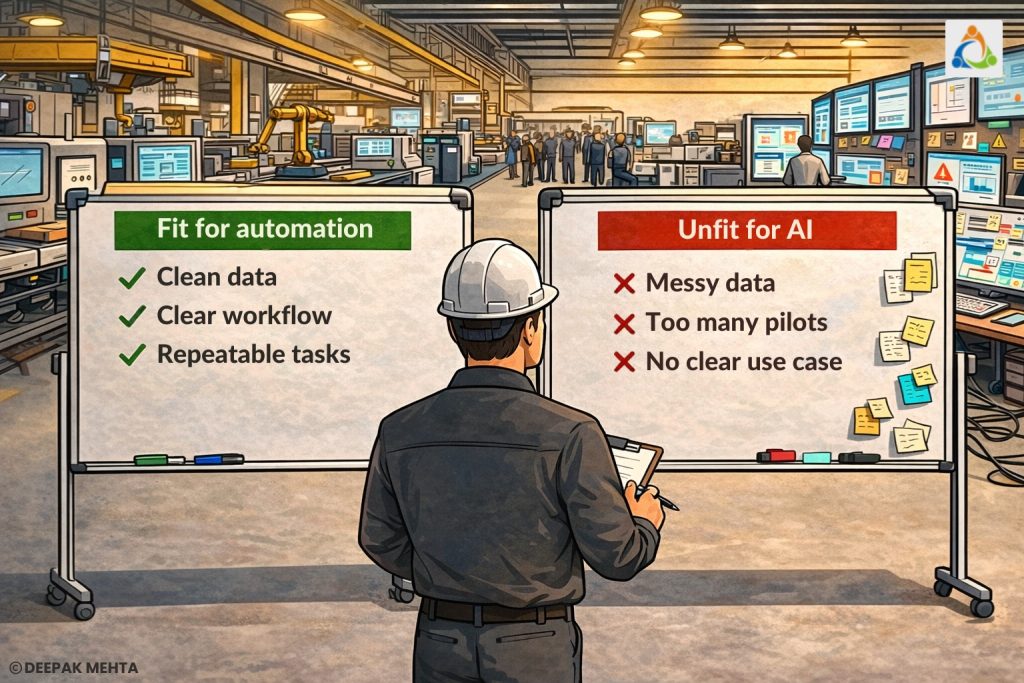
The real issue is not AI or automation. It is sequence.
A lot of manufacturers still frame the discussion as a technology choice: should we automate, or should we move to AI? In practice, that framing is too simplistic. Automation and AI solve different kinds of problems, and confusion begins when businesses ask one to solve the other’s job.
Automation works best when the work is repetitive, rules-based, stable, high-volume, and process-critical. That includes recurring approvals, workflow routing, standard reports, recurring administrative tasks, standard quality checks, and repeatable production-support work. These are exactly the kinds of activities where consistency matters more than intelligence. If the process is known, the steps are repeatable, and the decision logic can be defined clearly, automation is usually the right first answer.
AI becomes more useful when the work is exception-heavy, data-rich, judgment-based, cross-functional, and variable rather than repetitive. In manufacturing, that often means maintenance intelligence, planning support, quality pattern detection, anomaly recognition, root-cause analysis support, or knowledge assistance for supervisors. These are areas where the system needs to interpret patterns, compare scenarios, or support human decisions under changing conditions.
The problem is that many plants are trying to move to the second category before they have stabilized the first.
If a plant is still running on repetitive approvals, Excel follow-ups, unstable reporting, manual scheduling handoffs, and visible process gaps between departments, then AI is probably not the first intervention it needs. In that environment, the smarter first move is to standardize the work, define the flow, reduce variation, improve the data trail, and automate the repeatable load. Once that is in place, AI can be evaluated more honestly.
This matters because manufacturing AI adoption is still uneven even among companies already exploring smart manufacturing. Current survey data shows that 29% of manufacturers are using AI or machine learning at facility or network level, 24% have deployed generative AI at that level, and 38% are still piloting generative AI. That is meaningful progress, but it also shows that many companies are still in experimentation mode, not scaled operating mode.
That should change the tone of the conversation. AI should not be treated as a catch-up checkbox. It should be treated as a deliberate operating decision with clear fit, clear data readiness, and clear business value.
A useful way to think about this is to ask three questions before any technology decision is made:
- Is the process stable?
- Is the data usable?
- Is the problem really asking for intelligence, or just discipline?
Those three questions can save a company from months of confused experimentation. A surprising number of AI pilots are really attempts to bypass unresolved process work. When that happens, the model may produce output, but adoption remains weak because the business never fixed the conditions needed to trust and use that output consistently.
This is why weak process design is so costly. It makes simple work look more complex than it is. It makes unstable handoffs appear like information problems. It makes repetitive friction feel like an insight gap. Once that misdiagnosis happens, the plant starts spending on the wrong layer.
That is where leadership discipline matters most. The sequence should usually look like this:
What manufacturers should fix first
1. Standardize the repetitive work: if the same activity is being done in different ways by different teams, AI will not solve the confusion. Standardization should come first.
2. Clean the data trail: if the plant is still working with messy master data, partial entries, broken handoffs, or inconsistent reporting logic, intelligent output will remain difficult to trust.
3. Automate the rules-based flow: once the process is stable, repetitive approvals, workflow movement, reporting pipelines, and other recurring tasks should be automated first.
4. Identify two or three high-value AI use cases only: do not begin with twenty pilots. Start where the problem is real, the business value is visible, and the data is reasonably usable.
5. Keep humans in the loop early: in the first phase, adoption matters as much as accuracy. Teams need to understand how the system helps them, where it fits, and how its output should be used.
6. Define success before launch: if no one agrees on the value being measured, the project will drift into storytelling instead of accountability.
7. Review cost, adoption, and quality together: AI should not be reviewed only for technical output. It should be reviewed for whether people use it, whether decisions improve, and whether the economics still make sense.
8. Scale only after one real win: a single grounded success is worth more than a long list of disconnected experiments.
This is where many manufacturers can create a cleaner roadmap.
Automation should carry the repetitive load. AI should support the variable, judgment-heavy, pattern-based work. The sequence matters because the wrong order makes the plant spend early, learn slowly, and scale poorly. The right order creates clarity: first remove manual friction, then stabilize data, then automate what is repeatable, and only after that use AI where human decision support can genuinely add value.
That is also why the smartest manufacturers will not be the ones who announce AI first. They will be the ones who know exactly what should be automated, where AI actually fits, and in what sequence the two should be adopted. Automation is not old thinking. It is often the discipline that makes later AI adoption more useful. AI is not the wrong move. It is just often the wrong first move.
So the real leadership task is not choosing the more fashionable technology.
It is diagnosing the plant honestly enough to know what kind of problem it is actually facing.
- If the work is repetitive and unstable, fix and automate it.
- If the work is variable and judgment-heavy, then AI may deserve a serious place in the roadmap.
That is what makes the difference between digital experimentation and operational progress.


