A machine operator notices an unusual vibration during the morning shift. The machine is still running, production targets are being met, and there is no visible breakdown. He considers informing his supervisor but remembers the last time someone raised a similar concern and was told not to create unnecessary problems.
So he continues working, assuming someone else will notice it.
A few days later, the machine stops unexpectedly, production gets disrupted, maintenance is called and management starts asking why nobody reported the warning signs earlier. The issue appears new to management, but it was not new to the people working around the machine.
This is a common weakness in workplace reporting culture. Employees may notice operational risks, quality deviations and process gaps long before those issues appear in management reports. The difference lies in whether the organisation has created an environment where people feel safe raising uncomfortable information, and whether management knows what to do once that information arrives.
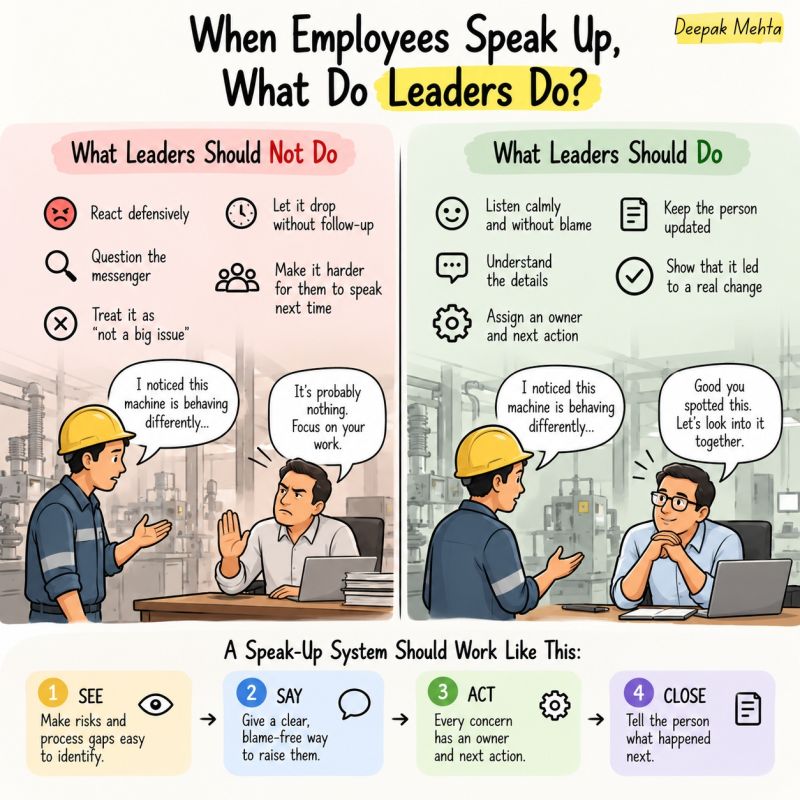
The illustration above captures this difference. In one situation, the employee is discouraged from reporting a concern. In the other, the same observation becomes an opportunity to investigate and prevent a larger problem.
Why Employees Don’t Speak Up at Work and What Leaders Must Change
In many organisations, employees are expected to follow procedures, meet targets and report deviations. Yet very little attention is given to how managers respond when someone challenges a procedure, questions a decision or reports something that may affect production.
An employee may be technically responsible for identifying a problem but emotionally discouraged from reporting it. The organisation may have an open-door policy, a suggestion box or an employee grievance system, but these mechanisms mean little if the person raising a concern is questioned more aggressively than the issue itself.
This is where psychological safety becomes an operational requirement rather than only an HR concept. Psychological safety means people believe they can raise questions, admit mistakes and report concerns without being humiliated or unfairly punished. It does not remove accountability, but it allows information to reach decision-makers before problems become more serious.
The challenge is visible in workplace research. Among more than 2,000 US employees surveyed about workplace misconduct, 22% of those who witnessed or experienced an issue did not report it. Although misconduct and operational safety are different categories, the broader reporting problem is relevant: formal channels do not guarantee that people will use them.
For manufacturing and other operational businesses, this gap can have direct consequences. A quality shortcut may continue until a customer rejects the material. A recurring maintenance issue may remain informal until a major breakdown occurs. An unsafe practice may be ignored because previous near-misses did not result in an injury.
When silence becomes part of the operating system
Employees rarely decide to stop speaking up after reading a company policy. They usually learn whether it is safe to report problems through everyday interactions with managers, supervisors and senior leaders.
Consider a production employee who notices that a checklist is being skipped to meet dispatch targets. If the supervisor reacts by questioning the employee’s attitude, the immediate message is that raising the concern creates personal difficulty. If another employee reports an issue and never receives an update, the message is that reporting produces no visible result.
Over time, these experiences shape behaviour. Employees begin handling concerns informally, avoiding disagreement or waiting until the problem becomes impossible to ignore. The organisation may interpret the absence of complaints as evidence that operations are running smoothly, when in reality it may have lost access to its most useful early-warning information.
This problem becomes sharper in promoter-led and highly centralised organisations. When managers are not encouraged to question decisions or take ownership, employees eventually stop offering suggestions. They learn to wait for instructions, follow established routines and avoid bringing information that may be unwelcome.
That is how employee silence develops into a wider culture of dependency.
The first management response decides whether the next concern will be reported
One of the most important moments in a speak-up culture is the first conversation after an employee reports something unusual. The manager’s response can either encourage further reporting or make the employee regret speaking.
Suppose an operator says that a machine has started behaving differently. A defensive manager may immediately ask why the employee did not report it earlier, suggest that the concern is exaggerated or dismiss the issue because production is still running. Even if the manager later investigates, the employee has already experienced the reporting process as uncomfortable.
A more useful response begins by understanding what has changed. The manager can ask when the employee first noticed the behaviour, whether it has happened before, what operating conditions were present and whether there is any immediate safety concern. This keeps the discussion focused on facts and possible consequences rather than personal blame.
The manager does not have to agree with every observation or accept every suggestion. However, the employee should leave the conversation knowing that the information was considered seriously and that a clear next step exists.
For genuinely dangerous situations, waiting for a routine review may not be appropriate. Organisations should define when employees are authorised to stop unsafe work, isolate equipment or call for immediate assistance under their safety procedures. Such decisions need clear instructions and proper training so that employees are not forced to choose between a production target and an immediate safety risk.
Give concerns a route that does not depend on one manager
Many organisations believe that asking employees to approach their immediate supervisor is enough. This works when the supervisor is approachable, competent and willing to escalate uncomfortable information. But the system becomes weak when that person is unavailable, dismissive or directly involved in the issue being reported.
Employees need more than one credible way to raise concerns. A machine-safety observation may belong with the shift supervisor and safety team, while a complaint involving intimidation or misconduct may require an independent HR or ethics route. Serious allegations should not be routed back to the same person whose behaviour is being questioned.
The reporting process must also suit the workforce. Factory employees may need a short form, a designated safety contact, an accessible reporting point or a multilingual channel that does not require lengthy written explanations. Office employees may find a digital system convenient, but accessibility, confidentiality and follow-up matter more than the sophistication of the technology.
Anonymous reporting can be useful where employees fear retaliation, although some concerns may require additional details for a proper investigation. Where anonymity is offered, the organisation should explain its limitations and protect the reporter’s identity as far as reasonably possible.
The objective is to make reporting straightforward, safe and reliable, not to create more paperwork.
Build a concern-to-closure process
One practical improvement is to stop treating employee reporting as a conversation that ends when the manager says, “I’ll look into it.” Every concern that warrants action should move through a visible process with appropriate urgency, an accountable owner and a clear resolution.
A simple concern-to-closure system can be designed around six operating disciplines:
- Make the concern easy to record. Capture what was observed, where it occurred, when it happened and what immediate risk may exist. Do not force the employee to diagnose the root cause before reporting; their role is to make the warning visible.
- Classify the risk before assigning priority. Separate immediate safety hazards from quality deviations, routine process gaps, employee grievances and improvement suggestions. A potentially dangerous machine condition needs a different response from a recommendation to simplify documentation.
- Assign one accountable owner. Every accepted concern should have a person responsible for evaluating it, coordinating the response and ensuring that it reaches a conclusion. Multiple departments may contribute, but accountability must not disappear between them.
- Define the next action and review date. The responsible person should record what will be checked, who must participate and when progress will be reviewed. Critical risks require immediate escalation, while routine observations can follow defined service timelines.
- Verify the corrective action. Closing the issue should involve more than confirming that someone attended to it. Management should check whether the underlying cause was addressed, whether the correction worked and whether a Standard Operating Procedure (SOP), checklist, training requirement or process control needs to change.
- Communicate the outcome to the employee. The person who raised the concern should know whether the issue was confirmed, what action was taken, whether further monitoring is required or why a particular change was not made. Confidentiality may limit what can be disclosed, but it should not prevent a meaningful status update.
These steps make the reporting system less dependent on the personality of individual managers. They also create a usable record for future analysis, particularly when similar concerns emerge across departments, shifts or locations.
A basic digital register or management information system (MIS) can support this process. Each entry should show the concern category, severity, assigned owner, reporting date, next action, due date, current status and closure evidence. The value lies in making ownership and follow-up visible, not merely in storing a larger number of complaints.
Do not confuse a blame-free environment with the absence of accountability
A common misunderstanding is that encouraging employees to speak up means management must avoid questioning mistakes or taking disciplinary action. That is not the objective. A responsible reporting culture distinguishes between an honest observation, an unintended error, a process weakness, reckless behaviour and deliberate misconduct.
For example, an employee who reports a near-miss should not be discouraged simply because the report reveals a weakness in supervision. At the same time, management must be able to investigate serious violations fairly and take proportionate action where justified. The process should protect honest reporting without ignoring responsibility.
This distinction matters because employees are unlikely to trust a system that changes its rules depending on who is involved. If concerns involving senior employees are quietly ignored while junior employees face immediate questioning, the organisation sends a clear message about whose voice carries weight.
Consistency in handling concerns is therefore as important as the reporting mechanism itself.
The closure gap is where employee trust is often lost
Many businesses focus on encouraging employees to raise more issues but pay less attention to what happens afterward. A concern is acknowledged, discussed during a meeting and passed to a department, but the employee never hears whether anything changed. The matter may remain open in practice even after management has moved on.
Over time, this creates reporting fatigue. Employees begin to believe that submitting concerns is another administrative exercise rather than a way to improve working conditions. Some stop reporting because they see no value in repeating an experience that produced little visible action.
A proper closure process should therefore have two parts: operational resolution and communication back to the reporter. A maintenance issue may be technically resolved, but the reporting cycle is incomplete until the employee receives an appropriate update. Where the fix requires longer-term monitoring, that should be explained rather than presenting the issue as permanently closed.
This is also where business process improvement becomes relevant. If several concerns point to the same underlying failure, management should correct the process rather than repeatedly resolve individual incidents. The best outcome is not simply closing the latest report; it is reducing the likelihood that the same issue will return.
Measure whether the organisation is listening, not just collecting reports
A growing number of employee reports can initially look like a worsening workplace situation. But it may also mean that employees have started trusting the reporting system enough to use it. Leadership should therefore avoid interpreting reporting volume in isolation.
A better management dashboard should examine the quality and effectiveness of the reporting process. Useful indicators include:
- time taken to acknowledge and classify a concern
- percentage of high-risk issues escalated within the required period
- percentage of reports with a named owner and agreed action
- overdue corrective actions and repeated issues
- percentage of employees receiving a closure update
- recurrence of problems after corrective action
- employee confidence in reporting without retaliation
These indicators help management understand whether information is moving, actions are being completed and lessons are being retained. They should be assessed alongside incidents, near-misses, inspections and employee feedback, because a low number of reports does not automatically mean a low-risk workplace.
Organisations should also review whether employees across shifts, functions, employment categories and locations have equal access to reporting. A system used mainly by office staff but rarely by contract workers or shop-floor operators may be missing important operational information.
That is why report quality, response quality and employee confidence matter more than celebrating a reduction in complaint numbers.
The leadership behaviour that makes the system credible
Even a well-designed reporting process can fail if senior leaders repeatedly bypass it. If a promoter or department head reacts defensively to bad news, reverses corrective decisions informally or discourages employees from questioning instructions, people learn that the formal policy does not reflect the real culture.
Leaders must therefore make room for disagreement and uncomfortable information. This includes allowing managers to investigate concerns without unnecessary interference, supporting corrective actions that may temporarily affect output, and reviewing whether employees are being treated fairly after reporting issues.
A genuine organisational change requires employees to see consistency between leadership messages and daily decisions. When quality, safety and transparency are described as priorities, those priorities must remain visible even during production pressure, customer deadlines and difficult commercial situations.
The most credible signal is not a new reporting policy. It is a management decision that demonstrates the organisation is prepared to act on an early warning, even when acting is inconvenient.
The real value of early warnings
Consider the earlier example of an employee noticing unusual machine behaviour. If the organisation has a dependable reporting system, that observation can be checked promptly, assigned to the appropriate technical team and evaluated before the problem becomes a major breakdown. The company may discover a maintenance issue, a process deviation, a training gap or an operating condition that requires correction.
In a weaker organisation, the same employee may remain silent, leaving management to discover the problem only after production is affected. The technical issue may be identical in both cases, but the organisational response changes the opportunity to prevent escalation.
The same principle applies beyond manufacturing. In a service business, an employee may notice repeated customer complaints before retention falls. In finance, someone may identify a reconciliation gap before reporting becomes unreliable. In logistics, a driver may recognise a recurring safety risk before an incident occurs.
The difference is whether the organisation can convert those observations into timely management action.
This requires leadership accountability in everyday execution, supported by clearly assigned ownership, dependable follow-up and a reporting process employees can trust. When leaders consistently respond to concerns, employees have stronger reasons to raise problems early rather than waiting for them to become unavoidable.
An effective speak-up culture should ultimately make the organisation more aware of its risks, not merely more comfortable discussing them. It should help management identify weak processes earlier, correct recurring failures and make better decisions using information that would otherwise remain hidden.
The real test is not whether employees have been told they can speak up. It is whether they have seen what happens when someone actually does.
When concerns are heard, investigated and brought to a proper conclusion, speaking up becomes part of normal working discipline. When employees are blamed, ignored or left without an update, silence becomes part of that discipline instead.
That is why employee trust is built after the concern is raised. The response determines whether the next warning reaches management early enough to matter.