Wearable technology is beginning to change how organisations manage employee safety. What started largely as personal fitness tracking is now entering factories, mining operations, transport fleets, warehouses and other workplaces where fatigue, physical strain and reduced alertness can have serious consequences.
Some employers are already exploring smart wristbands, fatigue-detection cameras and sensor-based monitoring systems that can identify possible safety risks before an incident occurs. These technologies can provide signals about alertness, movement, physiological changes or potential fatigue, allowing supervisors to consider timely interventions rather than waiting for an accident or operational failure.
The opportunity is significant, particularly in industries where long working hours, night shifts and physically demanding tasks are common. Yet the same technology introduces a management challenge that cannot be addressed through software alone. When employers begin monitoring employee wellness, where should workplace safety end and personal privacy begin?
The answer depends less on how much information the technology can collect and more on how responsibly the organisation decides to use it.
Wearable technology is moving onto the shop floor
Workplace wearables are no longer limited to smartwatches that count steps or track exercise. Industrial safety systems increasingly use sensors, cameras and connected devices to identify conditions that may increase workplace risk. Depending on the technology, these systems can monitor movement, estimate physical exertion, detect signs associated with fatigue or issue alerts when a worker may require attention.
A logistics operator, for instance, may use an in-cab camera to identify prolonged eye closure or other warning signs of reduced driver alertness. A mining operation may evaluate wearable devices that monitor physiological signals during demanding shifts. A factory may explore sensors that detect unusual physical strain among employees working in high-risk environments.
These are different technologies with different levels of accuracy and intrusiveness, but their management purpose is broadly similar: identify potential risks early enough for a safer decision to be made.
Fatigue makes this particularly relevant. It can slow reaction time, reduce concentration, affect short-term memory and impair judgement. Long working hours, night shifts, high temperatures, demanding tasks and insufficient recovery can all contribute to fatigue-related workplace risks.
There is evidence of why prevention matters. Occupational safety research has associated sleep-related problems with an estimated 13% of workplace injuries, while demanding combinations of long shifts, night work and insufficient breaks have been associated with substantially higher injury risk. These findings support a broader fatigue-management approach rather than relying on technology as the only preventive measure.
For an employer managing machinery, heavy equipment, vehicle movements or continuous operations, earlier identification of fatigue risk could support better decisions about rest, shift allocation and task suitability. However, a wearable reading is an estimate or warning signal, not an automatic medical diagnosis. Its accuracy depends on the device, operating conditions, individual differences and the evidence supporting its use.
That distinction becomes important as organisations move from collecting safety signals to acting on them.
Employee Wellness Monitoring: Where Safety Meets Privacy
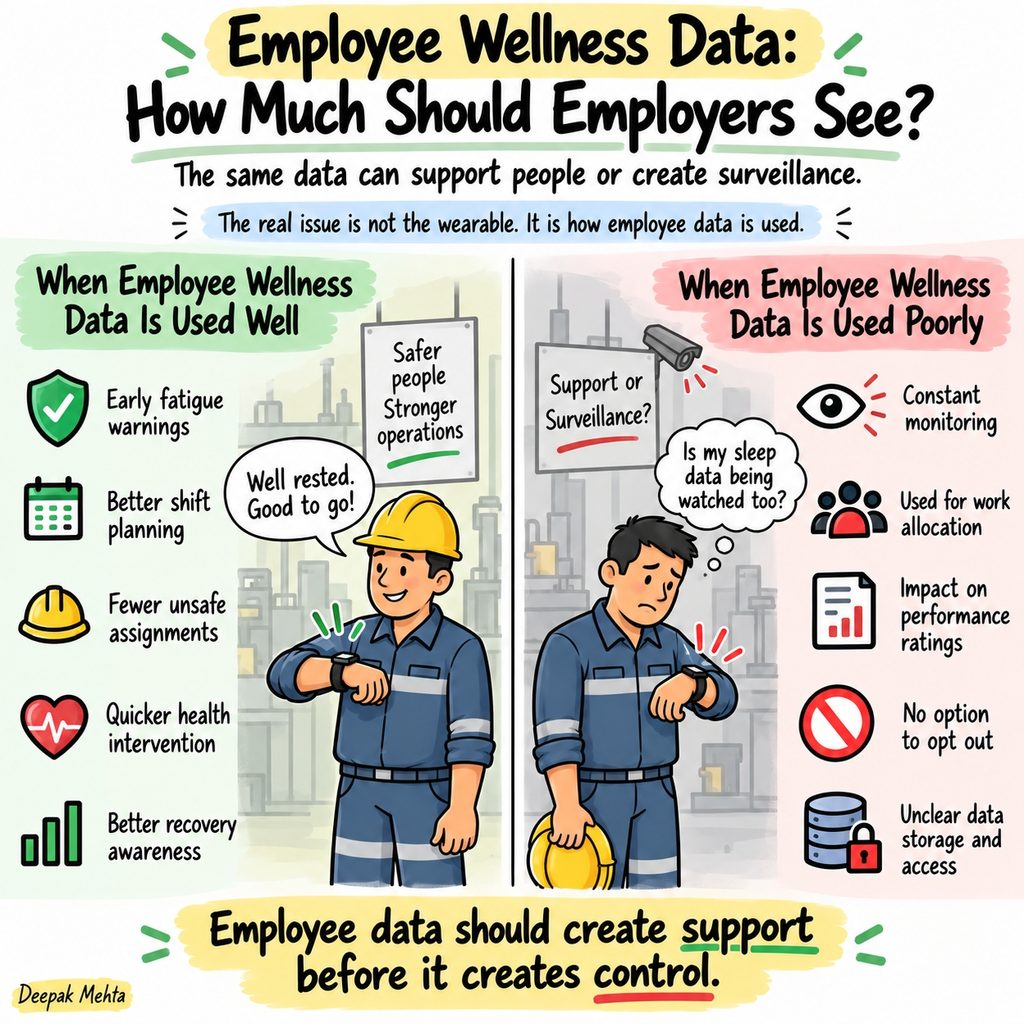
Consider an employee working a night shift in a manufacturing facility. A wearable device indicates a possible fatigue risk after several hours of physically demanding work. The system sends an alert, and the supervisor arranges a break or a safety assessment before assigning the employee to another high-risk task.
Used responsibly, this information can help protect the employee and the people working around them. The organisation has converted an early warning into a preventive action. The employee receives support, and the business addresses a potential safety risk before it becomes an incident.
Now consider a different situation involving the same technology. The supervisor can access the employee’s detailed sleep history, compare individual wellness scores across workers and use those readings during performance reviews. The system may even allow personal health information to influence promotion decisions, shift preferences or disciplinary discussions.
The technology has not necessarily changed, but its organisational purpose has.
The first application is focused on preventing an immediate safety risk. The second creates the possibility of continuous employee surveillance, unfair interpretation and decisions based on sensitive information that may have little relevance to actual work performance.
This is the distinction management must understand before introducing employee wearables at work.
The real question is not what the device can measure. It is what decision the employer genuinely needs that measurement to support.
Why employee acceptance can decide whether the system works
Introducing a wearable device does not automatically mean employees will trust it or use it consistently. In one published survey involving 1,273 employed adults, workplace safety applications received the highest acceptance among the wearable use cases studied. Acceptance was also associated with employees understanding how their data would be used and being involved in decisions about the technology.
That finding has practical implications for management. A worker may be comfortable with a device that provides a warning about fatigue but uncomfortable with a device that exposes personal health patterns to supervisors. Employees may also question whether information collected for safety today could later influence their appraisal, employment opportunities or reputation.
These concerns should not be dismissed as resistance to technology. They are questions about how management intends to use information that employees may consider deeply personal. If an organisation cannot answer those questions clearly, a programme introduced as an employee welfare initiative may create suspicion instead of confidence.
Trust therefore needs to be designed into the system from the beginning. It cannot be added later through a communication campaign after employees discover that more information is being collected than they expected.
The information a supervisor needs may be much smaller than the information a wearable collects
This is where the design of employee wellness monitoring requires careful judgement. A wearable may collect several data points to generate an estimated fatigue-risk alert. But the supervisor responsible for workplace safety may not need access to every underlying reading.
For example, a supervisor deciding whether someone should operate hazardous machinery may need a limited alert indicating that a safety assessment is required. The supervisor may not need the person’s detailed sleep history, heart-rate trends or other personal information.
An organisation can therefore establish different levels of information access.
- The employee can receive personal feedback relevant to their own wellbeing.
- A trained safety professional can receive the information necessary to assess an alert.
- The operational supervisor can receive an action-oriented recommendation, while senior management can review aggregated safety trends without automatically identifying individual employees.
More sensitive information, where genuinely necessary, should be handled by appropriately authorised occupational health professionals rather than being openly accessible through operational dashboards.
This approach changes the purpose of data collection. Instead of building a system around everything the technology can measure, the organisation builds one around the minimum information needed for a legitimate safety decision.
It also reduces the risk of collecting information that management does not need, cannot interpret correctly or may later use for an unrelated purpose.
Build the governance before buying the wearable
Before rolling out employee wellness monitoring, employers need more than a technology demonstration and a vendor proposal. They need a clear operating framework that connects the safety objective, the information collected, the decision being supported and the accountability for acting on that information.
A practical implementation approach should address the following:
- Define the safety problem first: identify the specific risk the technology is expected to address, such as fatigue among night-shift vehicle operators or excessive physical strain during hazardous tasks. Establish whether improved scheduling, mandatory breaks, workload redesign or other less intrusive measures could address the same risk.
- Decide what information is necessary: separate operational safety alerts from detailed personal health information. Collect only data that is justified by the stated purpose, and avoid continuous monitoring outside working hours unless a specific, lawful and proportionate need has been established.
- Create a clear access and usage policy: define who can view raw readings, who receives safety alerts and whether the information can enter HR or performance-management systems. Prohibit unrelated uses unless they have been separately justified, transparently communicated and lawfully authorised.
- Define the intervention procedure: an alert should lead to a proportionate response such as checking on the employee, assessing fitness for a particular task, offering rest or temporarily changing an assignment. Human judgement and an appropriate review process must remain part of decisions that affect employees.
- Protect the data throughout its lifecycle: establish retention periods, access logs, security controls, deletion procedures and vendor responsibilities. Employees should know what information is retained, whether a technology provider processes it and how concerns or inaccurate readings can be challenged.
- Pilot, measure and improve before scaling: begin with a limited, justified use case and meaningful employee involvement. Review device reliability, false alerts, employee experience, actual safety outcomes and whether the programme is creating any unintended stress or unfair treatment.
These are not merely HR policy matters. They involve operational management, occupational safety, information security, legal compliance, employee relations and leadership accountability.
A successful system needs those functions to agree on the rules before individual employee data begins moving between them.
What should happen when a fatigue alert is triggered?
One important part of implementation is deciding how the organisation should respond to an alert in real time. If the procedure is unclear, different supervisors may react differently to the same information. One may offer a rest break, another may immediately remove the employee from duty, while a third may treat the reading as evidence of poor performance.
A more disciplined approach separates the warning from the final decision. The system identifies a possible risk, an authorised person verifies the situation, and an appropriate safety action follows. The response should consider the nature of the task, the reliability of the alert and the employee’s circumstances without assuming that a sensor reading tells the whole story.
False positives and missed warnings also require attention. A system that frequently misclassifies employees can reduce confidence, while a system that fails to detect genuine risk may create false reassurance. Organisations should therefore test the technology under actual operating conditions rather than assuming that vendor demonstrations represent everyday workplace performance.
The purpose of the alert should be to trigger a responsible safety response, not to deliver an automatic judgement about the employee.
Employee health data needs stronger boundaries than ordinary operational data
A company may routinely collect production data, machine utilisation figures, attendance information and quality reports. Employee wellness data is different because it can reveal sensitive information about an identifiable person’s health, behaviour or private life. It therefore requires a higher level of care than an ordinary production or efficiency dashboard.
Privacy obligations also depend on where the organisation operates. In the United Kingdom and European data-protection framework, information concerning employee health generally receives special protection, and employers must establish an appropriate lawful basis and applicable safeguards for processing it. Employee consent cannot automatically be considered freely given simply because the employee has signed a form.
In India, the Digital Personal Data Protection Act, 2023 and the Digital Personal Data Protection Rules, 2025 are being introduced through a phased implementation schedule, with important substantive obligations scheduled to commence in May 2027. Employers should prepare their data-governance practices in advance and also consider applicable employment, occupational safety and other legal requirements.
Regardless of jurisdiction, collecting sensitive information requires clear answers about purpose, necessity, access, security, retention and accountability. A technology provider’s ability to capture information does not, by itself, justify an employer collecting or using it.
Organisations should be especially cautious about combining wellness information with employee rankings, appraisals, productivity scores or automated employment decisions. A programme that begins as a safety initiative can become intrusive if its original purpose is gradually expanded without proper scrutiny.
The final measure is safer work, not more employee data
An organisation introducing wearables should not judge success by the number of devices distributed or the volume of data collected. Those figures indicate technology adoption, but they do not prove that the workplace has become safer. The real evaluation should focus on whether the system helps identify risks earlier and improves the organisation’s response.
Relevant measures may include the time taken to respond to safety alerts, recurring fatigue-risk patterns, corrective action on high-risk shift schedules and employee confidence in the programme. These can be reviewed alongside incident and near-miss information, while recognising that changes in recorded incidents may also reflect changes in reporting behaviour.
Just as importantly, management should examine whether the technology is addressing the conditions creating fatigue. If employees continue working excessive hours, receiving inadequate breaks or facing unrealistic operational demands, monitoring their fatigue does not remove its underlying causes. The system may simply become better at observing a problem the organisation has failed to correct.
This is why employee wellness monitoring should remain one part of a broader occupational safety approach. Work design, shift planning, supervision, rest, training and employee participation remain essential even when technology provides additional information.
The direction of workplace technology is becoming clearer. More information can be collected, analysed and converted into management signals than was practical in the past, and safety-critical industries have understandable reasons to explore these capabilities. But greater visibility also creates greater responsibility over what organisations choose to know about their employees.
The more mature approach is not to reject wearable technology or to collect everything it can provide. It is to design a system in which employees understand the purpose, management sees only what it needs, and every intervention has a clear safety justification.
That is where responsible workforce technology governance becomes part of good management. It ensures that the organisation’s use of technology is supported by clear rules, appropriate authority and a disciplined approach to employee trust.
A workplace does not become safer simply because it knows more about its people. It becomes safer when the information it collects leads to better working conditions, earlier intervention and decisions employees can reasonably trust.
The strongest test of employee wellness technology is therefore not how closely an employer can monitor its workforce. It is how effectively the employer can protect its workforce without collecting more personal information than necessary.