Growth can make a business bigger and still make it slower.
That is one of the most uncomfortable realities for many promoters and CEOs. Revenue increases, more people join, departments become larger, reporting lines get created, managers are appointed, and meetings become more frequent. On paper, the company looks more organised. Inside the business, however, decisions may start taking longer than before.
This is the real issue behind organisational complexity.
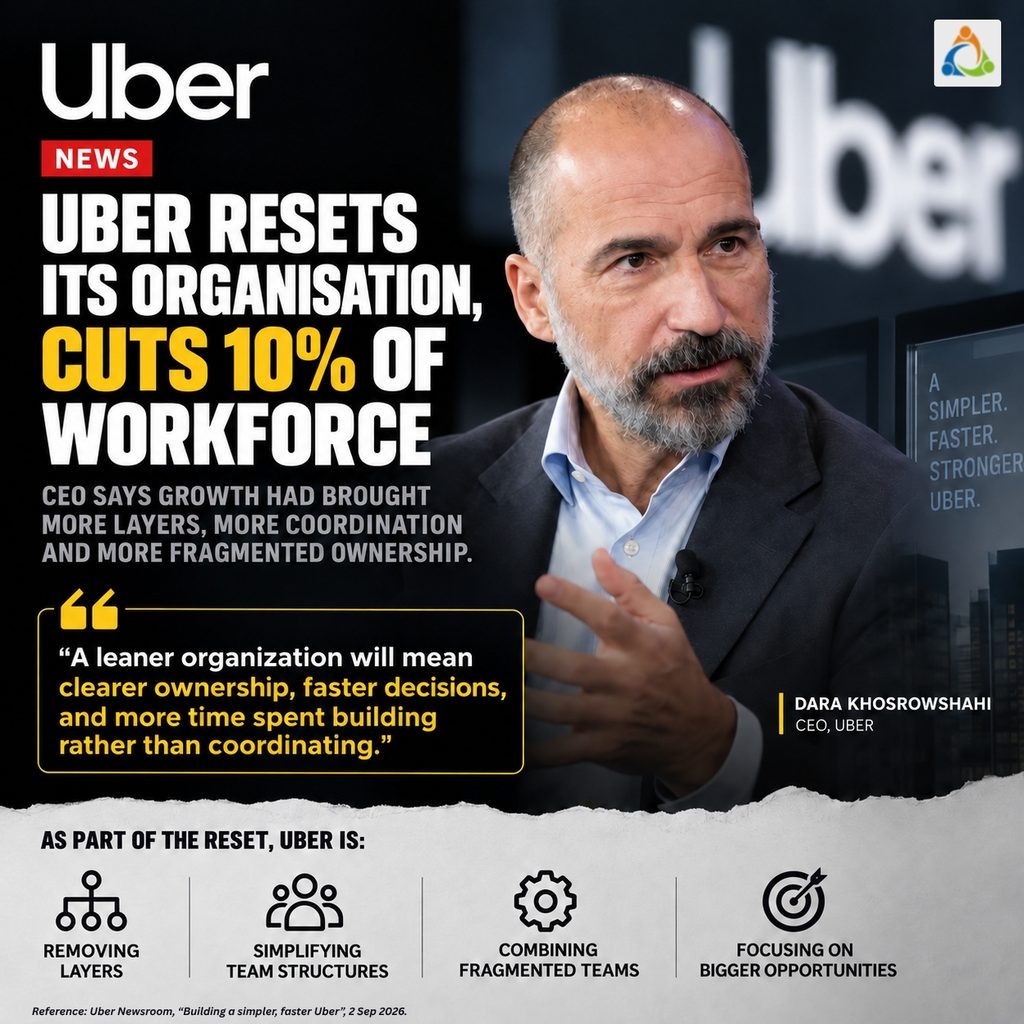
A recent example came from Uber’s organisational reset. The company announced that it was reducing the size of its team by about 10%, while also removing layers, simplifying team structures, and focusing people and investments on bigger future opportunities. The reason was not weak business performance. The company said that over the last 5+ years, its top line had nearly tripled, but growth had also created more layers, more coordination and more fragmented ownership.
That is a useful lesson for growing businesses. Complexity does not always come because people are careless. Many times, complexity comes because the organisation keeps adding people and departments without redesigning how decisions, ownership and work should move.
When Growth Starts Creating Friction
Every growing company reaches a point where the old way of working becomes too small for the new size of the business.
In the early stage, the founder or promoter can remain close to everything. A quick phone call can solve a delay. A personal instruction can close a decision. A small group can coordinate across sales, operations, purchase, finance and customer delivery. The system may not be perfect, but the organisation still moves because people are close to each other and the promoter is close to the work.
As the company grows, that closeness reduces.
More managers are added. More departments are created. More approvals are introduced. More specialist teams are built. More review meetings are scheduled. Each of these may be useful individually, but together they can create a hidden cost.
The problem starts when every layer adds coordination, but not enough judgement.
A company may add a manager to improve control, but that manager becomes only another approval point. A department may be created to improve focus, but it also creates one more handoff. A meeting may be created for alignment, but it slowly replaces ownership. A new approval may be added to reduce risk, but it starts delaying routine decisions.
This is how organisational complexity enters quietly.
No one designs it intentionally. It builds up through small additions that once looked reasonable. The result is visible on the ground. Routine decisions cross too many levels. Teams spend more time aligning than executing. Managers wait for confirmation from the top. Customers experience delays because internal ownership is unclear. People become busy, but outcomes move slowly.
That is not scale. That is friction.
Uber’s own reset note pointed to similar symptoms at a larger scale: too much coordination across teams, long debates, unclear decision-making rights, and time spent aligning instead of building, shipping or serving customers. The company said it reduced employees sitting seven or more layers below the CEO by 20% and reduced micro-teams with only one or two reports by nearly 50%.
For SMEs and promoter-led businesses, the numbers may be smaller, but the pattern is often the same.
The company grows, but the distance between action and decision also grows. That distance is what the promoter must study.
The first question is not, “Do we have too many people?” The better question is, “How far does one decision have to travel before work can move?”
A business may have ten managers and still work smoothly if every manager adds clarity, judgement and accountability. Another business may have only three layers and still feel slow if each layer only passes the decision upward. So reducing organisational complexity does not mean removing people blindly. It means removing friction from the way work moves. A useful complexity check can begin with 5 questions.
1. How many levels does a routine decision cross?
Every company has decisions that should not need senior leadership involvement. Examples include standard purchase approvals within limits, routine customer responses, normal discount requests, dispatch coordination, minor production priority changes, basic hiring approvals, vendor follow-ups or standard complaint resolution.
If these routine decisions still travel to the promoter or CEO, the business is carrying avoidable delay.
The practical correction is to create decision rights. Decision rights simply mean defining who can decide what, up to what limit, under what condition, and when escalation is required. This removes permission-seeking from daily work.
2. Who owns the outcome end-to-end?
Many growing companies divide work into departments, but forget to assign outcome ownership.
Sales books the order. Planning prepares the schedule. Purchase handles material. Production works on execution. Quality checks the output. Dispatch sends it. Finance tracks collection. But when the customer asks, “Who owns my final delivery?” the answer becomes unclear.
This is where fragmentation hurts scale.
Department ownership is not enough. The business also needs outcome ownership.
One person or one accountable team must own the final result. Not only the task. Not only the update. The outcome.
For example, “delivery completed as committed” is an outcome. “Customer issue closed” is an outcome. “New product launch executed” is an outcome. “Branch made profitable” is an outcome.
When no one owns the outcome end-to-end, the promoter becomes the default owner. That is how dependency returns to the top.
3. Which meetings exist because ownership is unclear?
Meetings are not the problem. Unclear meetings are.
Some meetings exist because the business genuinely needs review, decision-making and coordination. But many meetings exist because ownership has not been defined properly. People gather to ask for updates that should already be visible. They discuss issues that should already have an owner. They escalate decisions that should have been taken closer to the work.
A company should review every recurring meeting and ask:
- what decision does this meeting enable?
- what exception does it resolve?
- what ownership does it strengthen?
- what would stop if this meeting disappeared?
If the meeting does not improve decisions, capability or accountability, it may only be covering a structural gap.
A good review rhythm should not multiply meetings. It should reduce unnecessary follow-up.
4. Which approvals exist only because they have always existed?
Approvals are often created during a problem phase.
One wrong discount, one bad purchase, one delayed payment or one poor hiring decision creates a new approval layer. That may be necessary at the time. But if the approval remains forever without review, it becomes friction.
A mature business should separate approvals into three categories:
- approvals that protect risk
- approvals that improve judgement
- approvals that only slow routine work
The third category should be removed or pushed down.
Control does not mean everything must come upward. Control means the right decision should happen at the right level with the right limits, data and accountability.
5. Does every management layer add value?
A management layer should do at least one of 3 things.
- It should improve judgement.
- It should build capability.
- It should create accountability.
If a layer does none of these, it becomes a pass-through layer. Information moves up, instructions move down, and the organisation loses speed.
This is where many companies mistake designation for structure. A person may have a manager title, but if he is not coaching people, solving problems, taking decisions, improving process or owning outcomes, then the layer is not strengthening the company. It is increasing distance. That does not mean middle management is unnecessary. In fact, good middle management is essential for scale. But the role of a manager must be clear.
A manager should not only collect updates for the promoter.
A manager should convert direction into execution, build people, make decisions within boundaries, remove blockers and own results.
Once these questions expose friction, the solution is not simply cost-cutting.
The solution is organisation redesign. And organisation redesign must be done carefully because structure is not only an org chart. It is the route through which decisions, information, authority, ownership and accountability move.
A practical redesign can start with 4 shifts:
1) Decision rights should move closer to the work:
The person closest to the work often has the best context for routine decisions. But he may not decide because authority is unclear or because the culture punishes mistakes. The organisation must define decision limits clearly and then support people in using them.
This builds speed without removing control.
2) Ownership should be built around outcomes, not only functions:
Functions are necessary, but outcomes cross functions. A customer delivery does not care whether the delay was in sales, purchase, production or dispatch. The business must therefore create owners for outcomes that cut across departments.
This reduces handoffs and blame.
3) Management layers should be reviewed for value, not status:
A layer should exist only if it adds judgement, coaching, control or accountability. If a layer is only forwarding information, it should be redesigned. Some roles may need broader scope. Some teams may need merging. Some managers may need to become stronger individual contributors. Some decision points may need to move downward.
The objective is not to make the company smaller. The objective is to make work move better.
4) Review rhythm should focus on exceptions and decisions:
A growing company does not need more meetings. It needs better meetings.
Routine work should be visible through dashboards, reports or operating systems. Meetings should focus on exceptions, stuck decisions, cross-functional issues, capability gaps and matters needing leadership judgement.
When review rhythm becomes disciplined, the organisation spends less time coordinating and more time executing.
This is where the lesson from Uber becomes relevant beyond the technology sector. The company’s reset was described around making the organisation simpler and faster, with clearer ownership and faster decisions. Reports also placed the impact at around 3,300 jobs, or about 10% of staff, as part of the restructuring.
But for a growing SME, the lesson is not to copy the cut. The lesson is to understand the cause.
When growth creates too many layers, too much coordination and too much fragmented ownership, leadership has to redesign the way the company works.
If this is ignored, complexity starts compounding.
The promoter remains pulled into too many decisions. Good managers become coordinators instead of leaders. Departments protect their own work instead of owning the customer outcome. Meetings increase because the structure does not create natural accountability. Approvals remain because trust and boundaries are not built. Eventually, growth starts feeling heavier than it should.
This is why scale should not be measured only by headcount, branches, departments or turnover.
Scale should also be measured by decision speed, clarity of ownership, reduced dependency on the top, and the ability of the organisation to execute without constant coordination.
A company has truly scaled when capability grows faster than dependency. That is the real test.
- If the business is growing but decisions are slowing, the issue may not be lack of effort. It may be that the structure has not been redesigned for the size the company has reached.
- If meetings are multiplying, the issue may not be communication. It may be unclear ownership.
- If approvals are increasing, the issue may not be control. It may be weak decision rights.
- If every important matter still comes back to the promoter, the issue may not be loyalty. It may be dependency built into the operating model.
A simpler organisation is not a weaker organisation. It is often a stronger one because people know what they own, where they can decide, when they should escalate and how work should move.
That is the direction growing businesses need. Not less ambition. Not less growth. Not blind headcount reduction. But a cleaner structure where decisions are closer to the work, ownership is clearer, layers add real value, and review meetings help the business move instead of only discuss.
Real scale is not when the organisation becomes bigger. Real scale is when the organisation becomes easier to move.
And that is where implementation-led organisation redesign becomes important: growth should not leave the promoter with a larger company and the same old dependency. It should build a business where capability, accountability and decision confidence grow with size.