
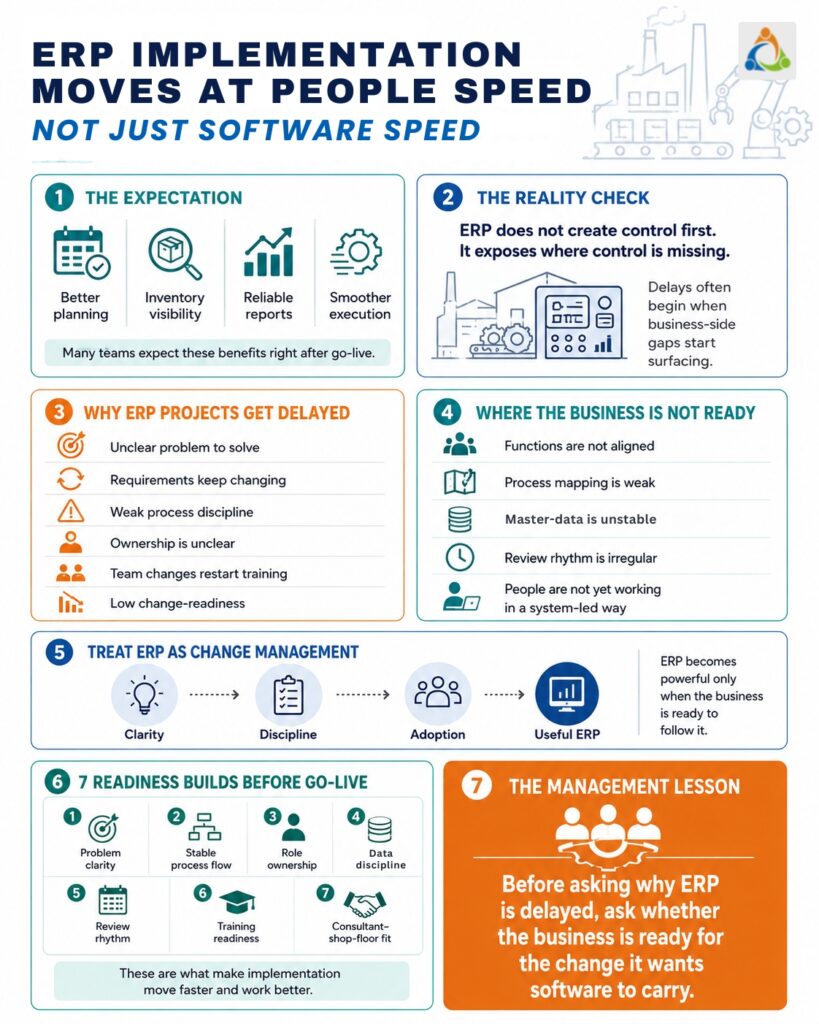
Many management teams enter an ERP project with a simple expectation: once the system goes live, planning will improve, inventory will become visible, reports will become reliable, and execution will become smoother.
That expectation is understandable. ERP is supposed to bring structure, visibility and control. Even ERP providers describe it as a system that helps organisations streamline core business processes and create a unified source of truth across functions such as finance, procurement, manufacturing, supply chain and sales. But the real challenge begins when management assumes that buying ERP is the same as becoming system-driven.
It is not.
A national study based on a primary survey of 2,882 MSMEs found that digital adoption is associated with higher productivity and growth, and that a 10% increase in digitalisation leads to a 1.6% increase in enterprise growth. The same study also found that a quarter of MSMEs have not adopted intermediate and advanced digital technologies because they do not have the required skill or human resources to operate them. That is exactly where ERP implementation delays begin. The software may be ready to move. The business may not be.
ERP implementation moves at people speed, not software speed
In one textile machine manufacturing case, management believed the ERP implementation would be completed in 3 to 4 months. The expectation was that once the system was purchased and implemented, planning would improve, inventory visibility would increase, reports would become more dependable and execution would become smoother.
That expectation did not survive contact with reality.
As implementation pressure increased, delays began surfacing from the business side. Coordination gaps became visible. New issues kept emerging. Requirements were not as stable as management thought. Process discipline was not as strong as people assumed. Training had to restart when team members changed. Ownership across functions was not fully clear. The software project slowed down, not because the software stopped, but because the organisation had not aligned itself fast enough.
This is the first reality check every SME should understand: ERP does not create control first. It exposes where control is missing.
That is why ERP delay is often misdiagnosed. Many management teams think the issue is the consultant, the software or the implementation partner. Sometimes that is true. But in many cases, the real delay begins inside the business:
- It begins when management is not fully clear about the problem ERP is supposed to solve.
- It deepens when departments describe processes differently.
- It becomes costlier when the project starts but the business is still changing its expectations.
- And it becomes frustrating when leadership expects speed from the system without building readiness in people, data, review rhythm and functional ownership.
This is why ERP should be treated less like a software-installation exercise and more like a business change programme.
To understand that better, it helps to look at where delays usually come from:
- First, the problem statement is weak: many ERP projects start with broad ambition rather than operational clarity. Management wants better control, better reports, better planning, better visibility. But “better” is not a process definition. Unless the company is clear about what exact business problem the ERP must solve, the project keeps drifting. The software team can configure screens and workflows, but it cannot define business clarity on behalf of management.
- Second, process flow is not stable enough: consultants can map the system only after the business has mapped its own working method. If departments are still operating with exceptions, undocumented steps and informal workarounds, the ERP project keeps absorbing confusion. One team explains the formal process. Another explains the actual practice. The result is slow alignment and repeated rework.
- Third, ownership across functions is unclear: ERP forces cross-functional discipline. Sales affects planning. Planning affects procurement. Procurement affects inventory. Inventory affects production. Production affects dispatch. Dispatch affects customer service and finance. If role ownership is unclear between functions, the project becomes a chain of unresolved dependencies. The software is not the bottleneck. The operating structure is.
- Fourth, master data is weak: no ERP works well when item codes, bills of materials, customer masters, vendor masters, approval rules or transaction discipline are unstable. Businesses often underestimate how much effort is required to clean, verify and maintain master data. Yet data quality is one of the biggest reasons why the system feels unreliable after go-live.
- Fifth, review rhythm is irregular: ERP implementation needs decision-making rhythm. If review meetings are irregular, if issues are escalated late, or if management attention keeps shifting, the project loses momentum. Many businesses assume ERP delay means technical complexity, when often it simply means the internal governance rhythm is weak.
- Sixth, people are not yet working in a system-led way: this is one of the most overlooked issues. ERP implementation demands behavioural change. People have to update transactions correctly, follow defined steps, close gaps quickly and trust the discipline of the system. If the culture still runs on memory, exception handling, verbal follow-up and individual dependency, ERP progress becomes slow and uneven.
That is why the solution to ERP delay is not only better software management. It is better business readiness.
A practical way to think about this is to separate ERP preparation into 8 readiness builds:
1. Problem clarity:
Before implementation begins, management should define the operational problem clearly. Is the issue planning? Inventory mismatch? unreliable reports? approval delays? weak visibility across departments? duplicated work? poor production coordination? If the problem definition is vague, the solution path will remain vague too.
2. Stable process flow:
The business should document how work must move across departments before expecting the system to support that flow. ERP becomes smoother when the process is already understood, agreed and stabilised at the business level.
3. Role ownership:
Each function should know what it owns, where its responsibility ends, when escalation is required, and who closes the issue. ERP works faster when ownership is settled before workflow is configured.
4. Master data discipline:
Businesses often want fast implementation but do not prepare clean data. That is a mistake. A reliable ERP needs disciplined data creation, validation and maintenance. Bad master data creates bad reports, and bad reports destroy confidence in the system.
5. Review rhythm:
ERP projects need a regular management cadence. Weekly review, issue tracking, decision closure and escalation rhythm should be established early. A project without review rhythm slowly becomes a project without direction.
6. Training readiness:
Training is not a one-time event. It must account for practical usage, department-wise adoption and team changes. When people leave and new people join, training restarts. Businesses that plan for this adopt faster than those that treat training as a pre-go-live formality.
7. Consultant–shop-floor fit:
Implementation becomes weak when consultants understand the software but not the business reality. The organisation must ensure that process discussions reflect how work actually happens on the shop floor, not just how senior management imagines it happens.
8. Change-management discipline:
This may be the most important of all. ERP should be treated as a change-management process. It changes how work is captured, reviewed, approved, escalated and completed. If the business is not prepared for that behavioural shift, delay is almost guaranteed.
This is the management lesson behind many ERP implementation delays. The software is usually expected to move fast because software logic is structured. The business moves slowly because people need time to align, habits need to change, data needs to be corrected, processes need to be stabilised and management needs to become clearer through the journey.
So when an ERP implementation stretches from four months to nine, the smarter question is not: “Why is the ERP slow?”
The smarter question is: “Which part of the business is still not ready for the discipline the ERP requires?”
That question changes the full conversation.
- It shifts the issue from blame to readiness.
- It shifts the focus from software pressure to business preparation.
- And it helps the company realise that a successful ERP project is not defined only by go-live. It is defined by whether the business becomes disciplined enough to make the system useful after go-live.
That is the real difference between installing ERP and benefiting from ERP.
A business may purchase software in one decision. But real system-led business transformation begins only when problem clarity, process discipline, role ownership, master-data accuracy, review rhythm, training readiness and business-side alignment are built strongly enough to support that software.
That is why ERP implementation does not move only at software speed.
It moves at people speed.
And that is exactly why businesses that prepare the people side, the process side and the management side first usually implement faster, adopt better and get more value from the system.