
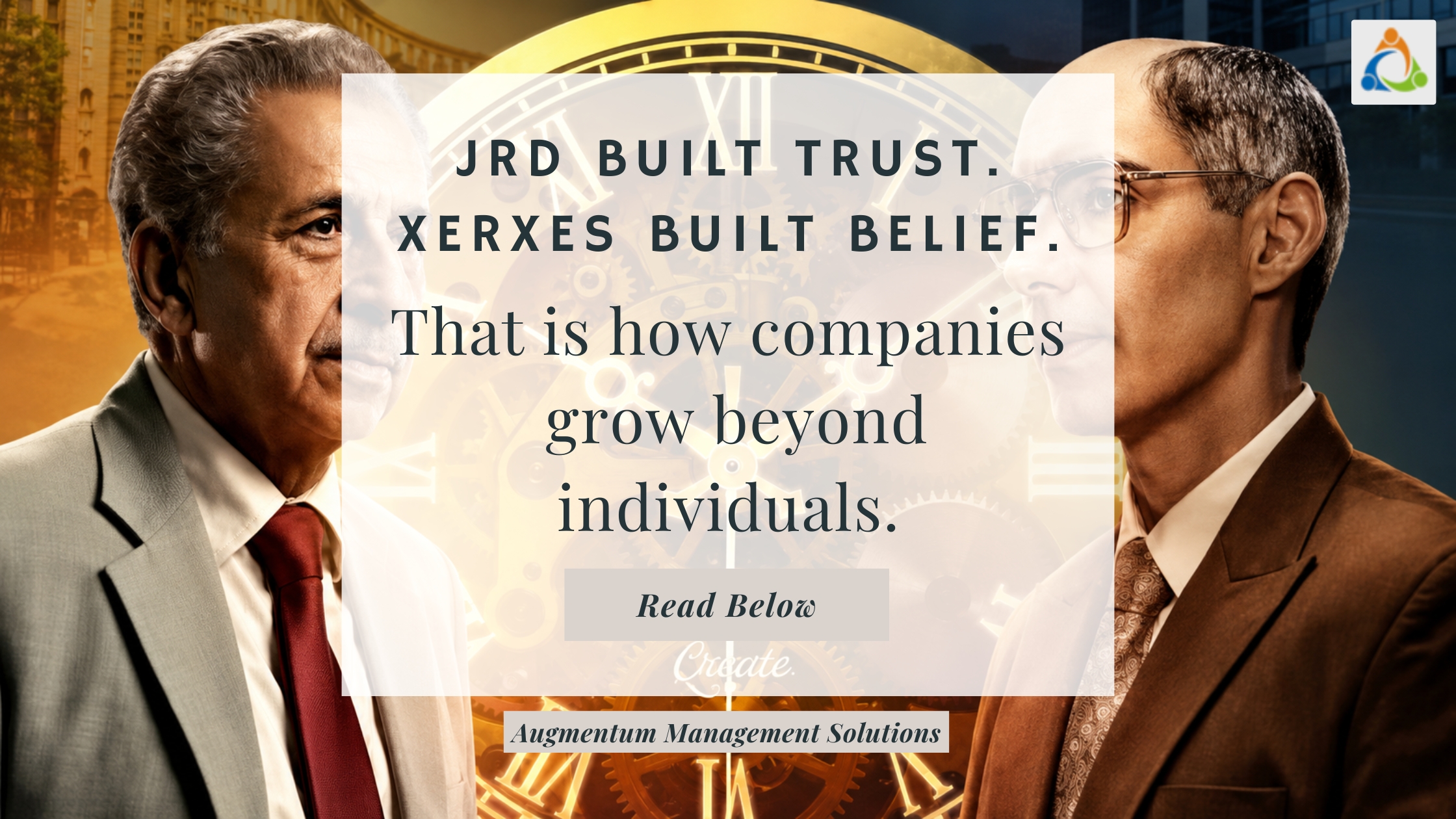
A good leadership story is rarely only about the founder.
That is what makes Made in India: A Titan Story useful beyond entertainment. The series is built around the early Titan journey, with J.R.D. Tata, Xerxes Desai, and the people around them, and it dramatizes something many businesses still misunderstand: institutions are not built only by big ideas. They are built when trust from the top, conviction in the middle, and dependability in the working layer come together strongly enough to carry the idea through difficult years. Titan’s own corporate history shows J.R.D. Tata and Xerxes Desai at the heart of the company’s early watch-factory era, and the currently streaming series centers that same founding phase.
That is why this is not only a Titan story. It is a leadership culture story.
Many owners want loyal teams, scalable companies, and strong culture. But those things do not appear because people are talented or because the founder is visionary. They appear when leaders repeatedly create trust, dignity, shared ownership, and leadership depth beyond themselves. Research on organizational culture keeps pointing to the same pattern: high-trust cultures are associated with stronger performance, lower stress, lower burnout, and higher retention than low-trust environments.

What turns a successful company into an institution
The Titan story is a useful opening because it highlights three layers that matter in almost every durable company.
- The first is trust from the top.
- The second is conviction in the middle.
- The third is dependability in the layer that carries the work every day.
Most businesses say they value all 3. Far fewer actually build them. That gap is where culture starts becoming either real or performative. A lot of companies think culture is built through speeches, value statements, internal campaigns, or one-off founder interventions. But culture is rarely formed by what leaders say in stable moments. It is formed by what leaders repeatedly normalize when the situation becomes difficult, uncertain, or personally uncomfortable.
That is why the strongest signal in a leadership culture is not inspiration. It is repeated behavior.
The Titan example helps because the leadership arc is not centered only on vision. It is also centered on how trust gets transferred. Titan’s own history shows J.R.D. Tata’s visible role in the company’s early years, including the launch of the Hosur factory and the Mumbai showroom, both alongside Xerxes Desai. That matters because institutions do not grow only when founders are central; they also grow when founders make room for others to become central in the right moments.
That is a lesson many promoters still resist.
Some leaders want capable people below them, but not enough room for those people to become larger than their role descriptions. They want accountability without too much autonomy. Visibility without too much influence. Loyalty without too much independent judgment. That creates companies that may remain successful for a while, but it rarely creates institutions. An institution becomes possible only when leaders do three things consistently.
First, they transfer trust rather than collecting all importance at the center:
This is one of the clearest differences between a controlling business and an enduring one.
Leaders who only collect credit, control, and final judgment may still build strong companies. But leaders who transfer trust build stronger systems underneath them. They create room for other people to own outcomes, represent the company, hold standards, and carry pressure publicly.
That matters because trust is not only a personal virtue. It is an organizational design force.
Once trust is transferred well:
- people speak more openly
- responsibility becomes more real
- ownership moves outward
- the company depends less on one ego at the center
- leadership becomes wider than designation
Research on trust-based workplaces has repeatedly shown that when trust rises, people report higher energy, stronger engagement, and greater willingness to contribute beyond the minimum.
This is why a leader who steps back enough to let others stand up does not become smaller.
The institution becomes larger.
Second, they combine conviction with discipline:
A lot of businesses have one without the other. Some leaders have vision, but not enough steadiness. That creates noise. Others have standards, but not enough belief. That creates fear. Neither one builds a great institution. The stronger combination is conviction with discipline.
That means:
- backing difficult ideas without making the organization chaotic
- holding standards without crushing spirit
- staying patient with the journey while remaining serious about quality
- protecting belief without becoming vague
That is what makes middle-layer leadership so important. Founders may open the possibility. But the people who sit below them and carry the daily reality often determine whether that possibility becomes execution or only narrative.
This is where many businesses struggle.
They assume the company needs more motivation. Often it needs more conviction in the leadership layer below the founder. Not louder energy. Stronger belief with better steadiness. Because once that middle layer becomes convinced enough and disciplined enough, the culture becomes more repeatable. It is no longer dependent only on the founder’s emotional force.
It starts becoming a working system.
Third, they build dependable second-line leadership:
No institution is built by founders alone.
It also needs dependable people who carry pressure, absorb uncertainty, support the core team, and make the vision executable day after day. That is where many organizations look thinner than they appear. The founder is strong. One or two visible leaders are strong. But the layer that carries the work is too dependent, too hesitant, or too thin to sustain the ambition underneath.
This is why trusted second-line leadership matters so much. It does not only help succession later. It strengthens execution now.
A business gets stronger when the next layer:
- can make decisions without waiting for constant top approval
- can protect standards under pressure
- can stay calm during internal failure
- can absorb uncertainty without spreading panic
- can carry the culture in action, not only in language
That is what makes culture operational instead of decorative. The difference becomes visible when something goes wrong.
Weak leadership cultures react to internal failure with blame, distance, or discouragement. Mature leadership cultures respond differently. They separate the mistake from the dignity of the people involved. They stay calm enough to keep the team open. And because the team stays open, correction happens faster.
That is not softness. That is management maturity.
A lot of leaders talk about wanting accountability. But when the difficult moment arrives, they normalize fear instead of learning. Over time, people stop bringing problems early, disagreement becomes weaker, and culture starts becoming performative. This is one of the reasons psychologically safer environments tend to support better learning, better communication, and better team effectiveness.
That is why internal failure is such an important leadership test. Every failure is not external. Some are internal. Mature leaders know the difference, and they do not treat both in the same emotional way. They remain steady enough to correct the issue without killing initiative.
That steadiness is what people remember. Not the poster values. Not the annual speech. The repeated behavior in difficult moments.
So what should leaders actually do if they want a stronger culture of trust, ownership, and leadership depth?
A practical answer is not to launch a culture program. It is to start normalizing a different set of leadership behaviors:
- Share credit publicly: not performatively, but sincerely. Public credit signals what kind of institution you are building.
- Back people in difficult moments: not by lowering standards, but by protecting their dignity while holding the standard.
- Create room for others to own outcomes: if every meaningful result still bends back to the same person, leadership depth is not being built.
- Make decision rights clear: ambiguous authority weakens culture quietly because people never know where ownership actually begins.
- Reward thoughtful disagreement: if disagreement is only welcomed in theory, trust remains shallow.
- Treat internal mistakes as learning moments before they become fear moments: that is how openness survives under pressure.
- Build institutions that do not need ego at the center: the strongest leaders do not make themselves smaller by doing this. They make the company larger.
That is also where the pain point becomes clear for many growing businesses.
They do not lack talent. They lack repeated normalization of the right leadership behaviors.
- So the team remains careful instead of confident.
- Ownership remains partial instead of real.
- The second line remains useful instead of trusted.
- Culture remains spoken instead of built.
This is why some companies become worth belonging to and others remain only professionally functional.
The difference is not always the market. It is often what leadership keeps normalizing.
A company becomes more than successful when people inside it feel that:
- trust can move downward
- belief is not reserved only for the top
- standards can coexist with dignity
- ownership can widen without chaos
- leadership is something others are allowed to grow into
That is what turns a company into an institution.
Not charisma alone.
Not product alone.
Not even success alone.
But a leadership culture strong enough to make other people bigger than their job titles. That is the deeper lesson inside the Titan story.
And it is also the more useful question for any promoter or senior leader:
- Are you only building a company that performs while you are central?
- Or are you building a culture where trust, conviction, and dependable leadership can keep the institution strong beyond you?
That is where the real difference begins. Because companies become memorable through products and performance. But they become worth belonging to through what leaders repeatedly normalize in front of people.


