
“Don’t delay Day-1 because your ERP isn’t ready.”
It sounds obvious until you are inside a carve-out or a cutover calendar and the dates start drifting. A project gets locked into a tech waitlist, teams assume the ERP will stabilise “in time,” and Day-1 slowly becomes a dependency instead of a deadline.
The deal rarely stalls because the technology is imperfect. It stalls because basic finance operations stop moving. If you cannot invoice, collect, pay vendors, run payroll, or close the books from Day-1, you are not dealing with an ERP issue anymore. You are dealing with a business continuity issue.
This is why an interim finance stack matters. Not as a “temporary workaround,” but as a deliberate bridge that keeps the company running while the ERP catches up.
The Day-1 Finance Stack Playbook
Start with the Day-1 rule: revenue, cash, and close must not pause
In ERP programmes, the most dangerous assumption is that finance can “wait” until the system is ready. Operations can sometimes manage with manual steps for a short period. Finance cannot, because finance is the bloodstream: billing triggers cash, cash triggers confidence, and confidence keeps customers, lenders, and suppliers calm.
A practical Day-1 lens is simple:
If the ERP slips, can we still do these four things without drama?
- Send accurate invoices on time
- Receive and reconcile payments
- Make payments and run payroll with controls
- Close books and report cash/KPIs reliably
If any one of these depends on the ERP being perfect, Day-1 is at risk. The job of an interim finance stack is to make those essentials independent of the ERP timeline.
Why ERP delays create panic fast
ERP delays are rarely just “a few tasks pending.” They usually signal unfinished fundamentals: master data is unstable, roles and approvals are unclear, integration points are incomplete, and people are not yet confident in the new way of working.
When teams realise late that the ERP will not be ready, the organisation doesn’t fail loudly. It starts leaking quietly:
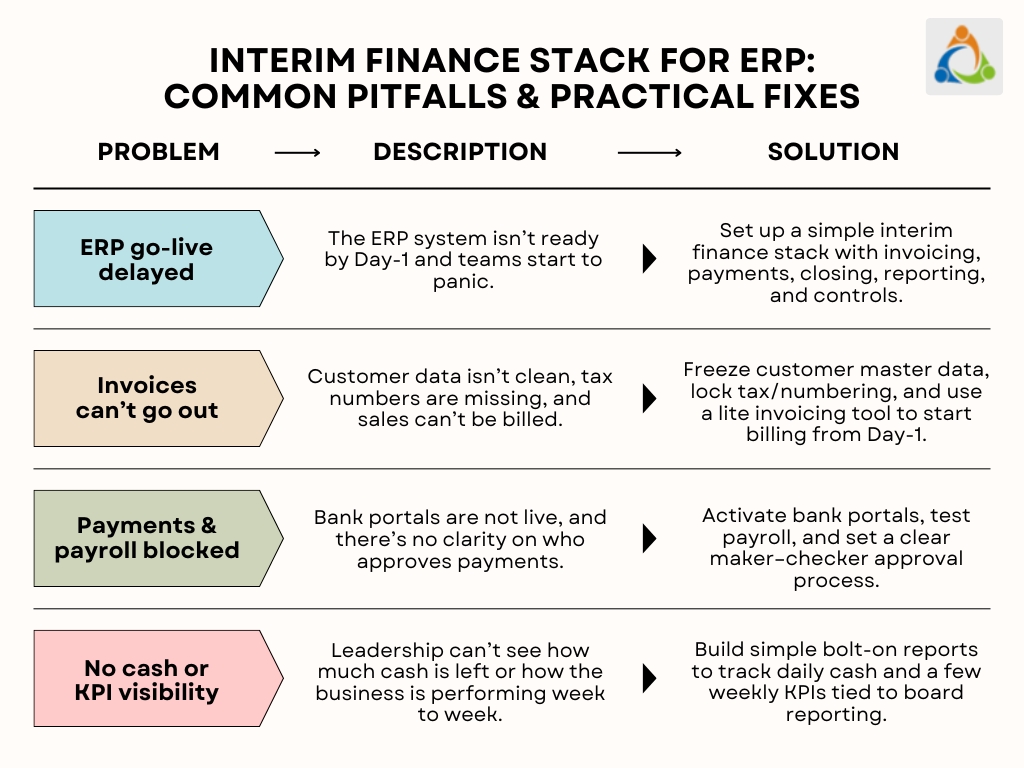
- Invoices don’t go out because customer data is incomplete or tax configuration is untested.
- Payments get stuck because bank portals are not activated or approval rules are unclear.
- Month-end becomes a scramble because the general ledger structure and posting discipline are not stabilised.
- Leadership loses visibility because cash and KPIs are not tracked in a reliable cadence.
The interim finance stack is not meant to replace an ERP. It is meant to prevent the “Day-1 freeze” that triggers all of the above.
The five layers that keep finance running from Day-1
A strong interim finance stack is deliberately boring. It does not attempt to recreate a full-suite ERP. It covers only what must work immediately, with clean ownership and basic controls.
Layer 1: A simple invoicing and collections tool:
If invoices cannot go out, everything downstream becomes reactive. The solution is not heavy tooling. The solution is clarity and speed.
What “good” looks like for Day-1:
- Customer master data is frozen (names, GST/VAT, billing addresses, payment terms).
- Numbering and tax rules are locked and tested.
- A lightweight invoicing tool is ready to issue invoices and record receipts.
The most common pitfall is leaving this to the ERP cutover, assuming billing will “start once the system is live.” The practical fix is to make invoicing independent, even if the tool is temporary.
Layer 2: Bank portals live with maker-checker approvals:
Nothing triggers leadership panic like blocked payments and payroll. Even a short delay creates noise across the organisation and damages supplier trust.
What must be ready from Day-1:
- Bank portals activated and access tested.
- Approval hierarchy defined (maker-checker and escalation rules).
- Clear separation between who initiates and who approves.
- Payment runs and payroll runs tested with real scenarios.
The common failure here is not technology. It is governance. People do not know who approves what, and approvals become ad-hoc. The interim stack forces clarity early.
Layer 3: A lightweight GL and month-end close mechanism:
You do not need a full ERP to close the books. You need a repeatable way to capture GL entries, track reconciliations, and run a monthly close without depending on heroic knowledge.
This layer should support:
- Basic journal entries and posting discipline.
- A closing checklist that is owned and followed.
- Reconciliations for bank, receivables, payables, and key balance sheet items.
- A calendar that makes close predictable.
When this is missing, the organisation learns the wrong lesson: “We will close once the ERP stabilises.” That approach turns a system transition into a reporting and compliance risk.
Layer 4: Cash tracking and a simple KPI dashboard:
When ERP is in flux, leadership needs visibility more than detail. The interim stack should provide a small set of numbers that can be trusted weekly.
Minimum viable reporting usually includes:
- Daily cash position and cash runway view
- Weekly collections and payables view
- A few operational KPIs linked to board comfort (order flow, fulfilment, gross margin, working capital levers)
The common pitfall is waiting for the ERP reporting layer to mature. The practical fix is bolt-on reporting that is owned by finance and updated in a disciplined cadence.
Layer 5: Basic controls and audit hygiene:
Interim does not mean uncontrolled. Day-1 is when fraud and error risks spike because people are learning new routines and exceptions multiply.
Controls that matter from Day-1:
- Role-based access and approval gates
- Audit logs for payments and master data changes
- Documented exceptions process (what is allowed, who approves, where it is recorded)
- A basic segregation-of-duties mindset, even in a small team
This is where many interim arrangements fail: they “work” but create invisible risk. The interim stack should be simple, not loose.
Common pitfalls leaders trigger without realising it
ERP journeys often get complicated because leaders unintentionally optimise for perfection before stability.
3 patterns show up repeatedly:
1) Heavy customisation upfront:
Customisation feels like progress because it produces detailed requirements and strong opinions. But heavy customisation early often prevents the standard ERP from stabilising.
A smarter sequence is boring but effective:
- First stabilise standard processes and core transactions.
- Then add customisation in phases, once the base is running predictably.
2) Underestimating change management:
People do not resist ERP because they dislike technology. They resist because the system changes how accountability works. It changes ownership, approval gates, data hygiene, and the “old shortcuts” that used to work.
If people are not prepared, they will recreate the old ways inside the new system. That is how you end up with a technically-live ERP and an operationally-chaotic company.
3) Assuming cutover is a switch:
Most cutovers require overlap. The old system often runs in parallel while the new system stabilises. If you ignore the overlap, you get a vacuum where no system is trusted and teams revert to spreadsheets and WhatsApp approvals.
The interim finance stack is the bridge that reduces this chaos, because it defines what must remain stable while the ERP transitions.
The practical cutover sequence that reduces chaos
The organisations that transition cleanly usually do three things in the right order.
First: clean and lock the master data:
Master data is where ERP projects quietly die. If customer, vendor, item, and tax data is unstable, the system cannot behave predictably.
A practical approach is:
- Clean the master data.
- Freeze it.
- Lock critical fields.
- Control changes through a single owner during cutover.
Second: do a parallel run for one full cycle:
A parallel run is not a “testing formality.” It is where teams build confidence and catch process breaks in real time.
One cycle is often enough to see:
- where approvals fail
- where data is missing
- where roles are unclear
- where transactions do not post correctly
Third: run a short war-room after cutover:
In the first days after cutover, decisions must be made fast, with direct ownership. This is not about panic. It is about preventing small exceptions from becoming permanent workarounds.
A short war-room period works best when:
- decision rights are clear
- issues are logged
- fixes are assigned with deadlines
- exceptions are tracked and closed
A timeline that keeps everyone calm
A useful way to think about this is not in terms of “ERP go-live date,” but in terms of business continuity milestones.
A practical cadence looks like this:
- Day-1: run the business (invoice, collect, pay, payroll)
- Day-30: close the books with discipline
- Day-90: stabilise the new ERP operating rhythm
- Day-180: retire the interim stack safely
The value of this framing is psychological as much as operational. It tells customers, lenders, and internal stakeholders that continuity has a plan, even if the ERP has a delay.
Meanwhile:
- cash keeps moving
- customers keep getting served
- suppliers stay steady
- leadership retains visibility
The Day-1 question that prevents bad decisions
When ERP timelines drift, teams often react in two unhelpful ways: they either wait longer, or they rush cutover into instability.
There is a better question to anchor decisions:what is the simplest interim design that keeps Day-1 finance reliable without creating long-term mess?
If you can answer that clearly, you remove the false dependency between “ERP readiness” and “business readiness.” You stop waiting. You keep the company moving, while the ERP matures properly.
If your ERP date is drifting, do not let your Day-1 drift with it. Stabilise the interim finance stack first, then phase the ERP in waves with discipline.


