

Most CEOs don’t need more motivation, vision sessions, or team offsites. What actually shapes the company’s momentum is far simpler – the design of the CEO’s week.
Look closely at the past seven days in a CEO’s calendar and you’ll usually see the truth. A week filled with approvals, escalations, and back-to-back meetings creates an organisation that learns to wait, react, and constantly look upward for answers. A week shaped deliberately around direction, leadership, and decision-clarity builds a completely different organisation – one that learns to think, decide, and move.
It rarely feels dramatic in the moment. But the calendar silently becomes the operating model.
Because companies don’t just follow strategy. They follow attention.
CEO calendar design that builds direction, not dependency
A CEO’s calendar is not a productivity tool. It is a behavioural design tool.
What you protect becomes “important.” What you repeatedly postpone becomes “optional.” What you respond to fastest becomes the company’s definition of priority. Over time, the calendar turns into culture without anyone announcing it.
That is why calendar design is one of the highest-leverage interventions for execution speed. It shifts the organisation without a reorg, without a speech, and without waiting for the next strategy cycle.
The hidden cost of a chaotic week
A chaotic CEO week rarely looks chaotic on paper.
It looks “full.” It looks “responsible.” It looks “hands-on.” It often looks like leadership.
But the downstream effects are consistent:
- Managers stop deciding and start forwarding.
- Teams stop planning and start preparing for escalations.
- Work starts moving through personalities instead of processes.
- Meetings multiply because decisions do not.
- The company becomes dependent on proximity to the CEO for speed.
The organisation then mistakes this dependency for control. What is actually happening is slower: the operating model is being trained to wait.
What growth-ready weeks do differently
A growth-ready CEO week has a visible pattern.
Not because it is “disciplined” in a motivational sense. Because it is intentionally designed to produce a different organisational behaviour: clearer decisions, stronger delegation, fewer escalations, and higher throughput.
A practical way to think about CEO calendar design is to allocate time to four blocks that create direction and reduce dependency.
Below is a working structure that consistently improves execution behaviour without adding bureaucracy.
Block 1: Direction time (the “future-facing” block):
In stuck organisations, direction time gets squeezed out by urgency.
In growth-ready organisations, direction time is protected as a non-negotiable input. It is where market signals, customer patterns, competitive shifts, strategic risks, and future bets get processed before they arrive as emergencies.
Direction time is not a long offsite. It is recurring calendar capacity.
What it usually includes:
- Reviewing customer signals (win/loss themes, churn reasons, renewal friction).
- Scanning external shifts (pricing moves, regulation, supply constraints, talent shifts).
- Identifying strategic risks early (concentration, delivery bottlenecks, quality patterns).
- Making “future bets” visible (what the company is building beyond this quarter).
A simple test helps here: if direction time disappears, the company will soon confuse today’s numbers with tomorrow’s growth.
Calendar rule: protect this block before you accept “update meetings.” Direction is not created in updates. It is created in thinking time.
Block 2: Leader time (the “delegation engine”):
Most CEOs say they want delegation.
But delegation is not an announcement. It is coached into existence through repetition.
Leader time is where the organisation learns decision quality, escalation hygiene, and judgment. It is where managers become leaders, not messengers.
This block includes:
- 1:1s that focus on decisions, not just status.
- Joint reviews where leaders are coached to think through trade-offs.
- Decision coaching: “What are the options? What do you recommend? What are you choosing?”
- Clarity conversations: “What do you own? What do you need from others?”
The goal is not to do more reviews. The goal is to increase the organisation’s decision capacity without adding layers.
Calendar rule: protect leader time even when the week gets busy. If it disappears, dependency rises and escalations increase.
Block 3: Protected deep-work time (the “anti-reactive” block):
A CEO without deep-work time becomes an executive version of customer support.
Always responding. Always available. Always busy.
And ironically, always becoming the bottleneck.
Protected deep-work time prevents leadership from becoming only reactive. It creates the conditions for high-quality thinking, writing, prioritisation, and design decisions that cannot be made in fragments.
Deep work is where:
- Complex decisions get structured.
- Strategy is translated into choices.
- Trade-offs are made explicitly.
- Narrative clarity gets built (for leaders, teams, and investors).
This is the block that reduces mental clutter. It also reduces organisational noise because clear decisions create fewer follow-up meetings.
Calendar rule: set a fixed weekly deep-work window and treat it as a board meeting with yourself. No rescheduling unless it is truly critical.
Block 4: The weekly friction review (the “flow protection” block):
Most companies review outcomes.
High-performing companies also review friction.
Friction is where execution bleeds quietly: handoffs, unclear ownership, slow approvals, rework loops, and cross-team dependencies that nobody wants to own.
A weekly friction review is a short, structured meeting (45–60 minutes) that asks one thing: where did work get stuck, and why?
It keeps attention on flow, not blame.
A strong friction review usually covers:
- Where did delivery slow down this week?
- Which handoff failed (Sales → Ops, Ops → Finance, Product → Delivery)?
- What approvals created delay or confusion?
- What decision rights were unclear?
- What should be redesigned so next week is smoother?
The output is not “more follow-ups.” The output is one or two system fixes that remove recurring drag.
Calendar rule: do not cancel this meeting during busy weeks. Busy weeks are exactly when friction compounds.
The behaviour shift that follows calendar design
When these blocks show up consistently, organisational behaviour changes without needing a restructure.
You start seeing patterns like:
- Managers decide instead of waiting.
- Teams plan instead of panic.
- Escalations reduce because decision rights clarify.
- Execution speeds up because friction is addressed weekly.
- The CEO’s availability stops being the company’s operating system.
This is how dependency dissolves: not through motivation, but through design.
A simple calendar audit CEOs can do in 15 minutes
Before redesigning anything, it helps to see the current reality.
A quick audit often reveals whether the company is being trained to think or trained to react.
Ask these 10 questions:
- How many hours last week were spent on approvals vs decisions?
- How many meetings existed only because clarity was missing?
- How much time was spent on “urgent” issues that were predictable?
- How often did the week get interrupted by escalations that could have been owned elsewhere?
- What portion of time went to customers and market signals vs internal coordination?
- Were there any protected hours for deep work and structured thinking?
- Did leaders receive coaching, or only instructions?
- Was friction reviewed, or only outcomes discussed?
- What meetings produced owners and next steps, not just updates?
- If the CEO disappeared for two weeks, what would slow down first?
The answers usually point to the same insight: calendar design is operating model design.
A practical redesign: the “four-block week” without adding hours
A common fear is that redesigning the week means doing more.
In practice, it often means doing fewer things, but doing the right things repeatedly.
A workable starting design looks like this:
- Direction time: 2–4 hours weekly (split into two blocks if needed).
- Leader time: recurring 1:1s and decision coaching (protected).
- Deep-work time: 2–3 fixed hours weekly (non-negotiable).
- Friction review: 45–60 minutes weekly (system fixes, not blame).
The rest of the week will still contain operations, stakeholder conversations, customer work, and approvals. The difference is that approvals no longer consume the entire calendar.
The week stops being a reaction engine and starts becoming a direction engine.
What to remove first (the fastest wins)
If the calendar is overloaded, the fastest results come from removing low-value patterns first.
Common candidates:
- Meetings that exist only to share updates already available in dashboards.
- Recurring meetings with no clear decision agenda.
- Meetings where the CEO attends by default instead of by design.
- Escalations that are actually decision-right gaps.
- Approval loops that could be replaced with guardrails.
If you remove one meeting but introduce one recurring direction block, the organisation feels the difference quickly.
Less noise. More signal.
The calendar is not private. It is contagious.
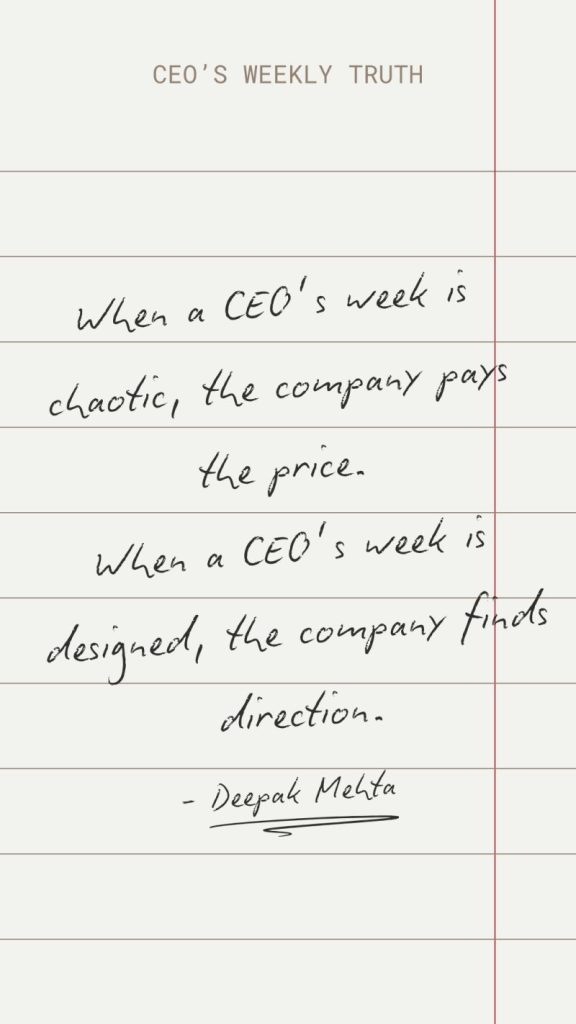
- When a CEO’s week is chaotic, the company pays the price in delay, dependency, and drift.
- When a CEO’s week is designed, the company finds direction without needing constant intervention.
So before changing your org chart, change your calendar.
If the last seven days looked like nonstop approvals and firefighting, it is not a motivation problem. It is a CEO calendar design problem, and it can be redesigned like any other system.