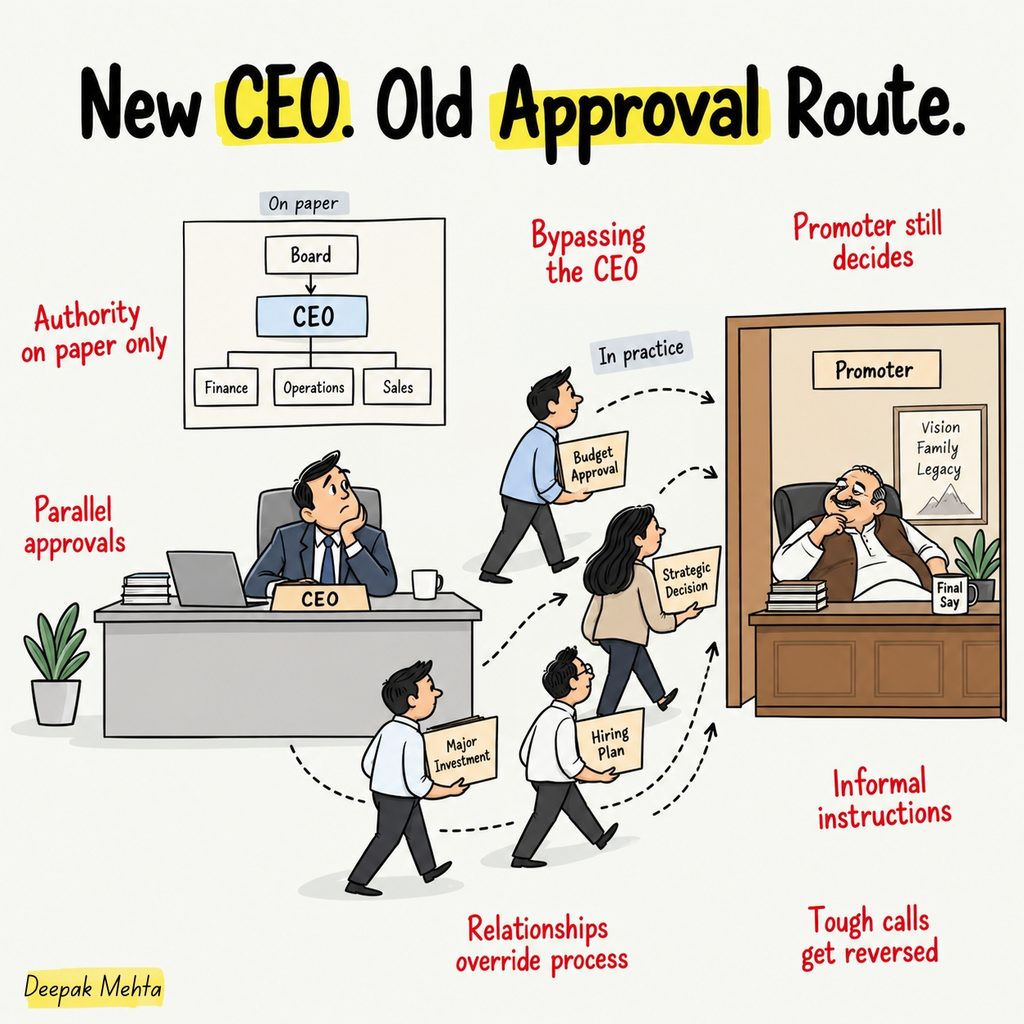
The image above captures a transition problem many family-run businesses face. The organisation chart shows a Chief Executive Officer. The visiting cards, reporting lines and board documents may also show the same. But when a difficult decision appears, people still walk past the new structure and return to the promoter’s room.
That is where professionalisation gets tested. A family business can appoint a professional CEO and still remain promoter-led in daily behaviour. The title may change quickly, but authority does not move unless the promoter deliberately creates space for it.
Across family enterprises, the move from promoter-led management to professional support for leadership is becoming more visible. Recent family-business research has identified this shift as one of the defining transitions ahead, along with the need to move from values held informally to governance that is properly codified. Another recent business report projected that family-run businesses directly managed by family members may reduce significantly by 2035, as professional managers take on larger operating roles.
But bringing in a professional CEO is not the same as building professional management. The real work starts after the appointment.
The authority transfer test for a family business
A professional CEO in a family business needs more than a designation. The role needs decision rights, operating space, formal review mechanisms, visible backing from the promoter and a clear separation between ownership and daily management. Without that, the CEO becomes responsible for performance without having full control over the levers needed to deliver it.
This is why many transitions get stuck. On paper, the CEO owns the business. In practice, senior people still seek parallel approval from the family. On paper, functional heads report to the CEO. In practice, informal relationships continue to override the formal structure.
This creates confusion inside the organisation. People do not follow the structure they see on the chart. They follow the authority they believe is real. If the promoter continues giving instructions outside the agreed route, the organisation quickly learns that the new CEO is not the final decision centre.
Before appointing a professional CEO, the promoter must answer one uncomfortable question: what am I genuinely ready to stop controlling?
That question is more important than the appointment letter. The promoter may still retain ownership, board influence, strategic oversight and family legacy stewardship. But day-to-day authority must be defined clearly, otherwise the CEO will inherit responsibility without enough room to lead.
A useful starting point is to divide decisions into 3 categories.
1. Decisions the CEO fully owns:
These may include operating reviews, team performance, routine commercial decisions, customer execution, vendor management, functional accountability, hiring within approved budgets and process discipline.
2. Decisions the CEO recommends but the board approves:
These may include major capital expenditure, large strategic investments, business expansion, senior leadership appointments, debt, mergers, acquisitions or long-term structural changes.
3. Decisions that remain with the promoter or family council:
These may include ownership matters, family employment policy, long-term family wealth decisions, legacy assets, shareholder matters and values that define the institution.
This division prevents confusion. It also prevents the family from feeling that professionalisation means losing control completely. Professional management does not remove ownership. It separates ownership from daily interference.
The second test is whether the reporting structure is protected after the CEO enters.
If managers continue bypassing the CEO, the transition weakens from the first day. A senior employee may say, “I only wanted to keep sir informed.” A vendor may say, “We have always spoken directly to the family.” A family member may say, “I only gave a small instruction.”
These small bypasses slowly become the real operating system.
The promoter must therefore make one rule visible: operational matters should move through the CEO unless they fall under a clearly defined board or family matter. If someone bypasses the CEO, the promoter should redirect the person back to the formal structure. This one behaviour sends a stronger message than any organisation chart.
The third test is whether customer and vendor relationships begin moving from individuals to the institution.
In many family-run businesses, key relationships sit personally with the promoter. Large customers call the owner. Vendors negotiate with the owner. Senior employees depend on the owner. In the early years, this may help the business grow faster because trust is personal and decisions are quick.
But when the business professionalises, these relationships must gradually become institutional. The CEO and leadership team need access, authority and credibility with customers, vendors, bankers, consultants and internal teams. Otherwise, the new CEO remains dependent on the promoter for influence.
This does not mean the promoter disappears from important relationships. It means the promoter consciously shifts from being the daily decision-maker to being the institutional sponsor. The difference is important.
The fourth test is whether performance is reviewed through agreed outcomes, not personal preference.
A professional CEO cannot be evaluated only through the promoter’s instinct. Before the CEO takes charge, the board and promoter should define what success means. These outcomes should be practical, measurable and connected to the phase of the business.
For example:
- revenue growth with margin discipline
- working capital improvement
- professionalisation of the leadership team
- reduced promoter dependency
- stronger systems and review rhythm
- improved customer and vendor governance
- succession readiness
- better decision speed across functions
- clear accountability for business units
Once these outcomes are agreed, reviews become more balanced. The CEO is not judged only by whether every decision feels familiar to the promoter. The CEO is judged by whether the business is moving towards the agreed direction.
The fifth test is the most difficult: what happens when the CEO takes a decision the promoter would not have taken?
This is where real authority becomes visible.
If every difficult decision is informally reversed, the organisation understands the truth immediately. People learn that the CEO can decide only until the promoter disagrees. After that, the real route is still the old route.
This damages the role faster than open disagreement would.
A promoter may not agree with every CEO decision. That is natural. But disagreement should move through the agreed governance route, not through informal reversal. If a decision is wrong, it should be reviewed professionally. If the decision is within the CEO’s authority, the promoter should be careful before overriding it.
Because every override teaches the organisation where power actually sits. This does not mean the CEO gets unlimited freedom. It means the business creates a clear governance model where authority and accountability match. If the CEO is accountable for results, the CEO must also have the authority to make operating decisions.
Handing over a weak system to a strong CEO is also not enough.
Many promoters assume that hiring a capable professional will fix everything. But if systems are weak, processes are unclear, review mechanisms are missing and people are used to informal direction, even a strong CEO will spend too much time managing confusion.
Before the transition, the business should strengthen a few basics:
- decision rights
- reporting rhythm
- role clarity
- performance dashboards
- authority matrix
- escalation rules
- board review structure
- family role definition
- customer and vendor ownership transition
- leadership team accountability
This is the operating foundation that allows a CEO to function properly. Without it, the CEO becomes the new pressure point. The business expects professional results, but continues to run through promoter-era habits. That is unfair to the CEO and risky for the organisation.
There is another part that promoters often underestimate: creating space for their own next role.
When a promoter appoints a professional CEO but continues solving issues informally, the promoter does not actually become free. The organisation keeps returning to the same person. Succession planning remains incomplete because the promoter has not moved into a different role. The promoter’s future role may be board leadership, strategic direction, family governance, long-term capital allocation, mentoring next-generation family members, institutional relationships or values stewardship. But that role cannot emerge if the promoter remains the daily approval route.
Professionalisation therefore requires discipline from both sides. The CEO must earn trust through judgement, transparency and performance. The promoter must give trust through space, backing and restraint. The organisation must respect the new route through visible decision rights and governance.
That is when professional leadership becomes part of the operating system. Not just the org chart.
A family business does not become professionally managed because someone from outside is appointed. It becomes professionally managed when the organisation knows:
- who decides
- who reviews
- who escalates
- who owns outcomes
- where the promoter’s role begins and ends.
That clarity is what protects the business from confusion. It also protects the promoter from being pulled back into every issue. And it protects the CEO from becoming a title without authority.
This is where implementation-led family business professionalisation becomes important. The goal is not to replace the promoter’s legacy. The goal is to build a structure where that legacy can continue without every decision depending on the promoter personally.