
A 75-year-old entrepreneur, still working full-time, quietly says both his sons are abroad and do not plan to return to the business. It sounds like a personal story, but it is not an isolated one.
Across family-owned businesses, succession is becoming less about inheritance and more about design. Only 7% of Indian heirs want to join the family business, even though most current owners still hope to pass the business to the next generation. At the same time, global surveys of next-generation family business members show they increasingly want greater freedom, clearer roles, better work-life balance, and real influence rather than symbolic succession.
This is why the old question – “Why don’t my children want what I built for them?” – is no longer enough. The more useful question is this: What about the business, the culture, and the system makes the next generation see it as a burden instead of an opportunity?
Why next-gen family members reject the family business and how to redesign it
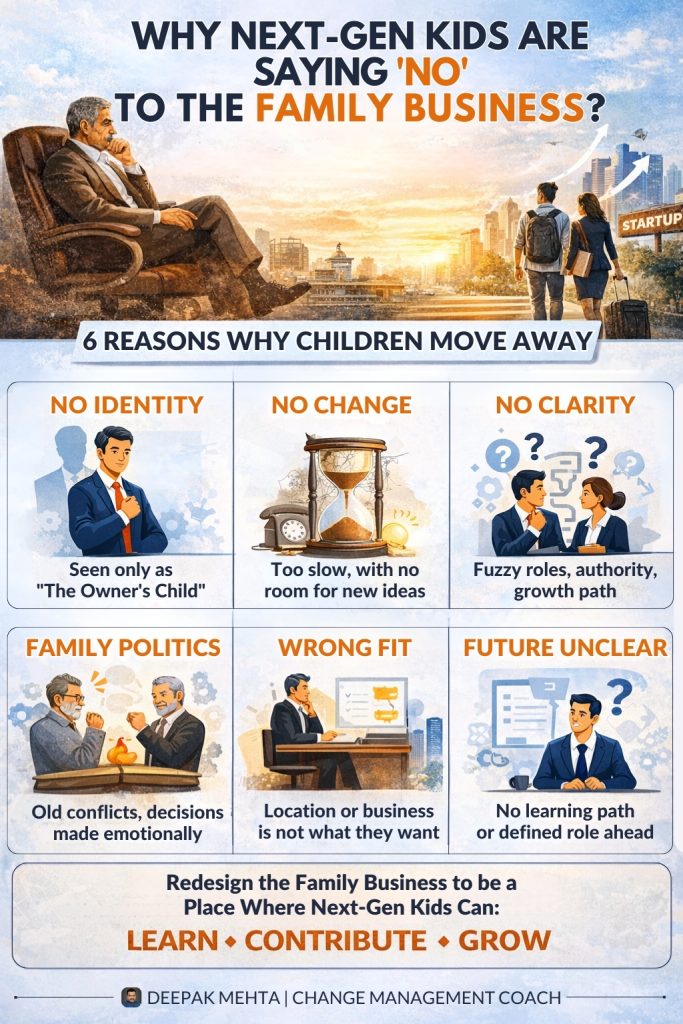
Most next-generation members are not saying no to enterprise, responsibility, or hard work. They are saying no to a version of the family business where identity is borrowed, authority is unclear, learning is accidental, politics are normal, and the future feels emotionally expensive. That is why family business succession today needs to be treated less like a family expectation and more like an organisational redesign project.
1. They don’t want to be seen only as “the owner’s child”:
One of the fastest ways to lose the next generation is to bring them into the business without giving them a professional identity.
In many promoter-led firms, the next-gen member enters with a title but not with legitimacy. Employees are polite, but not truly open. Every action is filtered through one invisible label: the founder’s son or the owner’s daughter. Success is discounted as privilege. Mistakes are magnified as entitlement.
That creates a double burden. They are expected to prove themselves faster than others, but are not always given the structure to do so. PwC’s global work on family business dynamics notes that younger family members often feel the need to establish credibility in ways that non-family professionals do not.
A healthier design starts by treating them as professionals first. That means:
- clear entry criteria
- real job descriptions
- defined reporting lines
- accountability for outcomes, not symbolic participation
If the organisation never sees them beyond bloodline, the business becomes an emotional test before it becomes a career.
2. They are asked to take responsibility without real authority:
This is one of the most common succession traps. The next generation is invited into the business, given projects, even given pressure but not given decision rights.
They are told to “learn the ropes,” yet every meaningful call still goes back to the senior generation. They may run meetings, but they do not control budgets. They may “handle” a business unit, but cannot redesign roles, approve investments, or challenge old ways of working.
Eventually, responsibility without authority starts to feel like theatre.
Research on succession repeatedly points to the importance of clear governance, honest communication, and decision clarity between generations. Where expectations are vague, frustration rises on both sides.
If you want the next generation to stay, define:
- what decisions they can make independently
- what still sits with senior leadership
- what milestones would expand their authority over time
Succession does not become real when someone joins. It becomes real when authority is gradually but clearly transferred.
3. They do not want to inherit slow systems and resistance to change:
Many next-gen members have seen more tools, systems, digital workflows, and new business models than the older generation. They often come in wanting to improve visibility, digitise processes, modernise customer experience, or create cleaner governance.
Then they meet the sentence that kills energy: “This is how we’ve always done it.”
KPMG’s work on family businesses notes that younger generations often bring a different outlook, seeking innovation, autonomy, and a better quality of life than previous generations accepted as normal.
If the business has no room for new ideas, or if every change is delayed until it loses momentum, the message becomes clear: you are welcome to join, but not really to shape.
That is where many next-gen members choose a job instead. Not because a salary is more attractive than ownership, but because a system with clarity and movement feels safer than a legacy with stagnation.
One of the smartest redesign choices a family business can make is to give the next generation ownership of selected upgrades:
- digital reporting
- process redesign
- ERP adoption
- customer-facing innovation
- new category pilots
That does two things at once. It modernises the business and creates a meaningful runway for next-gen contribution.
4. Family politics make the workplace emotionally heavy:
In family businesses, office dynamics rarely stay inside the office.
Old comparisons, sibling tensions, unresolved historical conflicts, and emotional loyalties often spill into reviews, hiring, promotions, and decisions. The result is not always open conflict. Often it is something quieter and harder to challenge: emotional uncertainty.
Who really decides? Whose opinion matters when two family members disagree? Will business disagreements become family drama? Will performance reviews remain fair if emotional alliances shape outcomes?
Family business literature has long identified conflict management, governance, and role clarity as critical to continuity across generations.
The next generation watches this closely. If they see that decisions are made emotionally rather than institutionally, they do not just question the culture – they question the future.
This is why healthy succession is not only about mentoring the next generation. It is also about building structures that reduce emotional spillover:
- family constitution or agreed governance norms
- role clarity between family and management decisions
- professional boards or external advisors
- office rules that protect the workplace from family disputes
Without this, even a profitable business can feel too heavy to join.
5. The business does not fit the life they want to build:
Sometimes the issue is not only culture. It is fit.
The next generation may want a different geography, a different sector, a different pace of life, or a different way of working. They may not want to spend the next twenty years in the same city, the same plant, or the same routine that defined the founder’s life.
That does not mean they lack commitment. It means their definition of a meaningful career is not identical to the previous generation’s.
PwC’s NextGen research has shown that younger family business members increasingly want careers that align with personal purpose, flexibility, and a broader life design.
Family businesses often lose the next generation because they present only one version of joining:
- same location
- same working style
- same leadership mould
- same sacrifice story
A better approach is to ask earlier and more honestly:
- What kind of life do they want?
- What kind of work energises them?
- Is there a real fit between the business and the person?
- If yes, what role could be redesigned around that fit?
Not every child must join. But when the option exists, it should feel like a professional opportunity, not an inherited obligation.
6. There is no visible learning path or leadership runway:
Many next-gen members are asked to commit to the family business without seeing how they will grow inside it.
No structured mentoring. No cross-functional exposure. No defined projects. No external benchmark. No plan for how they will go from “joining” to “leading.”
That uncertainty is one of the biggest reasons younger family members choose outside experience first. In fact, older global studies found many next-gen leaders preferred working elsewhere before joining, often to build credibility and skills beyond the family environment.
A family business becomes much more attractive when the runway is visible:
- early internships before graduation
- external work experience encouraged, not seen as disloyalty
- re-entry through real projects, not ornamental roles
- external mentors, not only family guidance
- time-bound learning path across functions
- fair rewards and clear milestones
The goal is not to guarantee succession. The goal is to make participation intellectually and professionally credible.
What owners can do differently now
If the next generation is stepping away, forcing them rarely works. Redesigning the business does.
The most practical shifts usually begin here:
- treat next-gen as professionals, not default successors
- involve them early enough to test real fit
- define role, reporting, and decision rights clearly
- let senior leadership guide, not intimidate
- stop trying to build a duplicate founder
- modernise systems and let them lead upgrades
- keep family conflict out of operational spaces
- build strong non-family leadership too
- add external mentors and transparent learning paths
- share financial realities clearly so doubt does not grow in silence
These are not cosmetic improvements. They change whether the next generation sees the business as a career platform or an emotional trap.
The real succession issue is not whether the next generation is willing to work hard. It is whether the business has been redesigned enough to deserve their commitment. A well-run family business can still be one of the best places for the next generation to build something meaningful. But only when it becomes a place where they can learn, contribute, influence, and be treated as professionals, not merely as heirs.
When that happens, succession stops being a family hope and starts becoming a credible leadership path.


