
Every factory has leaks.
Some are visible on the shopfloor: breakdowns, rework, late dispatches. The more expensive leaks sit quietly in meeting rooms: repeated excuses, unresolved decisions, issues everyone knows about but nobody really owns.
Industrial safety experts call this normalisation of deviation – when small departures from standards slowly become the “new normal” until a serious incident or loss forces attention. In manufacturing culture, the same thing happens with quality, safety, maintenance and even ERP usage.
Over time, leaders get used to living with the leak as long as monthly targets are somehow met. Till one day a key customer, a key engineer or a key machine fails at the wrong moment – and the real cost shows up.
This piece looks at those “normal” leaks and offers a practical way for promoters and plant heads to see them earlier, fix them faster and rebuild discipline without killing initiative.
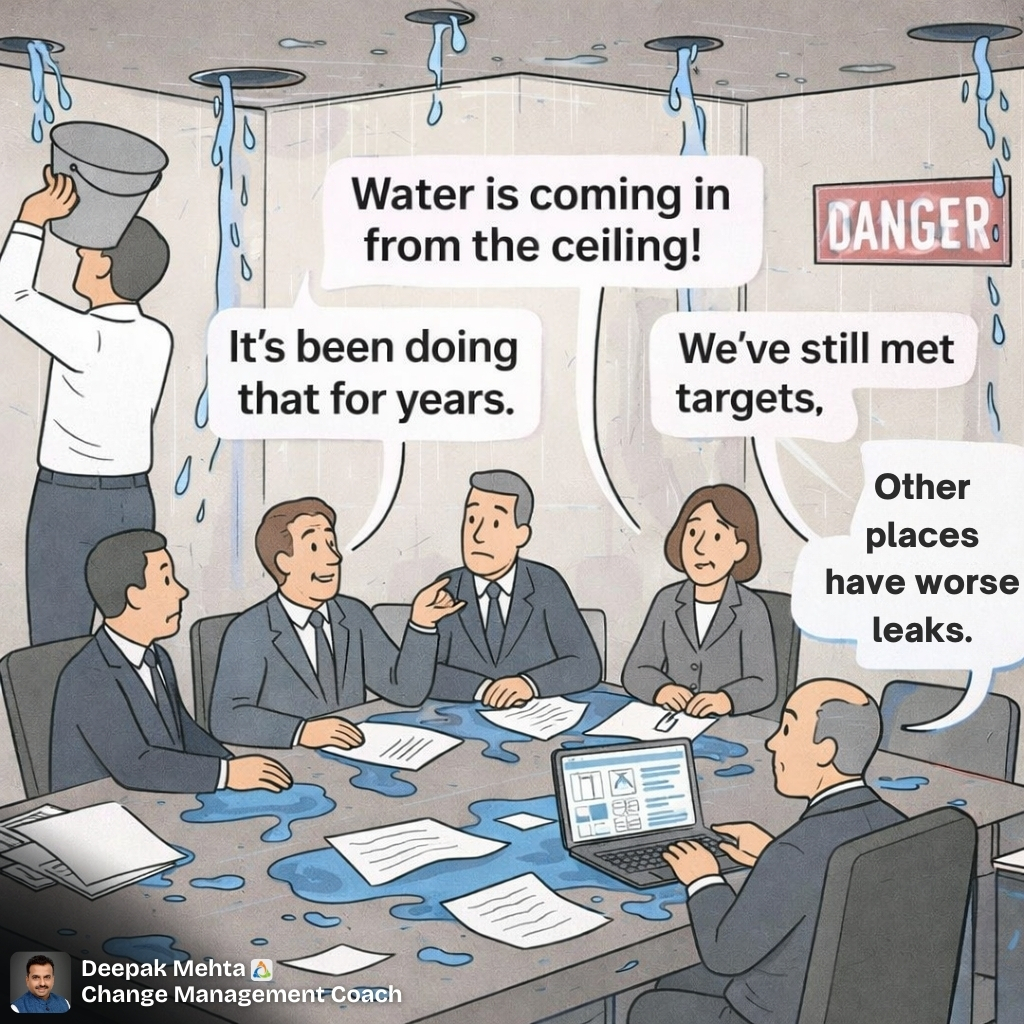
Most factories don’t ignore leaks because they don’t care. They ignore them because leaks arrive in small, manageable doses. And not all leaks are dramatic. Many sound like everyday sentences:
- “That machine always trips in the night shift, but we manage.”
- “Customer X always complains; that’s just their nature.”
- “Everyone uses this safety shortcut, otherwise production will suffer.”
- “ERP reports are never accurate; we keep a backup in Excel.”
- “That supervisor is difficult, but he gets work done.”
- “Month-end cashflow is always tight; we somehow juggle.”
Individually, each looks tolerable. Together, they form a pattern: the organisation is spending its best people and energy on coping, not correcting.
Why leaders start normalising problems
Leaders don’t set out to normalise leaks. The drift happens because:
1. Targets are visible; leaks are not: production volume, OTIF and rejection percentages show up on dashboards. The emotional toll of a rude supervisor or the silent fear around a safety shortcut rarely does.
2. Past success becomes a shield: when a plant has “always managed”, it becomes harder to question the way of working. People point to historic output as evidence that nothing is really broken.
3. Firefighting looks heroic; root-cause work looks slow: the person who saves a shipment at midnight gets applause. The engineer who spends two weeks doing root cause analysis and system changes looks “slow” in comparison, even though that work saves ten future emergencies. Root cause analysis is widely recommended in manufacturing, yet many plants still treat it as an optional extra rather than a discipline.
4. People stop raising issues: when problems are repeatedly minimised – “others have it worse”, “this is normal everywhere” – teams learn the real lesson: don’t bother speaking up. The leak remains, the messaging changes from concern to resignation.
On the balance sheet leaks show up as:
- chronic breakdowns and maintenance overtime
- high rework and scrap
- expedited shipments and constant customer escalations
- manual workarounds around ERP and SOPs
On the people side, leaks cost even more:
- talented supervisors become permanent firefighters
- process-minded engineers feel ignored and leave
- new hires learn that shortcuts beat standards
The organisation doesn’t just lose money; it loses the very people who could have helped fix the system.
Shift 1: From “problems” to “leaks that repeat”
Not every deviation deserves a project. The danger lies in repeating patterns that everyone has quietly accepted.
A practical starting point for a plant head is to create a simple “leak log” with three columns:
- What keeps repeating?
- Same machine – same fault code – same shift.
- Same customer – same complaint – same product line.
- How do people talk about it?
- “It’s always been like this.”
- “Others manage with worse conditions.”
- What do we actually do when it happens?
- Patch and restart?
- Escalate and forget?
- Or pause and fix?
Even this small exercise changes the conversation. The team moves from arguing about whether a leak is serious to asking why it keeps returning.
Shift 2: From denial to permission to speak:
Leaks survive in silence. A healthy factory culture makes it safe to point at the hole in the roof – even if that hole was ignored for years. That doesn’t mean encouraging endless complaining. It means:
- inviting operators and line supervisors to name the top three leaks they see
- listening without attacking their tone or exaggeration
- separating the issue from the person who raised it
Many leaders talk about “empowerment” in town halls. The real proof is whether a junior engineer can say, “this SOP is not being followed on weekends” without fear of being branded negative or disloyal.
One simple habit that helps: after every weekly review, ask the room, “What have we quietly learned to live with that we should no longer accept?” Capture those answers; they are often the real strategy document.
Shift 3: From heroes to systems:
Factories often celebrate the person who bails water fastest. The night-shift champion who fixes breakdowns with jugaad. The customer-facing manager who can “manage” any escalation with a phone call.
These people are valuable. The mistake is stopping there.
When only heroes are celebrated, three things happen:
- the system never improves because informal fixes remain in someone’s head
- succession becomes impossible when that person moves out
- other team members learn that being loud and available beats being structured
A more sustainable approach is to turn hero stories into system stories:
- After a major rescue, sit with the team and ask, “What must change so we never need this kind of rescue again?”
- Convert the answer into one change in SOP, one change in maintenance schedule or one change in staffing.
- Recognise the hero and the team that removed the need for heroics next time.
Over time, the organisation’s pride shifts from “we can handle any crisis” to “we rarely have crises”.
Shift 4: From tools to discipline (ERP and SOPs):
Many factories invest heavily in ERP, MES and digital dashboards, hoping the right software will tighten discipline. The reality is harsher:
- An ERP cannot fix a process that is unclear or constantly bypassed.
- Dashboards cannot replace leadership conversations about standards.
- Data quality cannot improve if basic roles and accountability remain fuzzy.
Treat ERP as a mirror, not a magic wand.
The questions to ask are:
- Are SOPs written clearly enough for a new team member to follow without guesswork?
- Are those SOPs followed when nobody is watching – during night shifts, weekends, peak pressure?
- Do process owners actually own the data in the system, or do they see ERP as “IT’s job”?
When a plant head insists on one simple view of reality – the SOP plus the data – leaks lose their hiding space.
Shift 5: From wrong seats to right fits:
Sometimes the leak is not in the process or the system; it is in the seat–person mismatch.
- A high-potential engineer is stuck in a purely clerical role.
- A technically strong but people-insensitive supervisor runs a critical line.
- A manager who hates ERP is responsible for adoption.
In these cases, fire-fighting and normalisation are symptoms of deeper misalignment.
Leaders who take organisation design seriously don’t just ask, “Who is available?” They ask, “Who is the right fit for this kind of problem and team?”
A practical check:
- List the 5 roles where leaks keep originating.
- For each role, ask: “If we were hiring this role fresh today, would we describe the current person as our ideal candidate?”
- Where the honest answer is no, treat it as a design issue, not a character flaw. Consider reassignments, support or structured exits.
Shift 6: From one-time drive to ongoing rhythm:
Cultural leaks don’t close after a single workshop or initiative. They close when a simple rhythm keeps the factory honest:
- Monthly leak review – three recurring issues, three root causes, three system changes.
- Quarterly culture check – short, anonymous pulse on safety, respect and fairness on the floor.
- Annual reset – revisit which behaviours have quietly been normalised again and need fresh boundaries.
The goal is not to eliminate every leak forever. It is to build a culture where leaks are spotted, spoken about and systematically reduced.
Designing factories that don’t live with leaks
Factories will always face variability – in orders, raw material, people and machines. That part is non-negotiable.
What is negotiable is whether the organisation chooses to normalise the resulting leaks or design its way out of them.
Leaders who keep asking “leak questions” instead of only “target questions” create a different kind of plant:
- one where operators feel safe to report what is really happening
- one where root-cause fixing slowly replaces permanent fire-fighting
- one where ERP and SOPs are used as anchors, not excuses
- one where good people stay because they can see problems being taken seriously
When that happens, production numbers improve, yes. But something more valuable also shifts: the factory’s reputation becomes that of a place where issues are faced, not hidden; where discipline is lived, not just stated in policy; and where pointing to a leak is seen as leadership, not complaint.
And over time, that changes more than performance metrics. It changes the kind of people the factory attracts, the kind of trust customers place in it, and the kind of culture that can grow stronger without depending on constant firefighting.


