The costliest delay in business isn’t losing a client or missing a sales target. It’s waiting for chaos to erupt before fixing operations. Many companies believe growth alone is the victory – more clients, bigger revenues, larger teams, and new markets. But beneath the surface, this very growth hides a silent gap that eventually threatens to undo it all.
In fast-scaling businesses, founders often build for growth but rarely for scale. They push revenue higher but leave processes, accountability, and systems behind. The result is: teams run on WhatsApp threads, memory, and verbal updates instead of reliable frameworks. What looks like success from the outside is, in fact, a fragile structure inside.
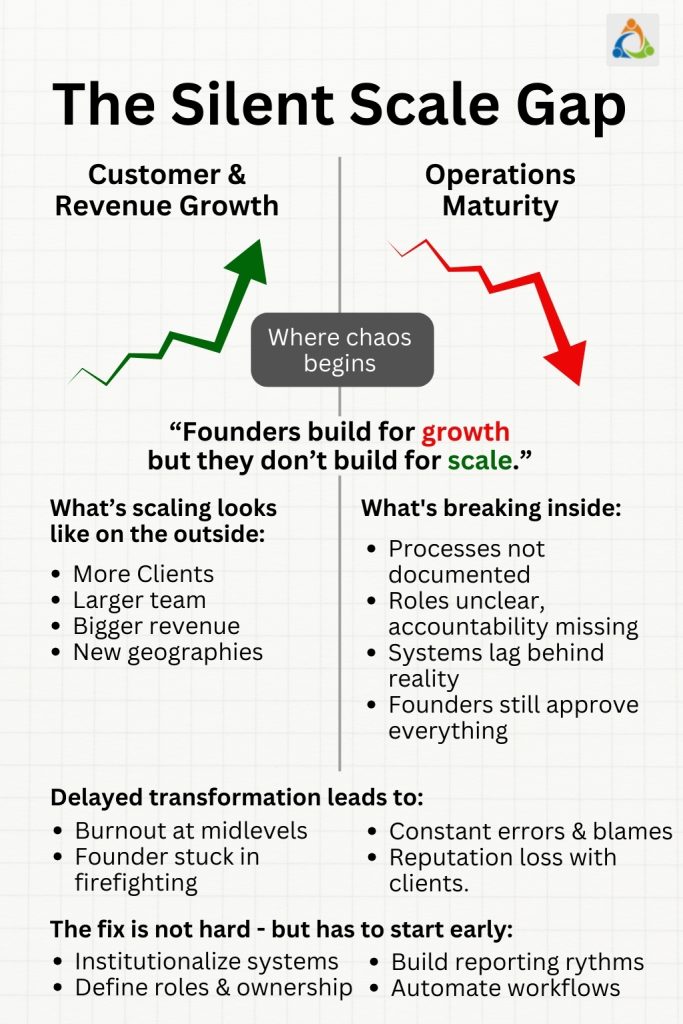
What growth shows vs. what chaos hides
On the outside, scaling feels like progress – clients multiply, revenue grows steadily, new offices open, and teams expand. Investors and markets applaud the pace. But internally, operations begin to strain. Roles remain unclear, decision-making is founder-dependent, and systems lag behind reality. Instead of scaling with ease, companies begin firefighting every day.
Leaders often mistake revenue growth for operational maturity. Yet, maturity doesn’t come from more sales; it comes from well-defined processes, empowered second-line managers, and systems that can handle the load without breaking. Without this balance, growth becomes a double-edged sword: the faster it accelerates, the sooner cracks appear.
The cost of delayed transformation
Delaying operational transformation is like building on weak foundations. At first, the cracks look minor—missed emails, unclear responsibilities, and extra client calls. But as growth accelerates, the weight on these cracks multiplies.
Soon, mid-level managers burn out from constant firefighting. Founders are trapped in tactical approvals rather than strategic planning. Errors increase, customers experience gaps before leaders even notice, and the company’s hard-earned reputation starts eroding.
Research shows over 45% of productivity gains in leading firms come not from chasing new markets but from operational transformation. Companies that prioritize process architecture early avoid revenue plateaus and reputation damage. Those that don’t often spend years repairing what could have been built right the first time.
Many leaders still see operations as a back-office function – a support role that only becomes important when something breaks. This is a misconception that costs millions. Operations is not a cost center; it is a strategic growth lever.
Companies that embed scalable processes, clear accountability, and automated workflows early enjoy smoother execution, faster decision-making, and more resilient teams. Instead of chasing growth through sales alone, they unlock scale by aligning internal systems with external expansion. This is why process architecture consulting is becoming critical for SMEs and mid-sized firms – it shifts operations from reactive firefighting to proactive growth enablement.
Fixing operations doesn’t have to be complex, but it does have to start early. The strongest companies institutionalize systems before chaos arrives. They define roles and ownership clearly so accountability doesn’t vanish in the growth rush. They build reporting rhythms that keep teams aligned and create automated workflows that cut coordination time dramatically.
By embedding these practices before scaling pressure mounts, businesses create room for innovation, customer focus, and leadership bandwidth. In contrast, those who delay are forced to patch holes while driving at full speed, often losing both efficiency and morale.
Growth without scalable operations is an illusion. Businesses that celebrate revenue without strengthening their foundations risk collapse under their own weight. The real advantage doesn’t lie in how fast you grow, but in how well your operations can sustain that growth.
The companies that will thrive in the next decade are not just the ones that chase clients and expand geographies. They are the ones that recognize early that scale is a system, not a slogan. They build processes before problems, empower teams before burnout, and design operations as a core strategy rather than an afterthought.
Because true scale is not about adding more – it’s about ensuring the system is strong enough to handle more.