Most leadership teams are not short of ideas. They are short of finished initiatives.
If you look closely at most growing SMEs, the pattern repeats. Strategy decks get made, announcements are done, a few town halls happen – and then daily urgencies quietly take over. Projects that sounded critical in January are half-implemented by June and quietly shelved by December.
The CEO’s calendar fills up with reviews and firefighting. Department heads keep “updating” each other. Yet very little changes in how the business actually runs. Strategy moves on slides; behaviour stays the same on the shopfloor.
This is the strategy–execution gap. Not a gap in intent or intelligence, but a gap in ownership.
Most org charts show who decides. Very few org charts show who owns implementation end-to-end. Somewhere between “approved in the boardroom” and “visible in operations”, ownership becomes fuzzy.
That is exactly where a Chief Implementation Officer (CIO) comes in – a role many companies already have informally, but almost none have named clearly.
What a Chief Implementation Officer Actually Does
A Chief Implementation Officer sits on the same side of the table as the CEO, but with a different lens. The CEO and leadership team decide what matters. The CIO owns how it will actually get done across functions, timelines, and people.
Think of the CIO as the architect of execution discipline. Not a glorified project manager, not another “operations head”, but someone who protects bandwidth, sequence, and follow-through across the whole agenda.
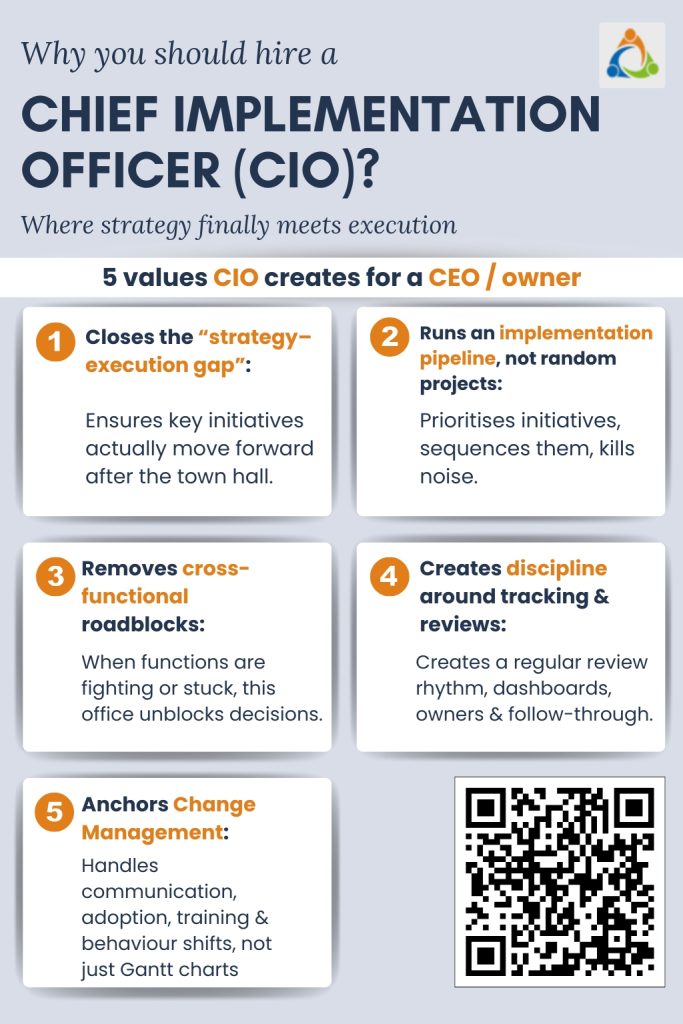
Below are the core ways this role changes how a company works.
1. Closes the strategy–execution gap:
The first responsibility of a Chief Implementation Officer is to ensure that key initiatives do not die after the town hall.
The CIO takes high-level strategy and converts it into a small, clear portfolio of initiatives with owners, milestones, and success measures. Instead of twenty loose priorities, the organisation sees five sharp ones, each with a path from decision to deployment.
Because the same person is watching both design and delivery, decisions stop floating. Teams know which initiatives will actually be implemented, not just discussed. Over time, people start trusting leadership announcements again, because they see visible follow-through.
2. Runs an implementation pipeline, not random projects:
In most SMEs, initiatives start based on who shouted loudest last month. An ERP upgrade, a plant expansion, a new sales channel – all launched in parallel, all pulling on the same limited leadership capacity.
A CIO replaces this noise with an implementation pipeline. Initiatives are prioritised, sequenced, and sometimes killed before they create more confusion. Trade-offs become explicit instead of political.
This pipeline view has a compounding effect. Frontline teams see fewer half-started projects. Leadership reviews stop jumping between themes. The company slowly shifts from “project chaos” to a rhythm of focused execution.
3. Removes cross-functional roadblocks:
Many good strategies stall not inside a department, but between departments. Finance wants controls, sales wants speed, operations wants stability. No one person feels authorised to resolve the tension.
The Chief Implementation Officer is designed to sit in that uncomfortable middle. Their mandate is to unblock decisions when functions are stuck, not to take sides. That may mean redefining approval flows, clarifying hand-offs, or sometimes forcing a decision when everyone is hesitating.
Because the CIO is accountable for overall implementation, they are incentivised to cut through cross-functional friction quickly. The result is fewer invisible bottlenecks and fewer “we’re waiting for them” conversations.
4. Creates discipline around tracking and reviews:
Implementation dies quietly when no one is tracking outcomes.
A CIO designs the review rhythm of the organisation: which meetings exist, what they are for, which dashboards are used, and how decisions are recorded. The goal is not more meetings; it is better meetings that result in closure.
Instead of open-ended status updates, the CIO pushes for clear decisions, owners, and next steps. Dashboards stop being cosmetic. Numbers link back to the initiatives the company said it cares about. Leadership stops chasing updates on WhatsApp because the cadence and formats are already agreed.
5. Anchors real Change Management, not just Gantt chart:
Most change programs underestimate the human side. New systems and processes are rolled out, but adoption is left to enthusiasm.
A strong Chief Implementation Officer treats Change Management as part of the job, not an afterthought. Communication plans, training, coaching of middle managers, and reinforcement mechanisms are all designed into the implementation plan.
They work closely with HR and functional leaders so that teams understand not only what is changing, but why. Behavioural shifts are tracked, not assumed. Resistance has a place to surface early instead of derailing the project later.
6. Takes ownership of outcomes, not just activity:
A CIO is measured by outcomes – improved lead times, cleaner data, higher on-time delivery – not by the number of review decks created.
This is what separates the role from traditional project management. A project manager may keep tasks updated; the CIO keeps business impact in focus. When metrics are off-track, they are expected to raise the flag, escalate decisions, and redesign the path – not simply report delay.
For CEOs, this creates a powerful shift. Instead of personally chasing every initiative, they have one senior counterpart whose job is to protect momentum and surface reality early.
Full-time CIO vs outsourced CIO for SMEs
Many large organisations can justify a full-time Chief Implementation Officer. Growing SMEs often hesitate, either because the org chart is already heavy or because they are not sure about finding the right person.
That is where an outsourced CIO model can work well.
An external implementation leader brings neutrality that is hard to achieve internally. They are not tied to legacy politics, and their mandate is easier to define: help leadership translate priorities into a workable pipeline, install a review rhythm, and build internal capability to carry it forward.
For the CEO, this model reduces the emotional burden of tough conversations. A neutral implementation leader can question priorities, call out unfinished work, and mediate cross-functional disputes without being seen as favouring one team.
Over time, the goal is not dependence on an outsider, but building an internal culture of implementation discipline. Many founders choose to work with an experienced change-management advisor in this role for a period, while grooming internal leaders to eventually take over.
(You can hyperlink the phrase “experienced change-management advisor” to Deepak sir’s LinkedIn profile.)
How to know if your company needs a Chief Implementation Officer
A simple way to test this is to look at the last 12–18 months:
- How many strategic initiatives were announced?
- How many reached full implementation?
- How many quietly faded after initial excitement?
If the gap between “decided” and “done” is large, the issue is rarely intelligence or intent. It is the absence of a clear owner for implementation.
Some other signals:
- The CEO spends more time chasing updates than shaping direction.
- Different teams have different versions of what the priorities are.
- Projects start strong but lose energy after the first quarter.
- People feel overloaded, yet leaders feel nothing is truly moving.
- ERP, CRM or other systems exist, but adoption and data quality are weak.
When these patterns show up together, naming and empowering a Chief Implementation Officer can be more impactful than launching yet another initiative. It gives the organisation one place where strategy, operations, and Change Management intersect.
Designing the role for your context
There is no single template for a CIO. In some companies, the role is closer to a strategy execution lead; in others, it leans heavily on operations, ERP, or plant performance.
What matters is clarity on 3 elements:
- Mandate: Which types of initiatives does the CIO own? Which decisions can they make directly, and which must go back to the CEO or board?
- Span of control: Do they have a small central team? Can they reassign internal project leads? Are they responsible for vendor coordination in large programs like ERP?
- Success measures: How will the CEO know the role is working? Fewer stalled projects, faster implementation cycles, better cross-functional coordination, cleaner data – choose a small set of tangible metrics.
Once these are clear, the CIO title becomes much more than a buzzword. It becomes a signal to the organisation that implementation is no longer everyone’s part-time job; it is someone’s core responsibility.
Most companies today compete on similar ideas. What separates them is not who can imagine a better strategy, but who can convert that strategy into consistent behaviour across sites, shifts, and screens.
A Chief Implementation Officer does not remove the CEO from execution. Instead, they protect the CEO’s time so it is spent on direction, key decisions, and building leaders – not on chasing every task.
When one person is trusted to design the implementation pipeline, remove roadblocks, and keep reviews honest, the organisation feels it. Projects stop dying in the middle. Communication becomes clearer. Teams see that when something is announced, it will actually be followed through.
In a world full of ideas, that kind of reliable execution is a strategic advantage by itself.