The biggest risk in succession planning isn’t the absence of talent – it’s ignoring the gaps that matter most.
Many organizations still view succession planning as a checkbox exercise, a safety net for when key leaders exit. But treating it as a one-off task leaves businesses vulnerable when disruption strikes. True succession planning is not just about replacing people; it’s about preparing leaders, aligning cultures, and embedding adaptability into the organization.
This blog explores the pitfalls of traditional succession planning, why Family Managed Businesses (FMBs) face unique challenges, and how companies can reimagine succession planning as a proactive, continuous process that builds resilience for the future.
Why Succession Planning Fails in Many Organizations
Most companies think of succession planning as choosing who comes next. But successful succession planning answers the bigger questions of how leadership transitions happen and why certain leaders are chosen.
Common pitfalls that derail succession planning include:
- Focusing only on role replacement and ignoring leadership development.
- Overlooking cultural alignment and soft skills in assessments.
- Assuming existing leaders will always stay.
- Neglecting preparation for external disruptions.
- Treating succession planning as a static document, not a living strategy.
For Family Managed Businesses (FMBs), the risks are even higher. Balancing tradition with modernization requires careful navigation. Without a structured approach, leadership transitions can weaken both performance and trust.
The Strategic Importance of Succession Planning
Succession planning is more than an HR activity – it’s a business continuity strategy. When done right, it safeguards organizational stability, protects shareholder confidence, and preserves company culture.
A Harvard Business Review study found that poorly managed CEO transitions can cost companies up to $1.8 billion in shareholder value. Conversely, structured succession planning strengthens market confidence and boosts internal morale.
For growing businesses, especially FMBs, succession planning ensures that legacy evolves into leadership continuity, rather than stagnation.
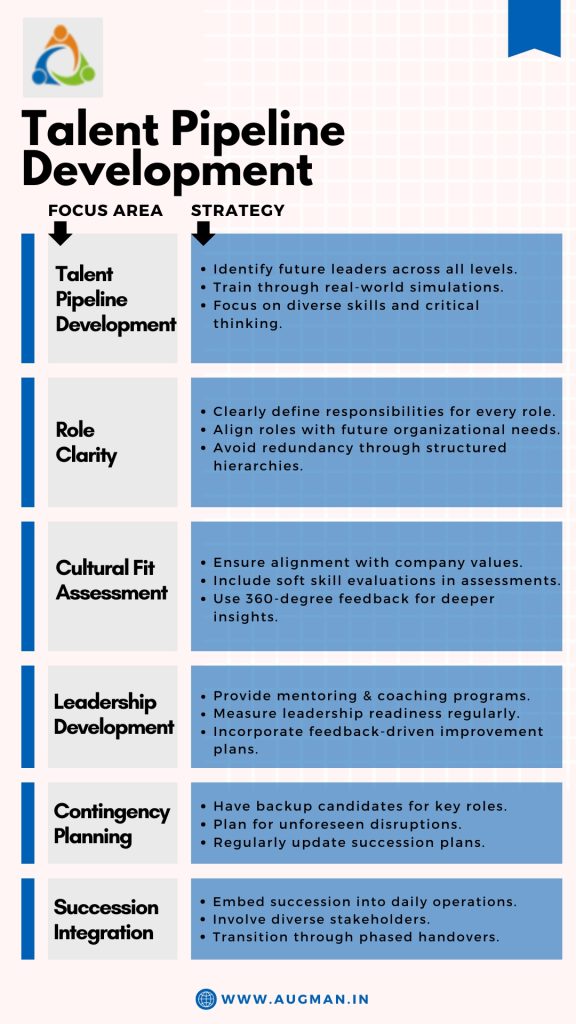
Six Core Pillars of Future-Ready Succession Planning
Organizations that succeed in leadership continuity focus on six interconnected pillars:
- Talent Pipeline Development:
- Identify potential leaders early.
- Use real-world simulations and scenario planning.
- Focus on critical thinking, not just technical skills.
- Role Clarity:
- Define responsibilities clearly for each role.
- Align job design with organizational strategy.
- Eliminate redundancy through structured hierarchies.
- Cultural Fit Assessment:
- Align leadership candidates with company values.
- Include soft-skill evaluations in leadership reviews.
- Use 360-degree feedback for deeper insights.
- Leadership Development:
- Invest in mentoring and coaching programs.
- Create feedback-driven improvement plans.
- Measure leadership readiness regularly.
- Contingency Planning:
- Always maintain backup candidates for critical positions.
- Prepare for unforeseen disruptions.
- Update succession plans annually.
- Succession Integration:
- Embed succession planning into daily operations.
- Involve diverse stakeholders in transition planning.
- Use phased handovers to ensure smooth knowledge transfer.
Why Mentorship is the Missing Link
Succession planning is not just about charts and plans. It requires mentors who guide both current and future leaders. A mentor bridges knowledge gaps, builds trust, and ensures execution doesn’t stop at theory.
In our work at Augmentum, we’ve seen how mentorship transforms succession planning from a mechanical process into a human-centered strategy. A strong mentor doesn’t just prepare the next leader; they prepare the organization to embrace change.
From Reactive to Proactive Succession Planning
The shift every company must make is simple but powerful: stop treating succession planning as a reaction to exits and start embedding it as a continuous process.
A proactive succession strategy ensures:
- Leaders are prepared before vacancies arise.
- Culture adapts to changing market realities.
- Organizations don’t lose momentum during transitions.
It’s about creating a future-ready leadership pipeline where people, culture, and adaptability are seamlessly aligned.
Succession planning is no longer optional – it’s essential for survival and growth. Companies that treat it as a living, breathing strategy safeguard not just their leadership pipeline but also their competitive edge.
At Augmentum, we believe the strongest organizations are built on continuity, adaptability, and culture-driven leadership. With the right framework – and the right mentors – succession planning becomes the engine of long-term stability.