
Leadership isn’t a destination – it’s an unfolding journey of impact. For decades, leadership was narrowly defined by titles and authority. The assumption was simple: leaders are those who direct, decide, and dominate. But in today’s complex and fast-changing business environment, this view is outdated and incomplete.
Modern organizations require leaders who do more than manage tasks or hold positions. True leadership is about shaping culture, enabling growth, and influencing people in ways that ripple across the organization. It’s about being dynamic – adapting, guiding, and inspiring through every interaction.
Think of it as tending to a garden. A leader doesn’t just plant seeds and wait for results. They nurture the soil, manage sunlight and water, and create the conditions for growth. In the same way, impactful leadership requires constant attention to clarity, ownership, agility, communication, and learning.
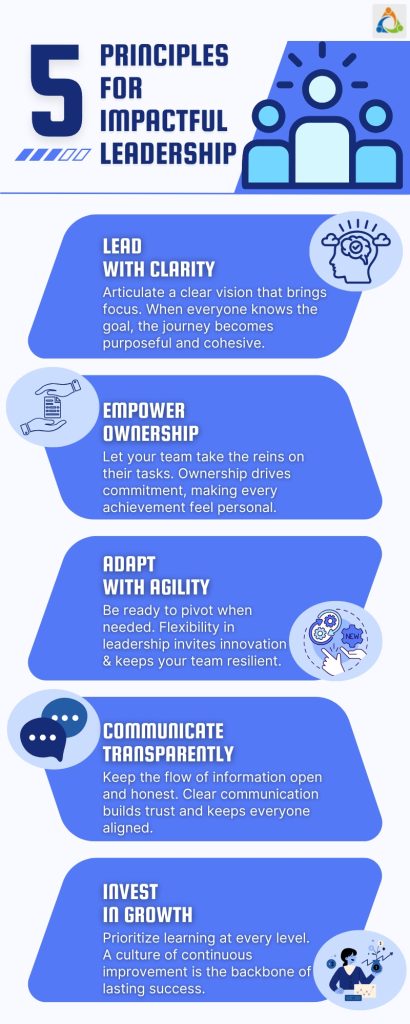
Five principles of impactful leadership stand out as the foundation for building resilient, future-ready organizations:
Lead with Clarity
In uncertain times, clarity is a competitive advantage. Leaders who articulate a clear vision bring focus to their teams. When everyone understands the destination, decisions become easier, collaboration flows naturally, and the organization moves in unison.
A McKinsey survey found that organizations with clearly defined visions are 2.8 times more likely to outperform peers on financial metrics. Clarity reduces wasted effort and prevents energy from scattering in multiple directions.
Great leaders don’t just announce a vision – they translate it into actionable priorities. They make sure that every initiative, from product strategy to talent development, connects to a bigger purpose. The result? Teams feel purposeful, aligned, and motivated.
Takeaway: A leader’s clarity is the foundation on which organizational trust and momentum are built. Without it, even the most talented teams can lose direction.
Empower Ownership
Micromanagement suffocates talent. When leaders cling to every decision, they inadvertently weaken their teams’ ability to perform. Empowering ownership flips this script. It gives individuals the freedom to take charge of their responsibilities, and in turn, it fuels accountability.
Studies from Gallup show that employees who feel genuine ownership are 21% more productive and significantly more engaged. Ownership transforms routine tasks into personal missions, creating deeper commitment and better outcomes.
Empowering ownership doesn’t mean leaders withdraw – it means they provide the guardrails, resources, and trust needed for teams to succeed. It’s about asking, “How can I enable you to do your best work?” instead of “How can I oversee your every move?”
Takeaway: Empowered teams don’t wait for instructions. They anticipate, act, and own results – unlocking a culture of accountability across the organization.
Adapt with Agility
Change is no longer a seasonal occurrence – it’s a daily reality. Leaders who cling to rigid playbooks find themselves quickly outpaced. Agility is the mindset that ensures leaders are ready to pivot when needed, without losing sight of the broader vision.
During the pandemic, organizations that adapted quickly to remote work models were the ones that thrived. Agility in leadership fosters resilience, allowing teams to innovate under pressure and embrace disruption instead of resisting it.
Being agile doesn’t mean being reactive. It means creating systems and mindsets that allow for proactive shifts – spotting trends, adjusting processes, and reallocating resources before crises demand it.
Takeaway: Agility ensures that leadership remains relevant in a world where yesterday’s best practices may no longer fit today’s challenges.
Communicate Transparently
Trust erodes in silence. Leaders who withhold information create uncertainty, which breeds fear and disengagement. Transparent communication, on the other hand, builds trust, fosters collaboration, and ensures alignment.
According to Edelman’s Trust Barometer, employees trust their company more when leadership communicates openly about both successes and challenges. Transparent leaders don’t just share updates; they invite dialogue, address concerns, and model honesty.
Communication is more than information transfer – it’s culture building. A leader’s tone sets the standard for how teams interact with each other. Clear and open dialogue reduces friction, encourages innovation, and builds a resilient culture where employees feel valued.
Takeaway: Transparency is not a choice; it’s a necessity. Leaders who communicate openly create organizations that thrive on trust and collaboration.
Invest in Growth
Leadership is not static; it evolves with continuous learning. Organizations that prioritize leadership development outperform peers because they cultivate future-ready talent at every level.
Research by Deloitte shows that companies with strong leadership development programs are 1.5 times more likely to be high-performing. By investing in growth – through training, mentoring, and upskilling – leaders ensure their teams remain relevant and competitive.
Growth is not limited to skills. It’s also about cultivating mindsets – curiosity, resilience, and adaptability. Leaders who invest in growth create cultures where improvement is celebrated, and failure is treated as a learning opportunity.
Takeaway: Growth-oriented leaders future-proof their organizations. They ensure that leadership isn’t dependent on one individual but distributed across capable, evolving teams.
The Myth of the “Perfect Leader”
One common misconception is that leadership requires perfection. In reality, impactful leadership is not about flawless execution but about continuous evolution. The best leaders acknowledge gaps, seek feedback, and adapt.
Rigid hierarchies and authoritarian approaches may have worked in the past, but today, organizations need leaders who are authentic, adaptive, and human.
As Deepak Mehta often emphasizes, leadership is about creating impact that outlasts individual effort.
Leadership today is not defined by authority but by impact. Leaders who bring clarity, empower ownership, adapt with agility, communicate transparently, and invest in growth create organizations that thrive in uncertainty.
The journey is not about the titles leaders hold, but the difference they make. Every decision, every interaction, and every principle lived out shapes a culture that resonates across teams, clients, and industries.
At Augmentum, we believe impactful leadership is the cornerstone of organizational transformation. It’s the difference between leaders who manage and leaders who inspire.