Most students meet ERP for the first time in a lab. Clean master data. Demo clients. Case studies with neat endings.
The first job is very different.
On a Monday morning in a factory or office, ERP feels like a living organism. Data is incomplete, seniors are busy, and everyone wants reports “by EOD”. Many young professionals quietly ask themselves: “I studied all these modules, but will I only click buttons and make reports?”
The honest answer is that there is a gap between ERP training for students and what organisations need from an industry-ready graduate. Colleges are built to teach fundamentals: concepts, menus, transactions. Companies are built to deliver outcomes: orders shipped, invoices raised, cash collected.
ERP sits exactly in the middle.
When ERP skills stay at a theoretical level, freshers struggle to add value beyond basic operations. When ERP skills are combined with implementation behaviours, the same fresher becomes one of the most useful people in the room.
The good news is that this gap is not mysterious. It can be closed deliberately by how students learn and how colleges design their ERP curriculum.
Four behaviours that turn ERP knowledge into career capital
1. See processes, not just screens:
Most ERP courses teach navigation: which menu to use, which field to fill, which button to click. Industry, however, needs people who can see the flow of work behind every screen.
A sales order entry screen looks simple. In reality, it sits on top of customer onboarding, credit checks, pricing rules, discounts, stock availability and logistics. When something breaks, the person who understands this end-to-end chain becomes the natural problem-solver.
Students can start building this muscle even before they graduate:
- During projects or internships, pick one real process (for example, purchase-to-pay or order-to-cash) and map it from the first trigger to the final impact on accounts.
- For every ERP transaction, ask: “What happens before this screen? What must happen after this screen so the work is truly complete?”
- Note down where information moves from one team to another. Those hand-offs are exactly where most ERP issues appear later.
Colleges can support this by designing assignments around process mapping, not just transaction screenshots. A student who thinks in flows will adapt much faster when they see a new ERP in their first job.
2. Turn documentation into a personal superpower:
In many organisations, the people who grow fastest are not always the most brilliant technically. They are the ones who capture work clearly and close loops reliably.
ERP implementation lives or dies on simple things: who is responsible for what, which steps are standard, which exceptions need approval, and what actually got finished after yesterday’s review.
Students can practice this long before they become part of an implementation team:
- Write short SOPs for small but real tasks: creating a customer, issuing material, closing a complaint.
- After every group meeting or presentation, list three things: actions, owners, and dates. Then check, a week later, what actually moved.
- When doing ERP or analytics projects, maintain a simple log of assumptions, data issues and decisions taken.
For colleges, making documentation and follow-through a graded component changes behaviour quickly. Marks should not only reward the final PPT; they should also recognise how clearly the team has converted discussion into steps.
Over time, this habit turns into a signature strength. Managers start relying on the young professional who not only understands the system but also keeps everyone aligned on “who is doing what by when”.
3. Practice people skills for change, not just tools:
ERP is often described as a technology project. On the ground, it is more of a people and behaviour project.
Most freshers will work with seniors who have years of experience and very little patience for jargon. Some will be enthusiastic about new systems; others will be skeptical or anxious. If a young professional only says, “System says so”, they will quickly be ignored.
Change management skills begin with very simple habits:
- Ask questions with respect. Seniors usually understand the process reality far better than any textbook.
- When suggesting a new way of working, start with the “why”: better visibility, fewer errors, faster billing – not “because ERP needs this field”.
- Listen for practical constraints: workload peaks, missing resources, real customer pressures. These are not excuses; they are design inputs.
Colleges can expose students to this reality through role-plays and interactions with practitioners. Invite operations managers, finance heads and implementation leaders to share stories of what worked and what didn’t. Let students hear how resistance feels from the other side.
When freshers walk into their first organisation with this mindset, they are able to support change instead of merely forwarding system emails. That is how ERP skills for students become leadership skills over time.
4. Get comfortable with messy reality:
In labs, master data is clean and transactions follow a straight line. In most organisations, things are rarely that tidy.
Customer addresses are incomplete. Part codes are duplicated. Approvals are delayed because someone is travelling. Month-end pressure distorts how processes are followed. The first instinct of a new joiner is to blame the system or the people.
A more mature instinct is to ask, “What is the ground reality behind this?” and then help improve it.
Students can prepare for this messy reality in simple ways:
- When faced with imperfect data in projects, resist the urge to silently “fix” everything in Excel. First, try to understand why it went wrong and how the process can be adjusted.
- During internships, volunteer to help with tasks like cleaning masters, validating codes or reconciling reports. These are not glamorous jobs, but they teach how small inconsistencies snowball into big ERP issues.
- Practise explaining problems in a structured way: what was expected, what actually happened, and what you recommend next.
Colleges that design live projects with real data – even if it is slightly messy – give students a more honest picture of digital operations. Graduates from such programs may not know every advanced feature, but they know how to think when reality does not match the manual.
From ERP student to implementation professional
For many young people, ERP feels like just another subject: important for exams, relevant for the CV, but distant from daily life. Yet the same systems will quietly shape a large part of their careers, whether they become managers, consultants or entrepreneurs.
Knowledge of modules, menus and reports is a necessary starting point. What creates career momentum is something deeper: the ability to map processes, document clearly, work with people through change and stay calm when data is messy.
Colleges that consciously build these behaviours into their ERP training for students do more than “cover the syllabus”. They create a pipeline of professionals who are ready for the factory floor, the head office and, eventually, their own ventures.
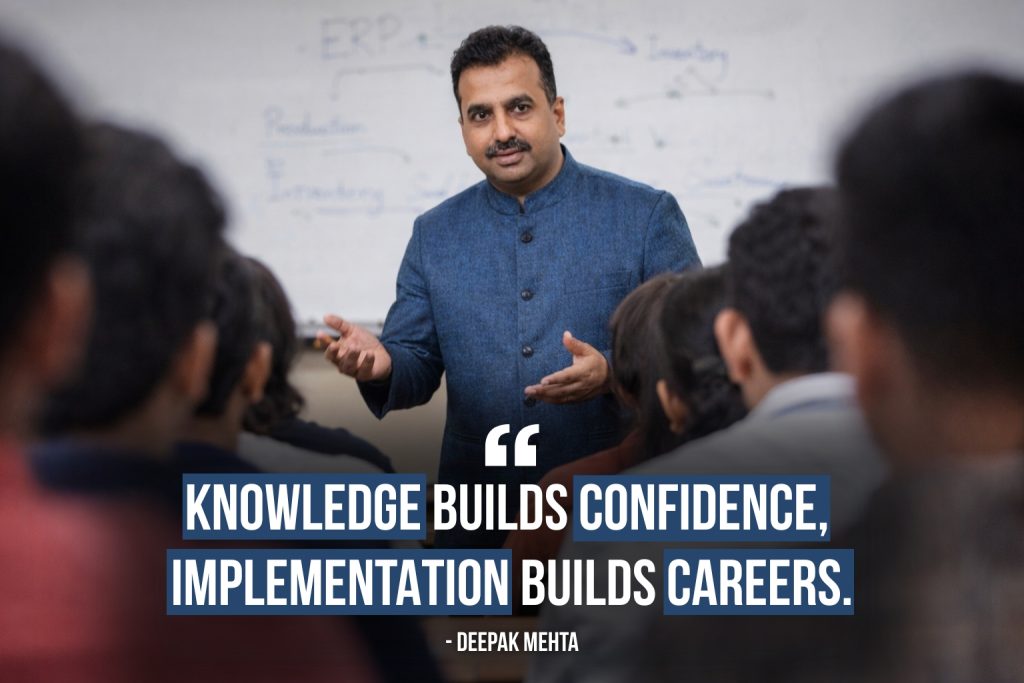
And students who adopt these habits early discover something important. Confidence comes from understanding concepts. Careers grow when those concepts are implemented, step by step, in the real world.