“Why is our AI not delivering what we expected?”
As 2026 begins, this question is becoming a familiar one in leadership rooms. Not because leaders are uninterested or underinvesting. Most are doing the opposite. They are buying tools, hiring talent, running pilots, and asking teams to “move faster.”
And still, the outcomes feel underwhelming.
In many cases, the problem isn’t the AI model, the vendor, or the budget. The problem is the organisation’s operating behaviour. AI does not arrive and rewrite how work gets done. It learns the patterns that already exist, and then scales them.
That is why two organisations can implement the same technology and see completely different outcomes. One sees stability improve. The other sees dashboards improve while the day-to-day reality stays chaotic.
If you want AI to deliver in 2026, the most important question is not “What platform should we use?” It is much simpler and much harder:
What does your organisation reward – heroic rescue, or boring reliability?
How to make AI work in a “boring” organisation
1) The real obstacle: AI hates ambiguity, and hero culture manufactures it
AI needs patterns. It needs repeatability. It needs decisions that happen the same way even when the manager is not in the room.
Hero culture produces the opposite. It creates a workplace where exceptions are treated as normal, and shortcuts become unofficial policy. People do what works in the moment, and the organisation quietly celebrates them for it because the crisis got solved.
The irony is that hero culture often looks like performance. It feels fast. It looks committed. It creates stories leaders remember. But it also creates three things AI cannot work with consistently:
- Untracked overrides (decisions made informally, outside systems)
- Invisible workarounds (fixes that never show up in data)
- Personal dependence (critical knowledge held by a few individuals)
AI cannot automate what your organisation cannot standardise.
So when leaders ask why AI isn’t delivering, it is worth checking whether the organisation is still rewarding behaviour that keeps operations unstable.
2) A simple diagnostic: what gets noticed in your operations?
Most organisations claim they value automation, discipline, and predictability. But daily signals often reward speed under chaos.
You can spot this quickly by observing who gets visibility:
- The person who fixes a crisis at midnight gets noticed.
- The person who quietly prevents that crisis rarely does.
This is not a moral failing. It is an incentive design issue.
Teams learn very quickly what “good” looks like in your environment. If the organisation’s applause follows firefighting, people will become better firefighters. They will also stop spending time on prevention, documentation, standardisation, and clean handovers because those behaviours do not receive the same social or career return.
And this is where AI initiatives quietly stall. Not with a loud failure. With slow erosion.
3) Two cultures are always competing during AI adoption:
In most organisations trying to scale automation, two cultures are running in parallel. They are not written down. They are lived.
Hero culture tends to sound like this in practice:
- “Just get it done, we will fix the process later.”
- “We cannot wait for approvals, this customer is critical.”
- “Only she knows how to solve this, loop her in.”
- “Let us bypass the workflow this one time.”
System culture tends to sound like this:
- “If it broke, we fix the root cause, not the symptom.”
- “Ownership stays clear even when no one is watching.”
- “The process is the product in operations.”
- “Consistency matters more than dramatic wins.”
Both can deliver short-term results. Only one allows AI to scale without becoming a fragile layer on top of chaos.
4) The trap most leaders miss: AI optimises what you measure:
Here is what often happens inside hero cultures.
Leaders design metrics for what they can see. Then heroes solve what leaders forgot to measure.
So the organisation creates two parallel realities:
- The dashboard reality (clean, structured, measurable)
- The operational reality (messy, informal, solved through human intervention)
AI learns from the dashboard reality. But the business runs on the operational reality.
That gap is the silent killer of many AI programs. Because leadership believes the system is improving, while the frontline believes the system is still dependent on workarounds.
A practical way to test this is to ask a simple question about any operational outcome: If the best person on the team took leave for 30 days, would the outcome still happen at the same quality?
If the honest answer is “no,” the organisation is still dependent on heroes. And AI will struggle to create stable value in a hero-dependent environment.
5) AI readiness is not a tech checklist, it is an operating model decision:
AI implementation strategy is often treated like a technology plan:
- choose tools
- train teams
- run pilots
- scale use cases
But AI readiness is more accurately an operating model question:
- Are processes stable enough to automate?
- Are decisions repeatable enough to predict?
- Are exceptions rare enough to treat as exceptions?
- Is ownership clear enough to keep systems intact?
When those answers are unclear, AI does not fail dramatically. It becomes a patchwork of initiatives that work in pockets and collapse when key people move.
In 2026, the organisations that get disproportionate value from AI will not necessarily be the most sophisticated technologically. They will be the most disciplined operationally.
6) Four shifts that make AI deliver reliably:
If your organisation wants AI to “stick,” focus on rewarding these four signals. They sound boring. That is the point.
Shift 1: Reward predictability over heroics
Predictability is not dull. It is scalable.
Start treating reliability as performance:
- fewer escalations
- fewer urgent approvals
- fewer “special cases”
- more outcomes delivered on time without drama
When predictability rises, AI can finally learn stable patterns and automate them.
Shift 2: Reward process ownership over personal control
Heroes often become informal bottlenecks because “they know best.” The organisation tolerates it because it feels safe.
But AI needs knowledge to be:
- documented
- shared
- built into workflows
- governed through ownership, not personality
This is not about removing people. It is about removing single points of failure.
Shift 3: Reward prevention over crisis response
The highest leverage work in operations is usually invisible:
- improving handovers
- fixing root causes
- reducing rework
- tightening data capture at source
- standardising decisions
If you want AI to deliver, you must make prevention visible and rewarded. Otherwise, teams will keep investing energy in rescue.
Shift 4: Reward boring discipline over exciting chaos
Automation thrives when execution is unglamorous and consistent.
That means celebrating:
- clean data practices
- compliance to the workflow
- proper closure notes
- decision logs
- stable cycle times
The goal is not to create bureaucracy. The goal is to reduce operational noise so AI can operate on signal.
7) A practical “AI operating model audit” leaders can run in one week:
If you want a concrete starting point for 2026, run this short audit across one critical process (order-to-cash, procurement, production planning, customer support, quality, or any area where AI is being explored).
Step 1: Map where exceptions happen
List the top 10 exceptions that trigger escalations, overrides, or urgent approvals.
Step 2: Identify where decisions change person-to-person
If two managers decide differently on the same scenario, AI will learn inconsistency.
Step 3: Locate invisible work
Ask frontline teams: “What do you do that never gets captured anywhere?” That is where your system is leaking reality.
Step 4: Clarify ownership
For each step, define: who owns the outcome, who owns the data, and who owns the decision.
Step 5: Change the reward signal
Pick one behaviour you currently reward that reinforces hero culture (late-night saves, bypasses, “just get it done”) and replace it with a system behaviour you want repeated (prevention, documentation, root cause fixes).
This is not glamorous work. But it is the kind of work that makes AI finally feel like progress instead of promise.
8) The choice every entrepreneur must make in 2026:
Every entrepreneur says they want scale. Every entrepreneur says they want AI to create leverage.
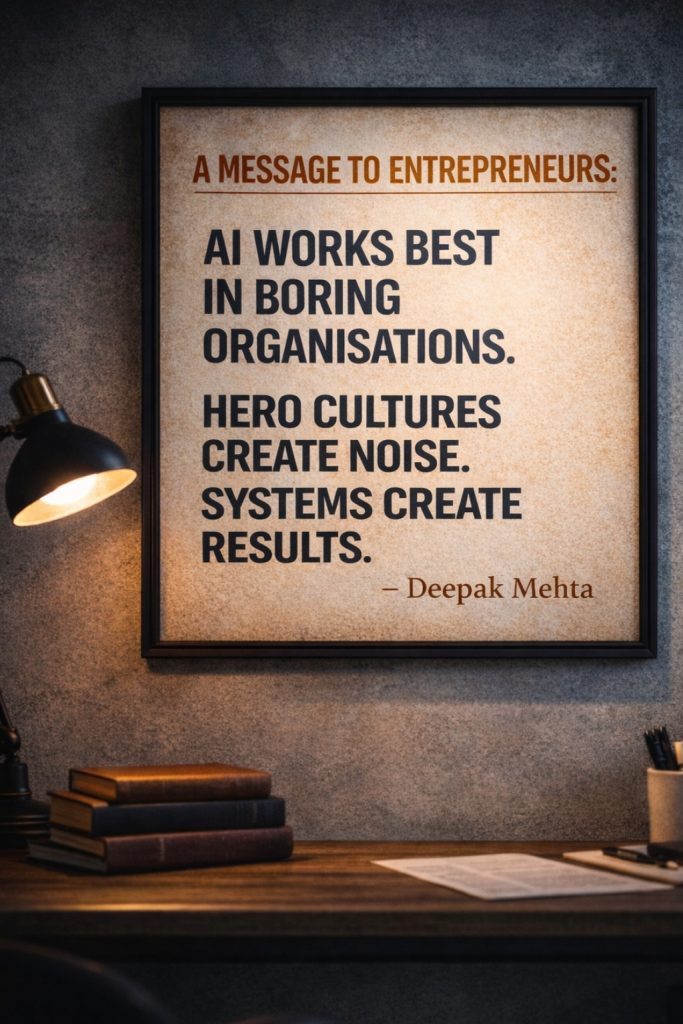
But leverage does not come from technology alone. It comes from reducing dependency. It comes from making outcomes repeatable. It comes from building an operating model that works even when specific individuals are not present.
So the real question is not whether your organisation is ready for AI. The real question is whether your organisation is willing to become the kind of place where AI can work.
- Do you want heroes to save the system?
- Or systems that no longer need heroes?
If 2025 was about experimenting with AI, 2026 will reward the organisations that remove operational drama and make discipline normal.
That is where AI stops being impressive & starts being useful.