Some business problems do not come back because the solution failed. They come back because the solution was never anchored.
A production delay gets fixed. A customer complaint reduces. A reporting error is corrected. A team conflict settles. For a few weeks, everything looks better. Then the same problem slowly appears again, almost in the same form, with the same explanations and the same firefighting.
That is where many organisations mistake temporary relief for actual improvement.
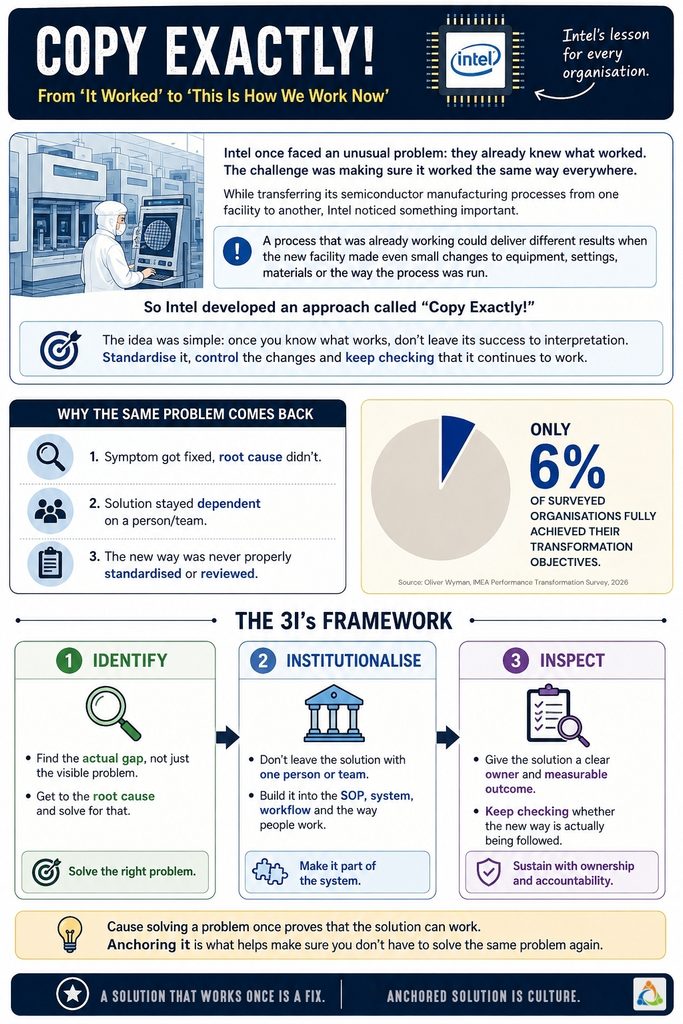
Intel’s “Copy Exactly!” approach gives a useful lesson here. In semiconductor manufacturing, even small changes in equipment, settings, materials or process steps can change outcomes. So once a method worked, the challenge was not only to know it. The challenge was to make sure it worked consistently across facilities, teams and time.
That lesson applies far beyond manufacturing.
A problem is not truly solved when one person knows what to do. It is solved when the organisation knows how to repeat the right action without depending on memory, personal effort or one strong team member.
Transformation research also shows how difficult this is. In a recent IMEA performance transformation survey, 98% of organisations had undertaken a transformation initiative in the past year, but only 6% fully achieved their transformation objectives. The gap is rarely only in ideas. It is usually in execution, adoption, ownership and sustained discipline.
From “It Worked Once” to “This Is How We Work Now”
Most recurring business problems follow a familiar pattern.
Something breaks. Leadership gets involved. A capable person studies the issue. A fix is created. People feel relieved because the immediate problem reduces. For some time, the business believes the matter is closed.
But if the root cause was not clearly identified, if the fix was not built into the process, and if nobody keeps checking whether the new way is followed, the problem quietly returns.
This is why organisations keep solving the same issue again and again.
The visible problem may be a delayed order, poor quality, repeat customer escalation, weak reporting, wrong stock data, missed follow-up, high rework, slow approvals or team dependency. But the real issue is often deeper. The organisation fixes the symptom, while the operating gap stays alive.
For example, a dispatch delay may be blamed on one person forgetting an update. But the root cause may be that there is no clear handoff between production, quality and dispatch. A reporting error may be blamed on one employee, while the real problem is that data is being entered differently by different teams. A customer complaint may be handled quickly, but the process gap that created the complaint remains unchanged.
When the root cause is not addressed, the fix becomes personal.
And personal fixes do not scale.
The better way is to treat every recurring issue through the 3I lens:
1. Identify: solve the real gap, not only the visible problem
The first step is to identify what is actually failing. This sounds simple, but it is where many organisations go wrong. A problem becomes urgent, so the first instinct is to act fast. That may be necessary in the moment, but speed should not replace diagnosis. If the same issue has come back more than once, the organisation should stop asking only, “Who made the mistake?” and start asking, “What allowed this mistake to repeat?”
That question changes the discussion.
A useful root-cause conversation should ask:
- where did the issue first begin?
- what was supposed to happen?
- what actually happened?
- which handoff failed?
- was ownership clear?
- was the process written?
- was the team trained?
- was the system supporting the process?
- was there any review to catch the issue earlier?
This prevents the team from correcting only the final visible failure.
In many cases, the actual gap is not effort. It is unclear responsibility, weak process design, outdated SOPs, poor review rhythm, missing escalation rules or lack of inspection. Unless that gap is identified, the organisation keeps depending on alert people to notice and fix things manually.
That is not process maturity. That is firefighting with experience.
2. Institutionalise: move the solution from person to system:
Once the real gap is identified, the solution has to move out of one person’s head and into the way the organisation works. This is where many fixes fail.
A senior person explains the new way in a meeting. One department follows it for some time. A manager reminds people for a few weeks. Then daily pressure returns, the reminder weakens, people go back to old habits, and the problem comes back. That happens because the solution was communicated, but not institutionalised.
Institutionalising a solution means building it into the operating system of the business.
That can include:
- a revised SOP
- a checklist
- a workflow change
- a responsibility matrix
- an approval rule
- a system field
- an ERP or MIS control
- a review format
- a training module
- an escalation trigger
- a dashboard exception
SOP means Standard Operating Procedure. But an SOP should not be treated as only a document. It should become the agreed method of work. If the solution is important, it must appear where work actually happens. If the issue is in quality, the solution must enter the quality checkpoint. If the issue is in dispatch, the solution must enter the dispatch workflow. If the issue is in reporting, the solution must enter the data process. If the issue is in approvals, the solution must enter the approval matrix.
The aim is simple. The solution should not depend on who is present that day. It should survive change in people, workload, pressure and memory. That is how a fix becomes part of the system.
3. Inspect: keep checking whether the new way is actually followed:
The third step is the most ignored one. Many organisations create SOPs, checklists and new processes. But after a few weeks, nobody checks whether the new way is being followed. The document exists, but behaviour returns to old patterns.
That is why inspection matters.
Inspection does not mean micromanagement. It means the organisation gives the new process an owner, a measurable outcome and a review rhythm. For example, if a new checklist is created to reduce dispatch errors, someone must check whether the checklist is actually used. If a new approval matrix is created, someone must review whether approvals are happening at the right level. If a new customer complaint process is created, someone must measure whether repeat complaints are reducing.
Inspection should answer three questions:
- is the new way being followed?
- is it producing the expected result?
- does it need adjustment as the business changes?
This last question is important.
A process that worked six months ago may not fit the business today. Volumes may have increased. Customers may expect faster turnaround. New products may have been added. The ERP may have changed. The team may have expanded. If the process does not evolve, people will start bypassing it.
So inspection is not only about compliance. It is also about keeping the solution relevant. That is where many organisations miss the real discipline. They create a solution and assume the matter is over. But a solution has to be checked, improved and owned.
Otherwise, it slowly becomes another unused document.
The 3I approach creates a better rhythm.
- Identify ensures the organisation solves the right problem.
- Institutionalise ensures the solution does not stay dependent on one person.
- Inspect ensures the new way continues to work in real life.
Together, these three steps take the organisation from temporary correction to sustained improvement.
This is especially important in growing businesses because scale exposes weak anchoring. When the company is small, strong people can hold things together. They remember exceptions. They call the right person. They adjust manually. They know the customer history. They know the vendor issue. They know where the process usually fails.
But as the company grows, memory-based working starts breaking. More people join. More departments get involved. More locations operate. More customers expect consistency. More data moves through systems. More handoffs are created. At that stage, the organisation cannot depend only on individual judgement. It needs a way of working that is clear, repeatable and inspectable.
That is the real lesson from “Copy Exactly!” for everyday business.
Do not copy blindly. Copy what works after understanding why it works. Control changes. Standardise the method. Keep checking the result. Improve only after the base method is stable.
A business should not become rigid. But it should not remain casual either. There is a difference between controlled improvement and uncontrolled variation.
- Controlled improvement says, “We know the standard method. We know why it works. We will change it only with thought, evidence and ownership.”
- Uncontrolled variation says, “Every team does it slightly differently, and we hope the outcome stays the same.”
That hope becomes expensive.
It creates repeated problems, inconsistent quality, customer dissatisfaction, internal blame, rework and leadership fatigue. Eventually, people start believing the team needs another new solution. But many times, the organisation does not need a new solution. It needs to anchor the solution it already found.
So when the same problem comes back, the leadership response should not be only another meeting, another warning or another quick fix.
The better response is a quiet operating discipline:
- First, identify the true gap.
- Then institutionalise the new way into SOPs, systems, workflows and roles.
- Then inspect whether people are actually following it and whether it is still producing the expected result.
That is how the organisation stops solving the same problem repeatedly.
Because solving a problem once only proves the solution can work. Anchoring it proves the organisation can work that way consistently.
And that is where implementation-led process discipline becomes important. The future of a growing organisation depends not only on finding good solutions, but on making sure good solutions become the normal way work is done.