A busy manager is not always an effective manager.
In many growing organisations, the middle manager slowly becomes responsible for every answer, every approval, every exception and every urgent interruption. The manager feels useful because people keep coming to them. The team feels supported because someone is always available. But slowly, both sides begin depending on the same person for movement.
That is where the manager bottleneck begins.
This is not only a workload issue. Globally, manager engagement dropped from 27% to 22% in just one year, while manager pressure has become sharper because teams expect support, senior leaders expect execution, and organisations expect speed with fewer delays.
A manager who is constantly available can unintentionally create a team that does not think before escalating. Over time, work starts moving only when the manager answers, approves, reminds, decides or follows up. That is not management strength. That is dependency wearing the mask of support.
The Manager Bottleneck Test
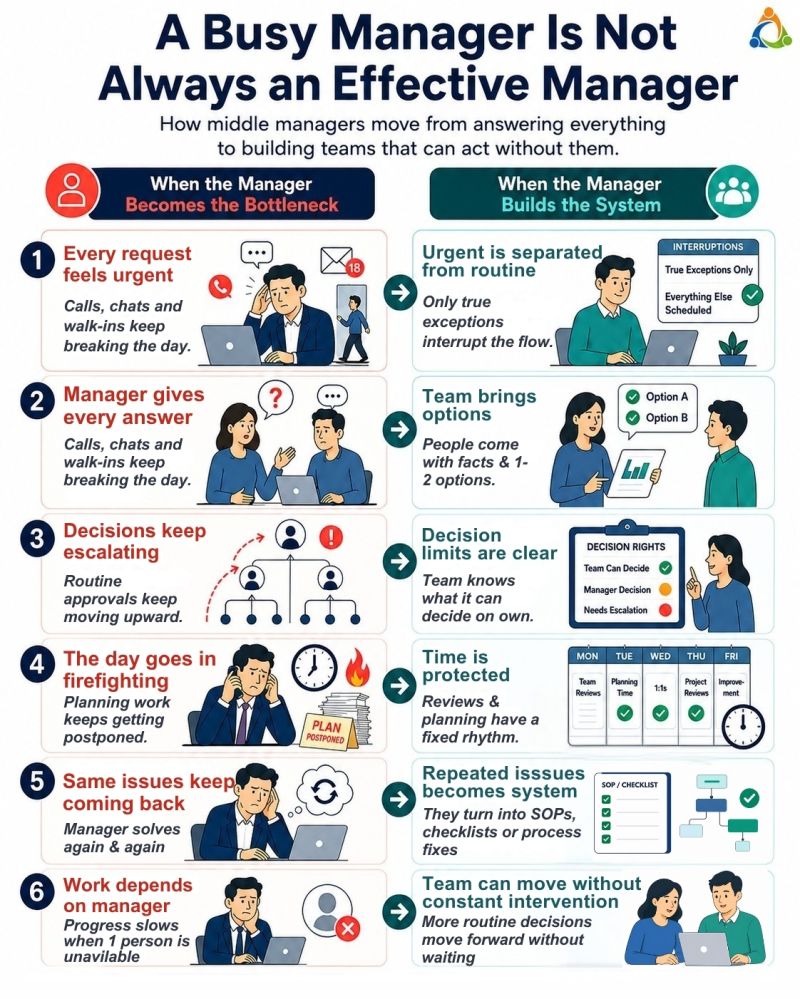
The easiest way to identify a manager bottleneck is not to look at how busy the manager is. It is to look at what happens when the manager is unavailable. If routine work slows down, if approvals wait, if people hesitate to decide, if the same issues come back repeatedly, or if planning always gets postponed because firefighting takes over, the team is not yet operating as a system. It is operating around one person.
This is where a manager has to shift from being the answer-giver to becoming the system-builder.
1) Define decision limits before asking people to take ownership:
Many managers tell their teams, “Take ownership.” But the team does not know what that actually means in daily work.
Can they approve a routine customer response? Can they commit a revised timeline? Can they decide between two vendors? Can they resolve a complaint within a certain limit? Can they move a small operational decision without asking?
If these limits are unclear, people will come back to the manager for safety. Not because they are incapable, but because the boundary is unclear.
A better manager defines three simple zones:
- what the team can decide independently
- what the team must discuss before deciding
- what must be escalated immediately
This one structure reduces unnecessary escalation. It also protects the manager from becoming the approval counter for routine work.
2) Stop giving the answer too quickly:
A helpful manager often gives quick answers. It saves time in the moment, but it creates answer-seekers over time.
When someone brings a problem, the better first response is not always, “Do this.” A stronger response is, “What do you think we should do?” That question changes the behaviour of the team. People begin coming with thought, not only with problems. They start checking facts, preparing options and understanding consequences before reaching the manager. This does not mean the manager refuses support. It means the manager uses the moment to develop decision capability.
Research on management effectiveness shows that when managers effectively develop their direct reports, those reports can perform up to 27% better and become 1.5 times more likely to exceed their goals.
So the manager’s role is not only to solve. It is to build people who can solve better next time.
3) Separate true exceptions from routine work:
One reason managers feel exhausted is that everything enters their day with the same urgency.
A machine breakdown, a customer escalation, a payment risk and a routine approval may all arrive through calls, chats or walk-ins. If the manager responds to everything immediately, the day becomes reactive.
This is where interruption discipline is needed.
A true exception needs immediate attention. Routine work needs rhythm. A manager should not allow every matter to break the flow of planning, reviews, improvement and people development. The team should know what qualifies as urgent. For example, urgent may mean customer risk, safety risk, dispatch risk, cash-flow risk, quality failure or a decision that can block work today.
Everything else can move into a scheduled review window.
This reduces noise. It also teaches the team that urgency is not decided by emotion. It is decided by business impact.
4) Convert repeated issues into systems:
If the same issue keeps coming back, the issue is no longer the issue. The real problem may be a missing SOP, unclear ownership, weak training, poor checklist discipline, an undefined approval matrix or a process that no longer fits the business. SOP means Standard Operating Procedure. It is not just a document. It is the agreed way of doing work so that people do not reinvent the process every time.
But creating an SOP is only half the job. The manager must also ensure two things:
- the team actually follows the SOP
- the SOP keeps evolving as business needs change
This second point matters. Many businesses create processes once and then allow them to become outdated. The team keeps following an old process even after the strategy, customer expectation, product mix, ERP system or approval requirement has changed.
An effective manager does not only write procedures. They keep the working method alive.
5) Protect time for managerial work that only a manager can do:
Many managers spend the day in calls, approvals and firefighting, then try to do planning after the day is already over.
That is not sustainable.
Some work should not be pushed to leftover time. Planning, reviews, team development, improvement projects, cross-functional coordination and capability-building need protected space. A manager who never protects time for these things remains trapped in the present. The team may survive the day, but the system does not become better.
This is why managers need a fixed rhythm.
For example:
- one time block for daily exceptions
- one weekly slot for team review
- one weekly slot for planning and improvement
- one monthly slot for process correction
- one recurring slot for coaching team members
The purpose is not to fill the calendar. The purpose is to stop firefighting from consuming all leadership capacity.
6) Measure effectiveness by team independence:
Many managers feel proud when everyone needs them.
That feeling is natural, but it can become dangerous. If work slows down whenever one manager is unavailable, the organisation has not created strength. It has created dependency.
A manager should measure effectiveness differently.
The better questions are:
- how many decisions can the team now take without me?
- how many routine issues are resolved before escalation?
- how many recurring problems have been converted into process fixes?
- how many people are becoming stronger in judgement?
- how much work can move when I am not in the room?
This is the real test of middle management.
A strong manager does not disappear from the team. They create a team that knows when to involve them and when not to.
That distinction is important.
The team should know that the manager is available for guidance, exceptions, coaching, escalation and judgement. But the team should not need the manager for every small answer, every routine approval and every next step.
A simple operating model for managers:
A manager who wants to stop becoming the bottleneck can use a simple 6-part model:
- decision rights: define what the team can decide, what needs discussion and what needs escalation.
- option culture: ask people to bring facts and one or two options instead of only problems.
- exception filter: separate urgent business risks from routine requests.
- process conversion: convert repeated issues into SOPs, checklists, approval matrices or workflow corrections.
- protected management time: keep fixed time for planning, reviews, improvement and people development.
- team independence score: track how much work moves without constant manager intervention.
This model is simple, but it changes the manager’s role. The manager moves from answering everything to building judgement. From solving every repeated issue to fixing the system behind it. From being constantly available to being available in the right way. That is how middle management becomes stronger.
Not by working longer hours. Not by answering faster. Not by becoming the permanent rescue point for the team. But by creating a structure where people can think, decide, act and improve within clear boundaries.
This shift is especially important in growing SMEs, where middle managers often become the bridge between promoters and execution teams. If that bridge becomes overloaded, the whole organisation slows down.
The promoter expects execution. The team expects answers. The manager stands in the middle carrying both sides. The solution is not to make the manager tougher. The solution is to redesign the way decisions, escalations, approvals, reviews and routines flow through the team.
A capable manager should remain important. But they should not become irreplaceable for routine movement. Because if everything depends on one manager, the business has not built management depth. It has built another bottleneck.
The real test is not how many problems reach the manager’s desk. The real test is how many problems the team learns to handle before they reach it.
That is where implementation-led management development becomes important, because the future role of middle management is not to answer everything. It is to build teams that can move with clarity, discipline and confidence.