
The India–EU Free Trade Agreement is being celebrated as the “mother of all deals”, and with good reason. It connects India, one of the fastest-growing large economies, with the European Union, one of the world’s largest consumer markets, through a long-term trade framework that cuts tariffs on a wide range of goods and services.
For Indian MSMEs, especially in sectors like engineering goods, textiles, leather, auto components and marine products, the headline is simple: better price competitiveness and easier access to a high-value market. Over the next few years, as tariffs reduce on more than 90% of bilateral trade and implementation starts from FY 2027, the opportunity in front of export-ready MSMEs will expand sharply.
But there is a quieter, more uncomfortable question behind the celebrations: how many MSMEs are actually ready to deliver to European buyers every week, without drama, without excuses, and with proof?
Because this is not only a trade policy event. For MSMEs, it is going to become a daily execution test on the shopfloor.
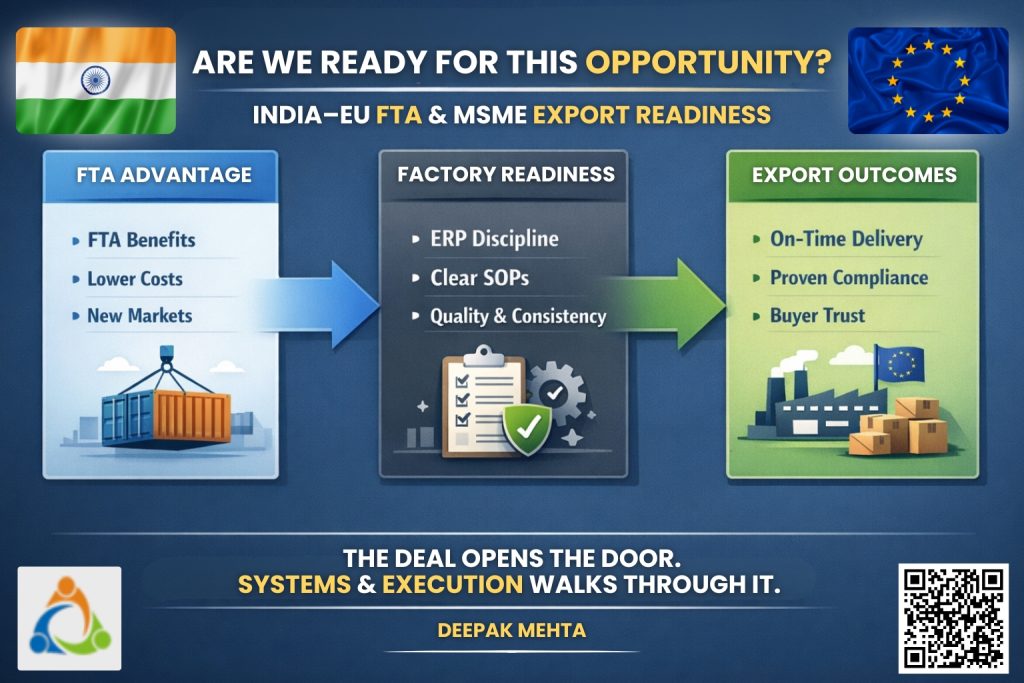
From “Mother of All Deals” to Daily Discipline on the Shopfloor
Most discussions on the India–EU FTA for MSMEs focus on tariff lines, product lists and market size. Those matter, but they do not decide whether a specific MSME wins or loses.
What decides that is much simpler and much tougher: whether one product line can deliver the same spec, on time, every time, with proof that stands up in a European audit.
1. Opportunity Becomes Real – But Only for Consistent Suppliers
On paper, the India–EU FTA lowers or removes duties on a large basket of Indian exports to the EU, including engineering, textiles and several industrial categories.
For a mid-sized engineering MSME in Pune or Rajkot, that could mean:
- A more attractive landed cost compared to non-FTA competitors.
- The ability to quote more aggressively without destroying margins.
- A chance to move from being a backup supplier to a preferred partner.
However, European buyers do not buy only on price. They buy on consistency, traceability and compliance. It is a “prove it” market. Attractive pricing might open the door, but only stable, repeatable delivery keeps the door open.
That is why the real opportunity is not just “export to Europe”, but “become the kind of MSME that a European buyer can trust for years”.
2. Competition Also Becomes Real – Even Inside India
The India–EU FTA does not just help Indian exports. It also lowers tariffs on key European products entering India over time, including machinery, components and high-value industrial goods.
This has two implications for MSMEs:
- Your export markets may open up, but your domestic market will also see sharper competition from EU players.
- Customers in India will quietly start comparing you to suppliers who operate with stricter processes, clearer documentation and tighter delivery discipline.
So the same deal that creates opportunity abroad raises the bar at home. MSMEs that rely only on relationships and jugaad-based execution will find that the margin for error keeps shrinking.
3. The Gap Is Not in the FTA. The Gap Is Inside the Factory.
Most MSMEs do the work. The quality checks happen. The effort is real.
The problem is: they cannot always prove it in a way that satisfies a European buyer, a lender or a regulator.
4 gaps show up again and again when MSMEs talk about export readiness and ERP in the same sentence.
A. Compliance and documentation gap:
Quality checks are done, but records are incomplete. SOPs exist informally, but only in people’s heads. When an auditor or buyer asks for traceability, teams pull data from different systems, Excel sheets and WhatsApp threads. Audit readiness becomes last-minute firefighting instead of a stable routine.
B. ERP and data gap:
Billing may run on an ERP, but actual operations often run on Excel, phone calls and follow-ups. Master data is inconsistent, item codes are duplicated, and reports rarely match what the shopfloor actually experienced. When a European buyer wants proof of process, teams scramble to reconstruct what should have been visible in a few clicks.
C. Process and capacity gap:
Promoters chase new geographies while the base processes at home are still stabilising. Too much dependency sits on one or two key people who “know how things work”. Lead times are tight even in the domestic market, and export orders only stretch the system further. The result is stress, overtime and higher risk of failure exactly when a new buyer is watching.
D. Leadership and change-management gap:
Strategy shifts, but habits on the shopfloor do not follow. Improvement projects start with energy and end without closure. People begin to treat every “new initiative” as temporary because the old ones were not seen through. In that environment, even a well-designed export or ERP programme loses credibility quickly.
When these 4 gaps intersect, the issue is no longer just “FTA readiness” or “ERP implementation”. It becomes a deeper question of operating model readiness.
A Simple Four-Question Readiness Test for MSME Promoters
Before booking tickets to Europe or redesigning your website for EU buyers, it is worth sitting quietly with your leadership team and asking four uncomfortable questions:
- Can we deliver one chosen product line to the same specification, on time, every time, for twelve weeks in a row?
- Can we show quality and compliance proof for that line without running around or “cleaning up” data first?
- If a buyer or lender visits tomorrow, will they see a system at work or jugaad holding things together?
- Is there one clear owner for export readiness and follow-through, with the authority and time to fix issues, not just observe them?
If the answers are vague, defensive or dependent on individuals who are already over-stretched, the first priority is not chasing Europe. The first priority is readiness.
The India–EU FTA for MSMEs will reward those who treat readiness as a strategic project, not a last-minute compliance checklist.
Turning the FTA into a Usable Opportunity: A 12-Week Shopfloor Sprint
A practical way to move from “FTA announcement” to “FTA usability” is to run a focused, 12-week readiness sprint on one export-ready product line.
A possible structure:
Weeks 1–2: Choose and define the line:
Pick a single product line where there is already some export interest or clear potential. Define what “good” looks like in simple terms: spec, lead time, defect rate, documentation, packing and dispatch norms.
Weeks 3–4: Clean the basics:
Tidy up master data for that line. Standardise item codes, units of measure, BOMs and routing. Align how this data appears in your ERP or core system and in the shopfloor language. The goal is not perfection, but a clean, reliable starting point.
Weeks 5–6: Write simple SOPs for key steps:
Document the 6–10 critical steps that must never be skipped: key inspections, approvals, sign-offs, and handovers. Keep the SOPs short, visual where possible, and actually usable on the floor. Train the team on these, not through one big session, but through brief, repeated touchpoints.
Weeks 7–10: Run a “practice export” cycle:
Even if every order is domestic, treat this line as if a European buyer is watching. Capture data properly, close loops daily, and review exceptions every week. Use one fixed weekly review to examine only two things: where did work get stuck, and where did proof break down?
Weeks 11–12: Debrief and lock in changes:
At the end of the 12 weeks, ask: what improved, what stayed fragile, and what still depends on individual heroics Convert the learnings into a simple readiness checklist and a small set of non-negotiable rituals (for example, a weekly friction review, a monthly documentation audit, and a quarterly process refresh).
This approach does not require a large consulting project or a complex new system. It requires focus, ownership and a willingness to expose the gaps before a buyer does.
Why This Matters Now – Not in 2027
The India–EU FTA is expected to start showing real effects from FY 2027 onwards, with deeper impact as implementation progresses.
That may sound far away, but it is not, if you consider how long it takes to:
- Stabilise an ERP in a way that actually mirrors reality.
- Clean and maintain master data across multiple plants or sites.
- Change habits from “manage by memory” to “manage by system”.
- Build trust with a first European buyer and then scale that relationship.
MSME owners who start their readiness journey only after the first big enquiry comes in will find they are reacting, not shaping. Those who use the next 12–18 months to quietly fix their shopfloor proof, documentation and operating rhythm will be in a very different position when the FTA’s full benefits kick in.
The India–EU FTA is a strategic win for the country. For an individual MSME, it is a mirror.
It will reflect back whatever already exists inside the factory: the strength of processes, the clarity of ownership, the discipline of documentation and the seriousness of leadership about closing loops.
If the mirror shows gaps, the good news is that there is still time to act. Starting with one product line, one team and one 12-week sprint can create proof that your organisation can repeat and scale.
Because in the end, the trade deal does not decide which MSME grows. The difference is made by the MSMEs that treat this deal not as a headline to celebrate, but as a daily standard to grow into.


