

Most people don’t quit because of workload or salary. They quit because of how they are led.
Study after study shows that a silent career killer sits between good talent and great results: micromanagement. It rarely appears in board reviews or monthly dashboards, yet it quietly drains energy, trust, and performance especially in SMEs where every person, and every decision, matters.
And the hard part is that many micromanagers don’t see themselves as micromanagers.
They see themselves as “hands-on,” “detail-oriented,” or “protecting quality.” Until one day, their best people start switching off… or walking out.
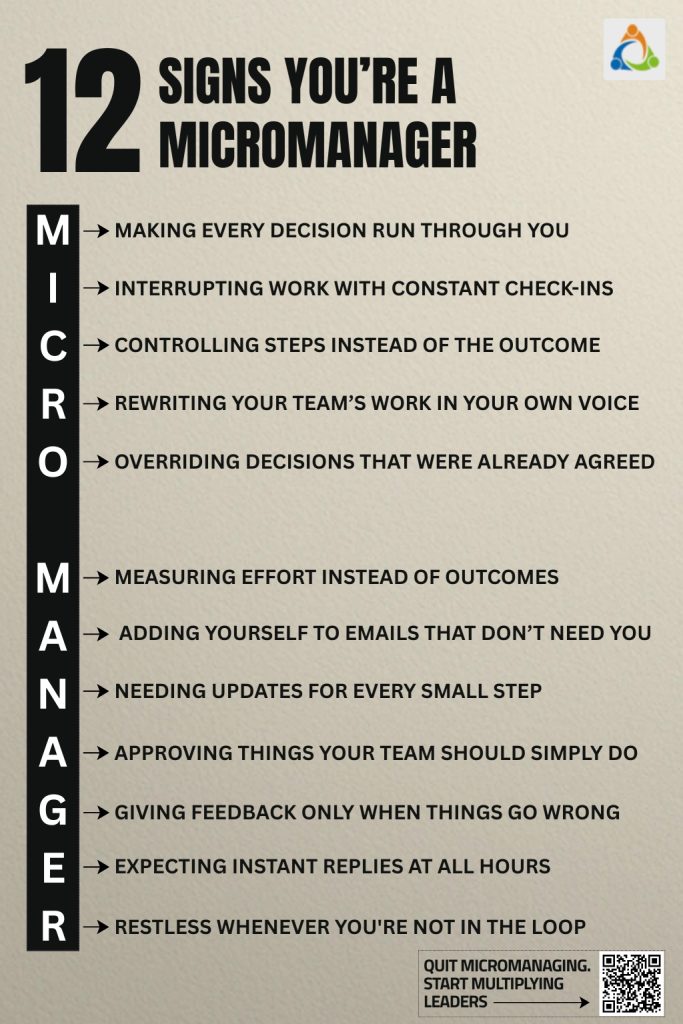
From Micromanager to Multiplier: A Practical Reset
Micromanagement isn’t a personality problem; it’s usually a system problem. When priorities change without warning, when decisions are unclear, and when trust has no structure, leaders naturally step in more than they should.
Over time, “stepping in” becomes the default. Control replaces trust. Updates replace outcomes.
And leaders become the bottleneck they were trying to avoid, which is not a good sign for any team.
Below is a reset that helps leaders move from controlling every move to multiplying ownership across the team.
1. Shift from steps to outcomes:
Micromanagers obsess over how something is done. Multipliers obsess over what must be achieved.
When you describe success as a clear outcome – deadline, quality standard, customer impact – your team can choose the best path to get there. You still set the bar, but you stop standing over every step.
A simple test: If your instructions are longer than your description of the outcome, you’re probably micromanaging.
2. Replace hourly check-ins with weekly alignment:
Constant “Just checking in…” messages feel harmless, but they shred focus. Every interruption restarts the mental engine.
Instead, create one structured weekly review where priorities, risks, and decisions are discussed openly. One good 45-minute alignment can remove ten scattered interruptions across the week.
You don’t disappear; you simply become predictable. Clarity replaces chasing.
3. Make decision rights explicit:
Micromanagement thrives in ambiguity. If nobody is sure who decides, the safest option is to involve you in every small choice.
Write down simple decision rights for key areas:
- Who owns the decision,
- Who contributes input,
- Who executes once the call is made.
When this is visible, your team stops forwarding every email “for approval” and starts acting within their lane. Your involvement becomes deliberate, not default.
4. Share context, not pressure:
Many leaders slip into micromanagement because they are carrying pressure from the top or the client. Instead of translating that pressure into context, they transmit it as urgency.
“Don’t mess this up” creates fear.
“Here’s what’s at stake if we get this right” creates ownership.
Explain the “why” behind a task – customer impact, financial implication, strategic relevance. Adults make better decisions when they understand the bigger picture, not when they are chased for updates every two hours.
5. Make progress visible without chasing people:
Micromanagers go hunting for updates. Multipliers design systems where updates appear without nagging.
This can be as simple as:
- A shared tracker updated every Friday,
- A Kanban board visible to everyone,
- Or a brief written summary before the weekly review.
The rule: visibility should not cost someone their focus. If you can see the work moving, you can step in only where it truly matters, instead of touching everything.
6. Build trust loops, not trust leaps:
Telling your team “I trust you” means little if your behaviour contradicts it. Trust grows in layers, not speeches.
Start by delegating low-risk decisions entirely. When those go well, expand the scope – larger budgets, more critical clients, more autonomy on timelines.
Each successful layer becomes a “trust loop”: your team proves reliability, you reduce control, and both sides grow confidence in the process. Over time, the need to micromanage fades because competence and clarity have taken its place.
7. Standardise the last 10%, not the first 90%:
Most leaders micromanage because of bad experiences at the finish line – errors in the final document, missed steps before dispatch, last-minute surprises before a client review.
Instead of hovering over every step, standardise the last mile:
- Use checklists for recurring work,
- Let SOPs and your ERP handle repeatable tasks,
- Define a simple quality gate before anything reaches the customer.
You keep the bar high where risk is high, without breathing down your team’s neck for the entire journey.
8. Protect people’s focus like you protect deadlines:
If everything is urgent, nothing is important.
Ask yourself:
- How often do you pull people into impromptu calls?
- How often do you expect instant replies at all hours?
Every time focus is broken, recovery time is longer than the interruption. Designing focus windows – blocks of uninterrupted work time – often improves output more than any motivational talk.
High-trust teams are not those with the loudest leaders; they’re the ones with the deepest concentration.
9. Align roles with strengths, not convenience:
Micromanagement sometimes hides a mismatch: the wrong person in the wrong role.
When someone works against their natural strengths, you feel compelled to monitor closely. When they work with their strengths, you can step back with confidence.
Map key responsibilities to people who naturally enjoy and excel at those tasks. A strong fit reduces the urge to supervise every move because the work starts flowing instead of dragging.
10. Step back so others can step up:
This is the real test.
If the team slows down every time you step out of the office, you don’t have a strong leadership culture – you have dependency.
Start with a simple experiment: be deliberately unavailable for a few non-critical decisions and see what happens. Support the choices that are “good enough,” even if they are not exactly what you would have done.
Leaders grow when they are allowed to make and fix their own calls. Your role shifts from “chief problem solver” to multiplier of problem solvers.
11. Recognise when you are the risk:
Micromanagement doesn’t reduce risk; it moves it. It moves the risk from the edge of the organisation to the centre – YOU.
When everything flows through one person:
- Response times slow down,
- Innovation shrinks,
- And your best people quietly start exploring other options.
Noticing this pattern early and choosing to change it is itself an act of leadership. Many founders and CEOs discover this during coaching conversations with a trusted change management coach like Deepak Mehta, where they can examine their own habits without judgment and redesign their leadership style with intention.
12. Design a system that outlives your presence:
Healthy teams should be able to run smoothly for a day – or a week – without you. That’s not loss of control; it’s proof of maturity.
Think of your role as building a system where:
- Outcomes are clear,
- Decisions are visible,
- Trust is structured, and
- People know what “good” looks like without waiting for your approval.
When that system is in place, your attention is freed for strategy, growth, and the next stage of transformation, instead of chasing status updates.
Micromanagement is rarely born from bad intent. It usually comes from leaders who care deeply but lack the structures that turn care into trust.
The good news is that the same energy that once fuelled control can now fuel design: clear outcomes, strong decision rights, visible progress, and repeatable rituals.
When that happens, something powerful shifts:
- People stop working for you and start working with you.
- You stop being the bottleneck and become the enabler.
- And your best talent no longer looks for the exit – they look for the next opportunity inside your organisation.
Because in the long run, the opposite of micromanagement isn’t absence. It’s a culture where leaders multiply leaders, not tasks.


