
Leadership isn’t a title. It’s a rhythm – a balance between clarity, ownership, adaptability, communication, and growth. Most leaders think of leadership as direction-giving. But real leadership is direction-shaping. It’s less about authority and more about alignment – between people, processes, and purpose.
When leadership loses that rhythm, organizations slow down. But when it finds its flow, it becomes the most scalable engine of progress.
THE LEADERSHIP FLYWHEEL
In growing organizations, leadership isn’t linear – it’s cyclical. Each quality strengthens the other.
- Clarity leads to ownership.
- Ownership builds agility.
- Agility drives communication.
- Communication fuels growth.
And when the cycle completes, leaders don’t just manage teams – they multiply impact. Here’s how each principle transforms leadership from a function into a force:
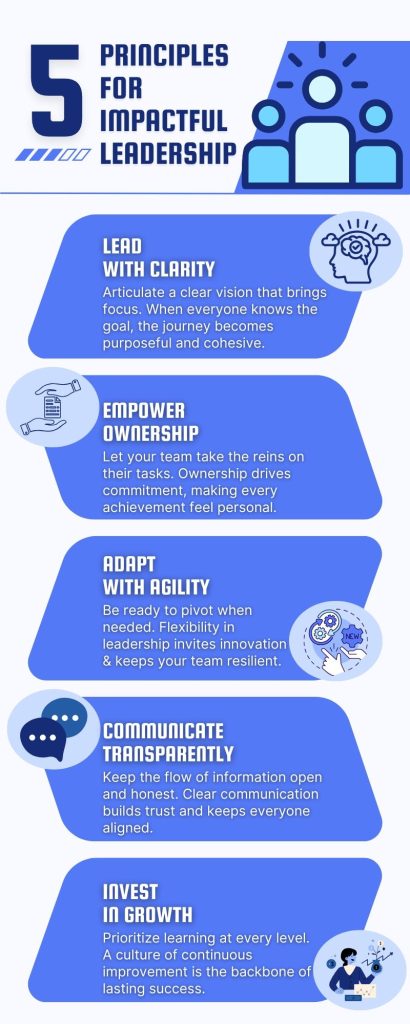
1. Lead with Clarity
Every successful leader starts by making the abstract visible. When teams don’t understand the why, they lose connection with the how. Clarity bridges that gap. It’s about articulating direction so well that everyone can move autonomously because alignment isn’t enforced, it’s inspired.
Practical Shift:
Replace complex goal sheets with a single, vivid narrative of purpose.
When clarity is communicated consistently, execution stops being reactive and starts being rhythmic.
2. Empower Ownership
The difference between compliance and commitment lies in ownership. True leaders hand over control not as a risk, but as an investment. When teams feel their decisions shape outcomes, they think sharper, act faster, and perform better.
Practical Shift:
Transform “task assignments” into “trust assignments.”
Delegate with intent – not to reduce your load, but to expand your people’s capacity.
3. Adapt with Agility
Leadership today isn’t about having the perfect plan – it’s about adjusting faster than the market changes. Rigid systems create comfort, but agility creates relevance. Adaptable leaders don’t panic when priorities shift; they pivot with poise.
Practical Shift:
Encourage dynamic reviews instead of quarterly overhauls.
When feedback loops are short, resilience grows long.
4. Communicate Transparently
The strength of a team isn’t in how much it talks – it’s in how much it understands. Transparency isn’t oversharing; it’s about providing enough clarity that people can act with confidence. A transparent leader removes ambiguity, which in turn removes anxiety.
Practical Shift:
Host clarity check-ins instead of status meetings.
When communication becomes a two-way street, trust becomes a shared asset, not a leader’s demand.
5. Invest in Growth
The best leaders treat learning as an operating principle, not an afterthought. Growth isn’t about scaling up; it’s about leveling up – skills, systems, and self-awareness. A learning culture doesn’t just create capable individuals; it builds adaptable organizations.
Practical Shift:
Allocate budget and time for learning, not just tools.
Remember: software upgrades your systems, but learning upgrades your people.
The above 5 principles aren’t independent values – they are interconnected systems.
- Without clarity, ownership feels chaotic.
- Without ownership, agility becomes shallow.
- Without communication, trust fractures.
- Without growth, leadership stagnates.
Leaders who integrate these principles don’t just build better teams – they build better cultures.
Leadership isn’t a milestone; it’s a mindset. Every conversation, every decision, every correction shapes your leadership architecture.
So, are you leading or just managing?


