
Transformation is ambition; restructuring is reaction.
When businesses encounter turbulence, the instinct is often to restructure: cut costs, reorganize roles, and stabilize operations. This approach can stop the immediate bleeding, but it rarely addresses the underlying issues. It’s like patching a sinking ship – you may slow the leak, but you won’t change the course.
True transformation, by contrast, is about reimagining the future. It shifts culture, strategy, and processes to build resilience and unlock long-term growth. Rolls-Royce offered a powerful example: instead of merely restructuring to survive downturns, the company chose to transform, redefining its purpose and strategy, ultimately creating a stronger, future-ready organization.
Restructuring: A Short-Term Fix
Restructuring often emerges in response to immediate pressures such as declining revenues, inefficiencies, or competitive threats. Its primary aim is stabilization: cutting costs, reorganizing roles, and streamlining processes. While these moves can provide short-term relief, they rarely resolve the root causes of organizational decline.
Research by McKinsey highlights that fewer than 25% of companies that rely solely on restructuring achieve sustainable long-term performance improvements. The reason is simple: restructuring improves the structure but not the strategy. It reduces pain but does not cure the illness.
Restructuring should be viewed as a stop-gap measure. It is useful to buy time, but without transformation, it risks creating a cycle of repeated fixes without lasting progress.
Transformation: A Long-Term Shift
Transformation, on the other hand, is an intentional and strategic overhaul. It extends beyond operational efficiency to culture, mindset, and purpose. This is not just about surviving – it’s about reinventing.
Transformation requires alignment across people, processes, and purpose. It integrates technology, fosters innovation, and empowers employees to embrace new ways of working. Companies that commit to transformation are better positioned to thrive amid uncertainty and disruption.
For instance, businesses that successfully transform often see measurable gains in both performance and engagement. A Bain study revealed that firms undergoing holistic transformation are 3.5 times more likely to outperform peers in shareholder returns compared to those focused on cost restructuring alone.
Key Differences Between Restructuring and Transformation
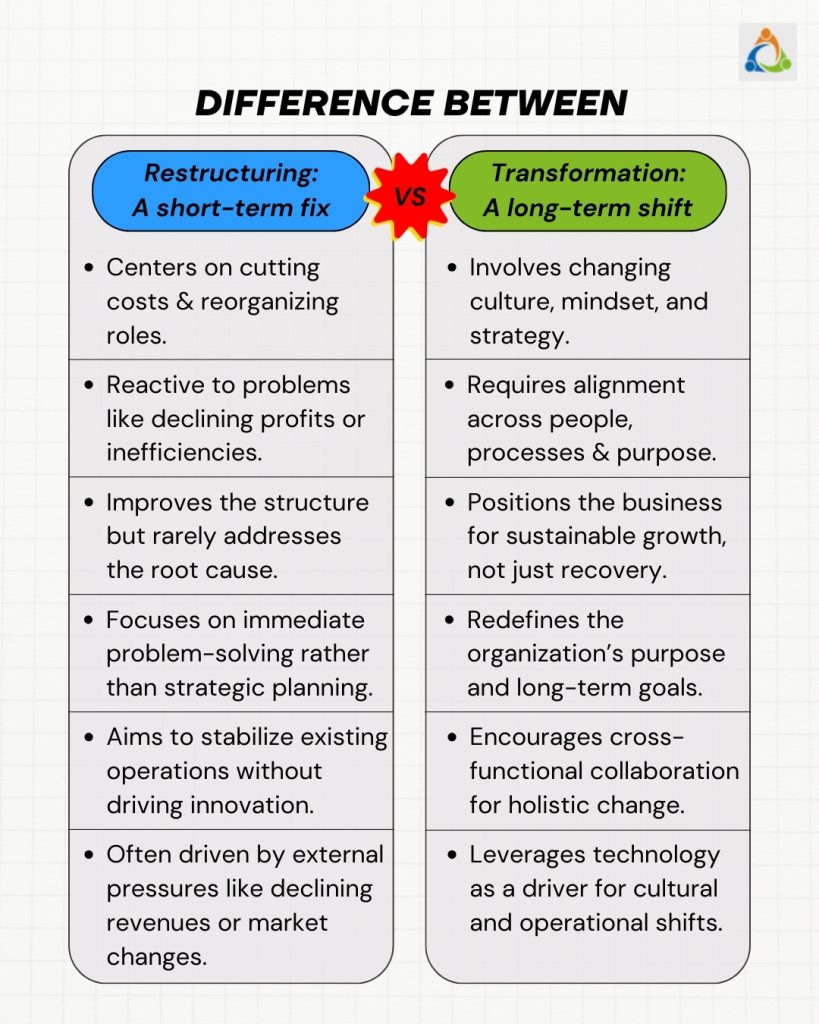
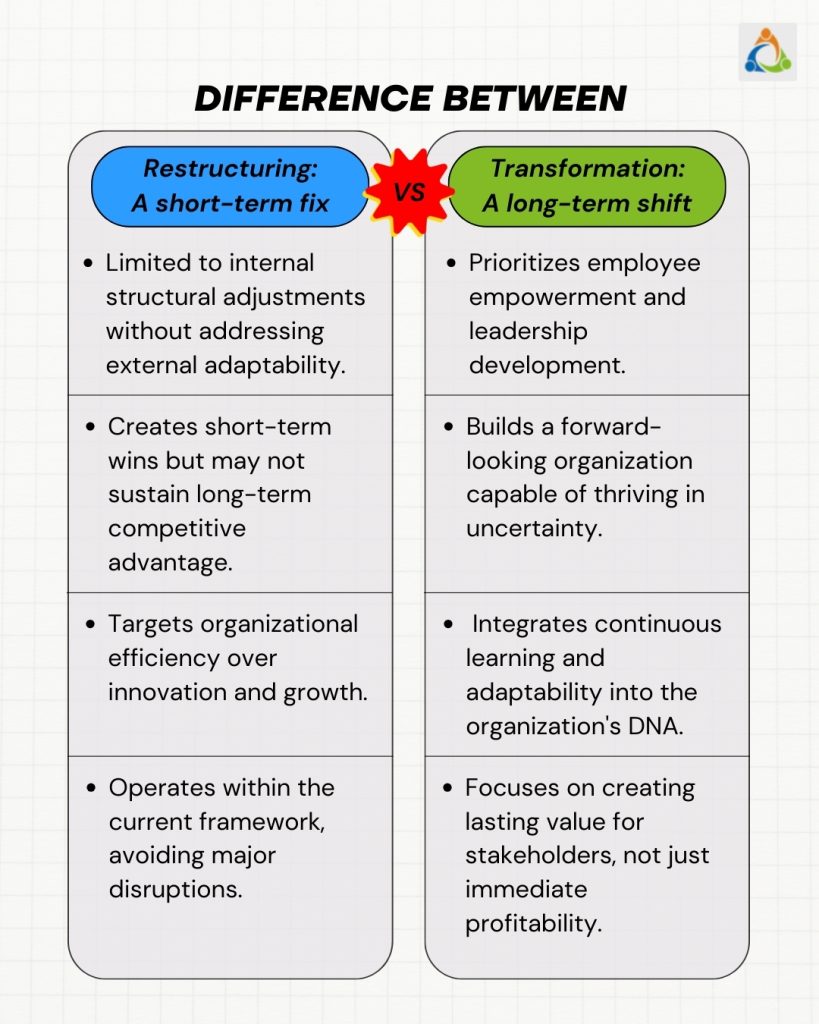
The above visuals clearly illustrate that restructuring is reactive and short-term, while transformation is proactive and sustainable.
Why Restructuring Alone Isn’t Enough
Restructuring helps stabilize, but it often fails to address adaptability. Organizations that focus solely on efficiency gains end up with rigid structures incapable of responding to new market realities.
Think of companies that cut staff or close departments during crises, only to face the same challenges again in the next downturn. Without transformation, the cycle repeats. Transformation builds adaptability into the DNA of the organization, ensuring resilience no matter how the environment shifts.
How Transformation Fuels Sustainable Growth
Transformation is about future-proofing. It redefines the organization’s purpose, builds cross-functional collaboration, and encourages continuous learning. By prioritizing empowerment and leadership development, companies foster a culture capable of thriving in uncertainty.
Technology plays a central role. Digital platforms, automation, and data analytics can drive innovation, but only when paired with cultural change. Transformation is most powerful when it leverages both structural and cultural shifts, ensuring that growth is not just achieved but sustained.
Practical Steps for Leaders
- Redefine Purpose and Vision – Ensure the organization’s goals are long-term, clear, and inspiring.
- Align Culture with Strategy – Embed values that support innovation, adaptability, and trust.
- Empower Employees – Leadership should create ownership at every level.
- Leverage Technology Wisely – Use tech not as a patch, but as a driver of cultural and operational change.
- Measure Beyond Profitability – Focus on stakeholder value, customer trust, and employee engagement.
These actions help move organizations away from reactive restructuring toward proactive transformation.
The difference between restructuring and transformation is the difference between survival and reinvention. Restructuring can stop the bleeding, but transformation changes the trajectory. Leaders who recognize this distinction and have the courage to choose transformation – build organizations that don’t just recover, but thrive.


