Every successful founder eventually hits a wall. The early years are powered by drive, speed, and personal decision-making. But after crossing ₹50 Cr, the same intensity that built the business becomes its biggest limitation.
What happens next is not visible outside the company. But inside, it looks like this: constant approvals, unclear accountability, and rising fatigue at the top.
Founder Dependency: The Silent Growth Killer
One founder described it perfectly: “If I don’t move, nothing moves.”
That reality is exhausting – for the founder and for the team. In practice, it looks like:
- Escalations at every step. Teams hesitate to act without approvals.
- Micromanagement by default. Because roles and processes lack clarity.
- Stalled initiatives. New projects wait for leadership bandwidth.
- Talent disengagement. High performers get frustrated without autonomy.
This is not a leadership issue. It’s a system design issue.
Why Adding People Doesn’t Solve It
Founders often hire senior leaders at this stage, expecting relief. But without clear decision pathways and ownership structures, new hires also fall into the escalation trap.
The result is this: more people reporting to the founder, not fewer.
That’s why scaling requires process-first thinking.
How Process Architecture Creates Independence
At Augmentum, we guide founders to shift from founder-driven to process-driven organizations. Here’s how:
- Decision Pathways → Map who decides what and when, creating authority clarity.
- Ownership Loops → Ensure accountability sits where execution happens.
- Cross-Functional Rhythms → Build structured collaboration between departments.
- Change Management → Align leadership to adopt – not resist – the new design.
This isn’t about documentation overload. It’s about creating a system that scales without constant founder intervention.
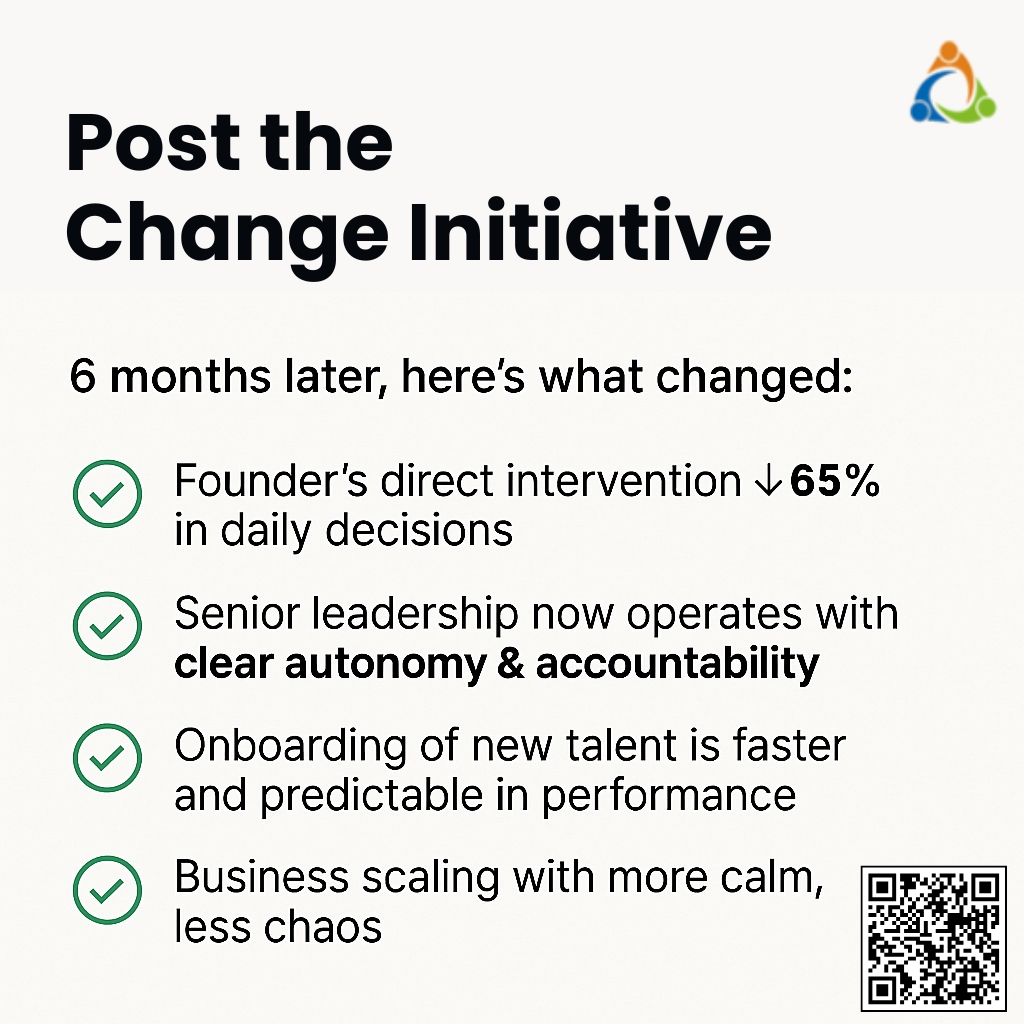
The Shift in Leadership Energy
When process architecture is embedded, the founder’s energy shifts from firefighting to future-building.
- Instead of approvals → focus on growth strategy.
- Instead of firefighting → build partnerships.
- Instead of micromanaging → design next-stage growth engines.
The leadership bandwidth once consumed by operations is now reinvested in scale.
The Risk of Scaling Without Process Architecture
Without process architecture, companies grow on adrenaline and improvisation. But both run out.
The risk is clear:
- Burnout at the top.
- Loss of talent.
- Slower growth despite higher effort.
Scaling stress, not value.
The journey from ₹50 Cr to ₹100 Cr cannot run on founder drive alone. It requires a shift in how work flows – through people, decisions, and accountability.
That shift is Process Architecture.